Combining thermal intelligence and visible imaging for faster, more reliable threat detection
For decades, video surveillance has relied primarily on visible-light cameras to secure critical assets. While advances in resolution, artificial intelligence, and video analytics have significantly improved security, conventional cameras still depend on one essential element – light.
Whether it is complete darkness, dense fog, smoke, heavy rain, or glare from the rising sun, challenging environmental conditions continue to affect the performance of traditional surveillance systems.
As security threats become more sophisticated and critical infrastructure demands uninterrupted situational awareness, the industry is increasingly adopting bi-spectral thermal cameras – a technology that combines visible imaging with thermal sensing to deliver continuous surveillance regardless of environmental conditions.
Why Conventional Cameras Have Limitations
Modern visible-light cameras produce exceptional image quality under favourable conditions. However, they still face challenges when environmental visibility deteriorates.
Typical challenges include:
- Complete darkness
- Dense fog and haze
- Smoke during fire incidents
- Rain and snow
- Backlighting
- Long-range perimeter monitoring
- Vegetation camouflage
In these situations, security operators may lose valuable seconds trying to verify whether an event is a genuine threat or simply environmental interference.
Understanding Thermal Imaging
Unlike conventional cameras that capture reflected visible light, thermal cameras detect infrared radiation (heat energy) emitted naturally by every object.
Every person, vehicle, machine, or animal has a unique thermal signature.
Instead of seeing colours or reflected light, thermal imaging visualises temperature differences, allowing operators to detect objects that would otherwise remain invisible.
This enables surveillance systems to operate effectively:
- In complete darkness
- Through light fog and haze
- In smoky environments
- Across long perimeters
- In remote locations without ambient lighting
Thermal cameras therefore become an excellent early-warning sensor.
What Makes Bi-Spectral Technology Different?
While thermal cameras are exceptional at detecting heat signatures, they generally provide limited visual detail.
Visible cameras, on the other hand, provide colour, facial details, licence plates, and scene context.
A bi-spectral camera integrates both technologies into a single intelligent platform, enabling operators to use each imaging modality where it performs best.
The thermal sensor detects the presence of an object, while the visible camera immediately provides visual confirmation and supporting evidence.
This dramatically improves both detection speed and incident verification. Instead of asking, “Did something happen?” operators immediately know: “What happened, where it happened, and who or what is involved.”
The Power of Sensor Fusion
Modern surveillance is increasingly moving toward sensor fusion.
Rather than depending on a single sensor, intelligent platforms combine multiple sensing technologies to create a far more accurate understanding of the environment.
Bi-spectral cameras merge:
- Visible imaging
- Thermal imaging
- Edge AI analytics
- Intelligent PTZ control
- Automated event detection
Together, these technologies reduce nuisance alarms while significantly improving operator confidence.
Advantages of Bi-Spectral Surveillance
24×7 Situational Awareness
Thermal imaging remains effective regardless of daylight conditions, ensuring uninterrupted surveillance around the clock.
Earlier Threat Detection
Heat signatures can often be detected before objects become visually distinguishable, providing valuable additional response time.
Reduced False Alarms
Combining thermal detection with AI-powered visible analytics enables more reliable event verification.
Faster Incident Response
Operators no longer need to switch between multiple systems or manually verify alarms, reducing response times during critical events.
Longer Detection Distances
Thermal sensors can identify heat signatures over extended distances, making them particularly valuable for perimeter protection and large open areas.
Where Bi-Spectral Cameras Deliver Maximum Value The technology is particularly well suited for:
- Oil & Gas facilities
- Airports
- Ports and harbours
- Power generation plants
- Defence installations
- Border security
- Rail infrastructure
- Utilities
- Data centres
- Industrial manufacturing
- Smart city perimeter protection
In these environments, uninterrupted situational awareness is often more important than image resolution alone.

Gaurav Taywade
Managing Director – India, Vicon
“A Leadership Perspective Security is no longer about simply recording events – it is about understanding them before they escalate. Bi-spectral technology represents an important evolution because it combines the strengths of thermal sensing and visible imaging into a single intelligent platform. This enables organisations to detect earlier, verify faster, and respond with greater confidence, regardless of environmental conditions”
Artificial Intelligence Complements Thermal Imaging
The next evolution in surveillance combines thermal sensing with edge-based artificial intelligence.
Rather than simply detecting heat, modern platforms can classify:
- People
- Vehicles
- Intrusions
- Loitering
- Wrong-way movement
- Perimeter breaches
AI enables the system to distinguish between genuine threats and environmental activity, significantly reducing unnecessary operator intervention.
The Industry Direction
The surveillance industry is steadily moving from isolated imaging devices toward intelligent sensing platforms.
This evolution combines artificial intelligence, thermal imaging, visible imaging, cybersecurity, and advanced video management into unified solutions capable of supporting mission-critical operations.
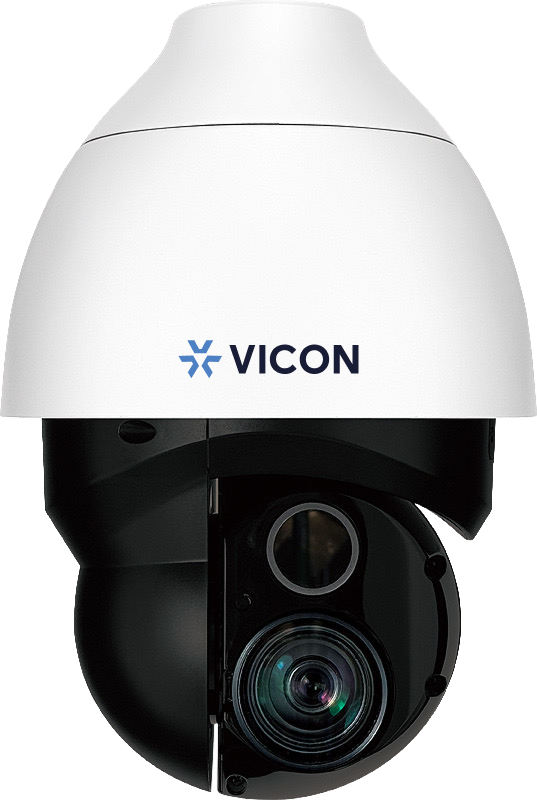
Reflecting this direction, Vicon’s Roughneck® Pro Bi-Spectral Thermal PTZ platform combines a 5 MP visible camera with 40× optical zoom and a high-sensitivity LWIR thermal sensor in a single rugged platform. Together with edge AI, intelligent auto-tracking, HDR imaging, electronic image stabilisation, and ONVIF interoperability, it is designed to support airports, ports, utilities, oil & gas, transportation, and other critical infrastructure applications.
Conclusion
As surveillance requirements continue to evolve, organisations are demanding more than high-resolution video. They require systems capable of delivering reliable detection, rapid verification, and continuous situational awareness under every environmental condition.
Bi-spectral thermal cameras meet this requirement by combining two complementary imaging technologies into one intelligent surveillance platform.
The future of perimeter protection will not rely solely on seeing more – it will depend on seeing what matters most, regardless of darkness, weather, or distance.