


Vijay Jyotish
Chief Executive Officer,
Vijay Jyotish LLC (JYOTINT)
Arizona, United States
On 13 October 2025, a private advisory naming a coordinated mass-casualty attack profile against the Vaishno Devi temple complex and the Katra-Bhawan yatra route in Jammu and Kashmir, centered on 5 December 2025, was delivered unsolicited to India’s National Security Adviser and Union Home Minister; a companion public artifact was time-stamped on 30 October, thirty-six days ahead of the named date. No attack occurred, and the public record shows an unrelated national trigger – the 10 November Delhi Red Fort blast – driving the region’s actual security escalation over the same window. This paper asks a narrower, practitioner-level question than whether the warning was right – if a site security director – not a national agency, but the person who actually sets the width of a bag-scan lane – had held only the advisory’s top-line claim on the day the private channel went out, what would have been open to do, at what cost, and how fast. Four low-cost actions inside the director’s own authority – perimeter re-inspection, standby-force repositioning, queue metering, and a general staff advisory – are compared against a monitor-only baseline and an over-invested maximal posture, and sorted along the authority line that separates them from a full closure order. The paper concedes directly that this is a prevention-class call, the least informative outcome a security warning can produce, and claims no causal link between the advisory and anything that followed.
Keywords
Pilgrimage Site Security, Crowd Management, Strategic Warning, Decision Analysis, Prevention Paradox, Soft-Target Protection, Counterterrorism, India
A security director running a high-footfall shrine with one ascending trek route and a fixed set of physical choke points works inside a narrow envelope – too little screening, and a queue becomes a target; too much, and the queue itself becomes the crush risk the corridor was designed to avoid. On 13 October 2025, a private advisory naming a coordinated mass-casualty attack profile against the Vaishno Devi temple complex and the Katra-Bhawan yatra route, centered on 5 December 2025, was delivered to India’s National Security Adviser and Union Home Minister, with follow-ups to the Prime Minister’s Office, the President’s office, and the Reasi District Collector.1 At the level of that top-line claim, the advisory named an attack class, a corridor, and a window; it did not, at that level, commit to a delivery mechanism, an attributed actor, or a second hazard.2 A companion public artifact was time-stamped on 30 October 2025, thirty-six days ahead of the named date, before being set private again to give the recipients room; the full advisory was released publicly only on 5 December itself, the day the window closed.3 This paper does not evaluate whether the National Security Adviser’s office was right to receive it or right to act on it. It asks a narrower, practitioner-level question: if a site security director – not a national agency, but the person who actually sets the width of a bag-scan lane – had held that top-line claim on the day the private channel went out, what would have been open to do, at what cost, and how fast.
What actually happened
No attack occurred on or near 5 December 2025. Kept against that single fact, the public record over the window shows an unrelated national trigger dominating security posture in Jammu and Kashmir – a bomb blast near Delhi’s Red Fort on 10 November, followed by intelligence recoveries, pivoted the country’s counter-terror posture nationally, and security was reported increased at Vaishno Devi and other temples in its immediate wake.4 Independently of that trigger, the public record over the following weeks documents a large multi-agency search around Udhampur and Basantgarh, roughly 35 kilometers from Katra, after three suspected individuals reportedly sought food at a home in the sector; CRPF ‘zero-gap’ area-domination patrols across the Jammu hills; intensified BSF vigil on the international border; VPN-usage suspensions and SIM-binding orders in border districts; and reported GPS-jamming activity against hostile drones across several border districts.5 The Vaishno Devi Shrine Board is separately documented running fire-safety and disaster-management drills, procuring security equipment, and adding personnel over the same period, with checkpoints reported installed across Katra and along the yatra track.6 None of this is attributable to the 13 October advisory, which was never shared with the temple trust and was addressed to national channels, not site management. The honest reading is that a regional security surge was already under way for reasons that have nothing to do with this particular seal, and the named window closed without the event the advisory described.
The counterfactual: what a choke-point decision-maker actually had
Set the ‘how did they know’ question aside entirely – it never has to be answered for the rest of this to matter. Hold to the top-line claim itself – on 13 October 2025, a site security director’s desk receives a claim naming a coordinated mass-casualty attack profile against this corridor, bounded to a window around 5 December, with no mechanism, no attributed actor and no second hazard specified at that level. What is open, and what does it cost? The fuller operational document delivered to national channels went on to specify particular tactics, a named overlook, and an itemised technical recommendation set; none of that is something a security director could have drawn from the claim itself, and none of it is treated as the basis for what follows – it belongs to the fuller record delivered to the government, not to this section.
Four kinds of action sit inside a security director’s own operational reach without needing to know more than the claim itself supports.7 First, re-inspect and close perimeter and barricade gaps across the complex and other pilgrim-assembly points – a general hardening step appropriate to any coordinated attack against a fixed site, not a response to any one named technique. Second, reallocate standby forces to the corridor’s choke points for rapid deployment rather than distributing them thinly across the whole twelve-kilometer route. Third, adjust queue metering and lane staffing at the named choke points to reduce the standing-crowd exposure a coordinated attack would target. Fourth, issue an internal security advisory naming the attack class and the window, raising general vigilance without asserting a mechanism or actor the claim itself did not name.8 None of these four requires the district magistrate’s closure order that a full 1-15 December suspension of the yatra would need.
Figure 1 lays out these options as a decision package.
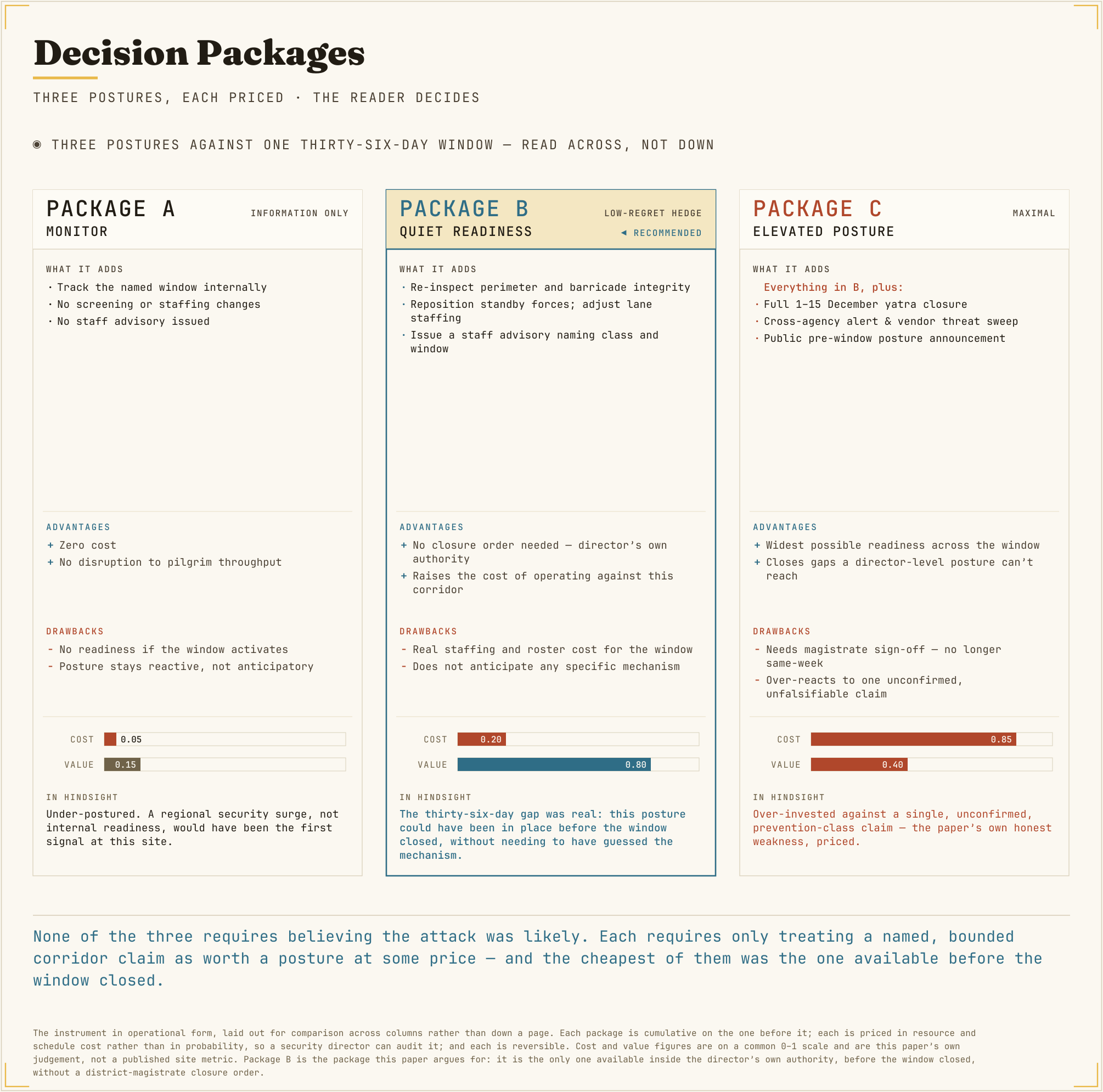
Figure 1. Three postures against the thirty-six-day window, priced and read across rather than down: Package A (Monitor, information only) carries no readiness if the window activates; Package B (the four actions above, and the posture this paper argues for) is the only one available inside the director’s own authority, without a district-magistrate closure order; Package C (Elevated Posture) over-invests against a single, unconfirmed, prevention-class claim. Every action in every package is pitched at the level the top-line claim itself supports — attack class, corridor and window, not the mechanism, actor or second vector the fuller document later specified. Cost and value are this paper’s own judgement on a shared 0–1 scale, not a published metric.
Sequence the decision by cost and speed, because that sequencing is the actual value of a 36-to-53-day lead over a warning that lands hours out. A perimeter and barricade re-inspection is a day-long, near-zero-marginal-cost action. Standby-force repositioning and queue/ lane-staffing changes are a one-to-two-week staffing-roster action, cheap relative to a closure but not free. Both are executable inside days to weeks once the geography is named – and geography is exactly what this advisory supplied at the claim level that a generic ‘elevated threat’ bulletin does not: a named corridor and a named window, not merely a region on alert.9 None of these four require the revenue-destroying step of a closure. They are the option set a screening-throughput manager actually has, and they are cheap enough that ‘we did not act because we could not confirm the threat’ is a weaker excuse than it would be for a step that costs real money or real political capital.
Authority is genuinely split here, and that split is itself the finding. A site security director does not control full closure, does not control national SIGINT tasking, and does not control whether CRPF or BSF redeploys. What the director does control is queue design, lane staffing, standby-force placement, and perimeter integrity at the named corridor. The claim’s content sorts cleanly along exactly that authority line, which is a property worth naming plainly – a national-level warning can still carry site-level, execute-today content at the level of generality it actually supports, and the two should not be conflated when a security director asks ‘is this actionable by me.’
Impact ledger. Financial: no public figure exists for either the cost of the four director-level measures or for pilgrim-revenue exposure at Vaishno Devi; the advisory itself prices nothing in rupees. Operational tempo – the four measures above are executable inside the 36-day public-seal lead without touching daily throughput targets; a full closure is not. Reputational: a trust that can show it acted on named, dated, government-adjacent geography before a quiet window closed is in a materially different position, after the fact, than one that can show only a generic seasonal alert. Cascading – a single-corridor site concentrates failure – the same twelve-kilometer route that carries pilgrims carries any crowd-crush or structural risk the site’s own layout creates, so a screening decision on this route is never isolated from the broader safety posture of the same corridor. Adversary advancement – the axis most often skipped in this kind of review – deserves its own sentence: an unscreened or thinly-staffed choke point on this corridor is not a neutral state; it is exactly the condition under which a coordinated mass-casualty attack of the kind the claim named becomes cheaper to execute, whatever its specific mechanism, whether or not this particular actor or window was real. Human: the same steps and narrow passages that concentrate any mass-casualty risk are the steps any queue-metering decision has to manage regardless of the threat call. Legal – a private trust operating a public safety choke point carries its own duty-of-care exposure independent of what any single advisory said, which is a reason to treat the four cheap, in-authority measures as good practice on their own terms, not solely as a bet on this seal.
Why weight this call at all
The field disagreed, in effect, by never seeing it – this advisory went to national channels, not to site security, so no security-research peer reviewed it in real time and no consensus formed to disagree with. The honest question a reader in this field should ask is why a 5W-format warning that named no confirmed attacker, no confirmed device, and no confirmed date-certainty should move a screening-throughput plan at all.
The answer starts with information yield – how improbable the statement was before the fact, not whether it later scored as a hit. The advisory’s own partition prices this at roughly 1 in 16,667 – about a 1-in-100 prior for any single high-profile site being the one named target on the J&K/ national threat surface in a given month, about a 1-in-50 prior for a coordinated attack landing in any specific week, and about a 30% conditional probability that an attack, if one occurred, would be coordinated rather than a lone actor – multiplied, with no additional multiplier applied on top, because a ‘contrarian framing’ credit on a prevention-class call would double-count the specificity already inside the partition.10 That is the moat this kind of call offers a planner – not a hit rate, but how narrow the space of possible statements was before anyone could check them.
SITA – 0.20 specificity, 0.20 improbability, 0.30 impact, 0.30 actionability – is worth naming because 60% of that weighting sits in impact and actionability, not cleverness. This call scores high on specificity (named site, named corridor, named window) and high on actionability (a recommendation set split by authority level), which is exactly the profile that should move a choke-point plan regardless of how the improbability term is argued.
On Brier scoring with the Murphy decomposition – reliability, resolution, uncertainty – the honest statement is that this call carries none of it, on purpose, and the ledger this sits inside keeps every miss it has ever recorded at full weight rather than pruning them; that discipline is what makes the following exclusion credible rather than convenient. A prevention-class warning has no outcome that can falsify it – if the event happens, the warning is ‘confirmed;’ if it does not, the warning ‘worked.’ Neither branch is checkable, so it is excluded from the graded ledger by the same rule that would exclude any warning with no answerable falsifier, not by a rule invented for this one case.11
What survives that exclusion is integrity, not proof of the threat: the private delivery on 13 October is dated by the channel it went through; the public artifact was stamped on the open record on 30 October and paired with a SHA-256 hash and a Bitcoin-anchored timestamp before the window it described had closed.12 That chain proves the claim existed, unaltered, before 5 December. It does not and cannot prove the claim was correct.
What this implies for a security director’s intake process
If a site’s screening-throughput plan currently has no defined intake channel for a warning of this shape – specific corridor, specific window, no confirmed source the site itself can verify – then declining to run the four in-authority, low-cost measures against it is a choice, not a neutral default. The cost of running them, on this call’s own numbers, is days-to-weeks of procurement and roster work against a corridor whose bounds are already named. The cost of building no intake channel at all is that the next warning shaped like this one, whatever its source, has nowhere to land before the window it describes closes.
Limits
This is one case, and the counterfactual is unprovable by construction: no version of this paper can show that a security director who ran the four measures would have produced a different December than the one that occurred, because nothing happened either way. The alternative explanation has to be volunteered plainly, because it is the stronger reading of the public record: the security surge visible at Vaishno Devi and across the wider region tracks the 10 November Red Fort blast and the routine winter-season hardening of a major pilgrimage corridor far more cleanly than it tracks a private advisory that the temple trust itself never received. This paper claims no prevention, no save, and no causal link between the seal and anything that followed it. It claims only that the advisory’s own recommendation set, read against a security director’s actual authority, sorts into a cheap, fast, in-authority tier and an expensive, slow, out-of-authority tier – and that the sorting itself, not the underlying threat call, is the transferable part.
Vijay Jyotish
Vijay Jyotish is the Chief Executive Officer of Vijay Jyotish LLC (Arizona, United States), an independent strategic-intelligence practice working on space, defense and global security. He publishes dated forward risk assessments on launch windows and security events, in public and before the event, on an open record at jyotishintelligence.com. His work has appeared in F1000Research. X: @vijayjyotish | YouTube: @VijayJyotish | contactus@vijayjyotish.com
Notes: 1. Vaishno Devi advisory record, “DELIVERED FIRST”: “Sent unsolicited to the Government of India, before any public seal – no request, no tasking”; timestamp-chain detail. jyotishintelligence.com/vaishno-devi. 2. Top-line claim (attack class, corridor, window) and the fuller “WHO/ WHAT/ WHERE/ WHEN/ WHY/ HOW + WHAT TO DO” panel – which is where the mechanism, actor and second-vector detail this paper’s counterfactual does not rely on actually live – both published at jyotishintelligence.com/vaishno-devi. 3. Timestamp chain – private delivery 13 Oct 2025, public companion artifact stamped 30 Oct 2025, full public release 5 Dec 2025, published at jyotishintelligence.com / vaishno-devi; sealed artifact, YouTube, https://youtu.be/IXhscEBjYHc. 4. “Delhi (Red Fort) blast + intelligence recoveries,” 10 Nov 2025, and “Security increased at Vaishno Devi and other temples,” 10-11 Nov 2025, jyotishintelligence.com/ vaishno-devi (public timeline); NDTV, “6 months after Operation Sindoor, Lashkar and Jaish’s new J&K attack plan,” https://www.ndtv.com/india-news/6-months-after-operation-sindoor-lashkar-and-jaishs-new-j-k-attack-plan-9580788. 5. “Massive multi-agency search near Katra (Udhampur/ Basantgarh),” jyotishintelligence.com/vaishno-devi (public timeline); India Today, “Terror suspects ask for food at J&K home, spark massive search operation,” https://www.indiatoday.in/india/story/terror-suspects-ask-for-food-at-jk-home-spark-massive-search-operation-2827955-2025-11-29; “CRPF zero-gap domination; BSF coordinated ops,” “VPN-usage restrictions in the valley; web-WhatsApp limits,” and “Hostile drones disrupted via GPS jamming,” public exhibit register, jyotishintelligence.com/vaishno-devi (Ex-43, Ex-54, Ex-57). 6. “Shrine Board reviews disaster-mgmt + security; procurement,” public exhibit register, jyotishintelligence.com/vaishno-devi (Ex-21); Tribune India, “Vaishno Devi Shrine Board reviews disaster mgmt, security measures,” https://www.tribuneindia.com/news/j-k/vaishno-devi-shrine-board-reviews-disaster-mgmt-security-measures/amp; “Katra & Vaishno Devi on high alert; checkpoints installed,” jyotishintelligence.com/vaishno-devi (Ex-22). 7. “Concrete Recommendations · A. Security & preventive measures” and “B. Natural-disaster preparedness,” jyotishintelligence.com/vaishno-devi. This paper draws only the general categories a security director’s own authority reaches – perimeter/barricade integrity, standby-force positioning, and staffing – not the fuller document’s itemised technical measures, which exceed what the top-line claim itself supports. 8. Ibid., items “Perimeter security & infrastructure checks” and “Operational readiness & response planning” – the two categories this paper’s generalized actions draw on. 9. Trek-route length (~12 km, Katra to Bhawan) and the named corridor bound by the top-line claim, published at jyotishintelligence.com/vaishno-devi. 10. Statistical defense / partition, published at jyotishintelligence.com/vaishno-devi. 11. Advisory record – sealed 30 Oct 2025, no materialization, 36-day lead, kept ungraded, prevention-class; “OUTCOME… Kept UNGRADED” and “CLASS… a warning that succeeds cannot be Brier-scored,” published at jyotishintelligence.com/vaishno-devi. 12. “SEALED,” public SHA-256 + Bitcoin-anchored stamp, 30 Oct 2025; timestamp-chain narrative, published at jyotishintelligence.com/vaishno-devi.