

securitylinkindia

video-management-software-and-third-party-system-integration

Integration of VMS with Third-party Systems to Improve Business Operations & ROI

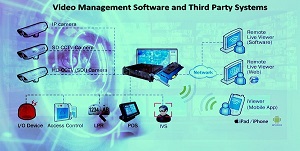
Video management software has become an indispensable part of security and surveillance applications. With the advent of cloud-based video surveillance, the power of VMS cannot be limited to just video monitoring. The new age VMS systems with intelligent video analytics are capable of offering much more than surveillance. The cloud-based VMS systems not only fulfill comprehensive surveillance needs of the businesses, but also complement other business processes, which may directly or indirectly reflect into the business ROI. Whether it is a new VMS installation or upgradation of an existing VMS system, enterprises (considering their business processes to be more interactive, connected and integrated) prefer their on premise or remote business systems to be integrated with the cloud-based Video management software. Since every business and its processes are different, the video surveillance needs of the enterprises also vary from each other. With the availability of flexible and customized video surveillance and analytics services, enterprises find it challenging to pick suitable thirdparty systems and apps to support their preferred VMS system. Therefore, most of the enterprises are shifting towards Video Surveillance-as-a-Service with their system integrators or VMS service providers. Most of the VMS service providers and system integrators are offering an open source or vendor independent cloud-based video management software to their clients for the obvious reason of making VMS compatible with third-party systems and applications. Why do third-party systems need to be compatible with video management software The third-party systems in VMS can be defined as any of the systems, applications or devices used to support and enhance the functionality of a video management software in order to improve the security and business processes of an enterprise. There are hundreds of companies manufacturing security and surveillance devices (like IP cameras, NVRs, Audio Devices, GPS systems etc.), but all the available devices are not necessarily compatible with the video management software preferred by the companies. Therefore, it is very important for VMS service providers or system integrators to check the compatibility of the surveillance software with the available thirdparty devices required for the project. Types of third-party systems and applications for VMS solution Third-party systems for a video management software are either physical devices installed at the surveillance location and office premises or widgets/ applications embedded in a video management software to enable intelligent video analytics. These systems and applications can be classified into two major categories; one as the systems for security and surveillance, and other as the system for supporting and enhancing business processes. Let us discuss them in detail. Security and surveillance systems Most of the third party systems and applications for security and surveillance are common across industries and are necessarily required to be part of a video management software. IP cameras An IP camera is a primary and mandatory requirement of any VMS system. A cloud-based video management software should support all types of IP cameras (Wired and Wireless cameras, PTZ, 360 degree, night vision, autofocus cameras etc.) from the major players/ manufacturers of the industry. VMS systems for customized surveillance projects must support IP cameras with open standards-based application programming interface (API), which allows system integrators to program the cameras for specific applications. IP surveillance cameras for video surveillance software must support multiple video streams and video compressions (H.264, MJEPEG) to send the video data with low latency. ONVIF support of the IP cameras with VMS systems can be an added advantage for the surveillance project. Access control devices Access control devices integrated with video management software provide physical security to any place or premise secured by the system. Integration of VMS with access control devices allows users to monitor, control and analyze multiple access points in real time, track the number of times access granted by the devices and react immediately in case of any event is triggered. Video surveillance along with access control helps in intrusion management, biometric attendance management and identity management. Fire and smoke detectors Fire and smoke detectors are the devices, which essentially need to be integrated with the VMS system of an enterprise. Large sized enterprises can have a large number of smoke detectors, which in case of fire, trigger the fire alarms of the building. An integrated fire alarm system with VMS allows a user to quickly identify and view the location of the fire alert. A quick response to such an emergency can help in saving lives and business assets. Video analytics for security & surveillance Video analytics in a VMS solution are a result of the structured algorithm of the software and many times inbuilt functionality of the devices connected to the VMS system. Video analytics for security and surveillance can be motion detection to prevent unauthorized access in restricted areas, perimeter protection to protect the virtual/ physical boundary within the enterprise, object detection, face recognition, people counting etc. A well-connected video management software with other surveillance and business-related devices can allow users to have complete control over business processes with security solutions and helps in improving the customer’s experience with the enterprise. Third party systems supporting business processes Cloud-based video management software is a well-accepted solution for security and surveillance across industries. Moreover, its structure of assimilating the functionalities of other business supporting systems enhances its business management capacity, incredibly. It empowers its administrators to have an inclusive approach to managing their business processes optimally without compromising on safety and security. Let us discuss the third party systems (used in different industries) that can be integrated with a VMS solution to enhance the business processes. Retail Third party systems and applications of a retail video management software are helpful for both employees of the retail stores and the customers visiting the stores. Here are some of the important systems to be integrated with retail video management software: Point of sale (POS systems): Integration of VMS with POS of any retail store can help in checking the fraudulent activities done by shoplifters or employees in a retail store. At POS, a customer pays for the shopped products,…

Read More

The Proxim Advantage Video Security via Wireless

Wide operating temperature range Security is not just a concern in temperate climates. The Middle East with day time temperatures reaching 50°C, and other areas such as Russia or Canada going as low as -40 degrees C, the wireless network has to be able to survive these brutal temperature ranges. Tsunami® products are rated for -40 to +60 degrees C operation. For those environments that are more temperate there are version of Tsunami® that support -30 to 55°C temperature ranges. Beyond these core, fundamental requirements for any wireless network carrying mission critical video traffic Proxim offers additional support. Small form factor Video camera deployments are meant in most cases to be unobtrusive, able to blend into existing surroundings. The Tsunami® 800 series of products offer a unit that is only 4.96×8.62×2.58 in (126×219 x 65.5 mm) in dimensions, and includes an integrated antenna to limit the overall subscriber unit profile. PoE out Given that for every subscriber unit there will be a camera attached, Proxim offers a second PoE port on the subscriber units that can deliver up to 25 watts of power to third party devices such as video cameras. This feature means deploying the camera does not require additional cable runs, the camera is plugged into the Tsunami® unit for both power and connectivity. Wireless video case studies Proxim has been delivering to customers high end, carrier class Tsunami® systems for many years. Video security has always been a major application for the Tsunami® line given how it meets and exceeds the demanding feature a specification set required by the video security application. A select group of typical deployments are described here. Dubai Investment Park Spread over 2300 hectares, Dubai Investments Park required a high-speed, cost-effective network to enable video security for intrusion detection and monitoring purposes. Over 40HD closed-circuit television (CCTV) cameras, 6 fixed ALPR cameras and automatic license plate recognition were deployed. The Proxim Tsunami® MP-8200 solution was installed across the residential zone of the park aggregating live feeds to a central monitoring station. The result: The video surveillance network covers over 25% of the entire park area and required 15 days to perform the whole installation. Allentown PA As part of the city’s re-vitalization project, Allentown, PA – USA deployed security cameras to capture license plates at significant distances at night as well as monitor critical locations around the clock. The video solution they chose used high definition PTZ cameras requiring 4Mbps of continuous bandwidth per camera. The local integrator, Communication Systems Inc (CSi), installed more than 300 Sony cameras, 175 of which are connected using wireless. Tsunami® was used as the wireless network component for Allentown. The result: The citywide surveillance network helped reduce crime by 20%. Statue of Liberty When Hurricane Sandy hit the greater Metro New York area, one of the areas hardest hit was the island in the middle of the harbor with the Statue of Liberty. As part of the renovation following the devastation, the Statue surveillance and security system needed to migrate from analog CCTV to the latest in digital video technology. The Park decided to deploy 160 IP cameras with HD resolution. The cameras had the ability to operate in extreme low light, with an undistorted 200 degree FOV and operated at 6 megapixel resolution. The result: The entire park/ island is now covered with HD video surveillance using Proxim Tsunami® radios as the network backbone. Tenerife Spain tram In Tenerife Spain they have a tram used for local mass transportation. The requirement was to provide complete CCTV coverage at speeds up to 100Km/h along 80Km of winding track which goes through the city and through tunnels. Proxim Tsunami® BSUs were deployed along the track in the proper locations and multiple SU’s were deployed in each train to backhaul each camera and provide 4Mbps of continuous connectivity. The result: The Tenerife Tram surveillance solution team was able to effortlessly and quickly deploy the surveillance cameras on board the moving trams and backhaul the video traffic using Proxim’s wireless mobility solution. The resultant network cost-effectively delivered connectivity along the track and within the tram, with the entire network being managed with Proxim’s ProximVision Advanced system. Summary Video security is increasingly becoming a fact of life. Places like downtown London have 100% coverage and many cities such as New York are moving in that direction. It is clear that to protect and monitor public domains such as sidewalks, parks, transportation systems, and the like, a wireless network will be part of the solution. Of critical import in selecting the mission-critical wireless network system, are the abilities of the system to survive the harsh environment both physical and radio frequency, provide guaranteed QoS via WORP® over a secured connection, and be able to deliver high bandwidth connectivity not just to light poles but on moving platforms as well. Proxim’s FastConnect™ is the best and possibly the only cost effective QoS assured mobility solution available. For a mission critical applications such as video security, when performance matters Proxim delivers. 1 || 2 || 3 || 4 || NEXT-> || ALL  

Read More

MATRIX Latest Surveillance Campaign

The recent Matrix video surveillance ad campaign in the Times of India saw how outdated CCTV reduces security to monkey business and how Matrix smart video surveillance solutions enhance security strategy and business productivity. Along with its 3-dimensional security – proficient, persistent and preventive – Matrix offers analytics driven cognitive video surveillance. Matrix SATATYA, a family of video surveillance solutions is specifically engineered for large organizations to address their enterprise grade applications. The solution includes an enterprise video management software, network video recorders and IP cameras. Considering the need of today’s globalized organizations, the entire Matrix solution focuses on four major aspects which are preventive security, centralized control with ease of management, storage space optimization and efficient bandwidth utilization. Moreover, Matrix solutions can seamlessly integrate multiple locations to provide centralized management. Matrix provides solutions that grow with the business. Its software powered video surveillance system gives the scalability that every enterprise needs while expanding its footprints across the globe, and the best part is that all these solutions are designed and manufactured in India. Matrix community includes many progressive organizations such as Schneider, Tata Motors, Samsung, GE, Airport Authority, Indian Railways etc.

Read More

Infinova Stands out at Secutech India 2018

Infinova shined at the recently held Secutech India in Mumbai winning the ‘Best Booth Award’ of the show. They depicted their core strength and credibility of expertise through the design and structure of booth, and portrayed their efficiency in critical infrastructure solution, city surveillance, transportation surveillance, banking surveillance, and industrial security surveillance in the most unique way. Infinova  Showcased following Products & Solutions at the Event :  Infinova showcased their intelligent face recognition management platform which is designed in a serviceoriented architecture (SOA). It integrates deep-learning based intelligent face recognition algorithm, and mainly achieves such functions as surveillance deployment, face comparison and face retrieval through flexible access service and professional application development. The system extracts an industryleading face recognition algorithm model by means of the most massive GPU clustering computing in the industry, and the training of the sample face library increasing recognition accuracy. The algorithm supports recognition of multi-angle characteristics and extraction of multiple characteristics under varying illumination, facial expression, occlusion and ages, reducing error recognition rate. It also features user-friendly configuration and retrieval ends, and supports target library management based on black and white lists. Its intuitive intelligent surveillance interface synchronously displays real-time video, face capture, face comparison and warning, improving user perception of recognition results. Infinova’s face recognition system is applicable to intelligent security surveillance systems of the ‘Safe City’ projects, public facilities and any critical infrastructure projects. The advanced clustering solution to the face recognition server can be easily expanded and deployed for the whole system. HD Megapixel cameras H.265 HD Megapixel Smart Starlight WDR IP Box Camera: Infinova’s VT210-A2 series H.265 HD Megapixel Smart Starlight WDR IP Box Camera allows image output resolution upto 1920×1080@30fps. The camera boasts of rich intelligent functions such as wire cross detection, regional invasion detection, field of view change detection, defocus detection, and too dark and too light detections. H.265 HD 5Megapixel Intelligent IR IP Bullet Camera: VT211-A5 series 5MP IR IP fixed camera features 1/1.8” progressive scan CMOS sensor and built-in 5.0 megapixel 2.8-12mm Vari-focus lens. With H.265/ H.264/ M-JPEG compression format utilized, this camera can output HD full-frame videos with the resolution of 5292×1944@30fps. The built-in dot matrix IR illuminators allow a maximum of 30 meters night vision distance. H.265 HD 2Megapixel Starlight WDR Intelligent IR IP PTZ Dome Camera: VT231-A2 series high definition infrared network dome camera supports 1920×1080@60fps HD network video output. It adopts H.265/ H.264/ M-JPEG encoding and its output provides excellent definition and color revivification degree which enables the acquisition of rich and accurate details so as to effectively guarantee smart analysis accuracy. This product adopts large power LED infrared lamps with long night vision distance up to 200m. HD 2Megapixel Starlight WDR Intelligent IP PTZ Dome Camera: VT230-A2 series is high definition intelligent IP dome camera that supports 1920×1080@60fps. It adopts H.265/ H.264/ M-JPEG encoding and its output provides excellent definition and color revivification degree which enables the acquisition of rich and accurate details so as to effectively guarantee smart analysis accuracy. H.265 HD 4Megapixel IR IP Dome Camera: VH221-A4 Series is an Infinova HD 4MP WDR IR Smart IP Minidome Camera. It adopts a 1/3” progressive scan CMOS sensor with an internal 2.8mm-12mm HD motorized zoom lens. The camera has an internal dot matrix LED IR lamp of 30m IR distance. The camera supports up to 2592×1520@20fps HD network video output. It uses H.265/ H.264/ M-JPEG encoding. HD IP 2MP Integrated Explosion Proof Fixed and PTZ Dome Camera: These camera adopt explosion proof shield design featuring high definition, high frame rate, high signal-noise ratio and high assurance. They come with a built-in 22x HD integrated network camera module. These support H.265/ H.264/ M-JPEG dual encoding, three-code stream HD video view and control and allows image output resolution up to 1920×1080@30fps.  

Read More

Axis Facial Recognition and IP Audio Solutions for India

Axis Communications has recently launched an array of solutions and products that can be customised for different industry verticals – smart city, retail, defence and manufacturing, and the transportation sector. The latest technology and offerings in the surveillance industry include IP audio and facial recognition leading the way. Facial recognition is a technology software that identifies real time video with a database of stored images. The application can be easily integrated to trigger an alarm and reduce response time, for instance, of an unforeseen intruder alert. To strengthen its network video offering, Axis has introduced a networkbased audio systems that can be easily installed and integrated to an existing system since it’s on open standards with other systems. The range of audio portfolio includes network hornspeakers and audio accessories that complement Axis’ network cameras. With the use of IP and analytics in network video, the surveillance industry is going beyond cameras. Axis Communications offers complete high-quality audio systems best suited for background music and announcements that can be used in retail formats and other applications combining with the possibilities of working with their partners who can customise the requirement for facial recognition. Other innovations on the offering include Axis perimeter defender, TCO and Zipstream technology. With the growing importance of cybersecurity, constant enhancement and upgradation of cybersecurity will be a never-ending task, because well-resourced cyber-criminals will never stop looking to exploit vulnerabilities in any new technology. As the number of connected devices grows exponentially, so too do the potential flaws, and the answer is proactivity and a systematic process for ensuring that patches are implemented as soon as they are available. “We are seeing an increasing trend in India, where intelligent building systems is aiding in the convergence of multiple networks over an IP backbone. At Axis Communications, we are continuously innovating our existing line of products and solutions that are capable to cater to the high end requirements of the retail sector to the high security need of the Indian defence and border security. We are thereby increasing our offerings and presence in the enterprise segment with products that make surveillance solutions more efficient and intelligent” – Sudhindra Holla Sales Director, India and SAARC, Axis Communications  

Read More

Protect Education from Cyberthreats

Across the world, the year 2016 turned out to be quite eventful for cybersecurity with multiple, major threats and breaches reported. It is the time to prevent cyber-threats lurking around India’s educational institutions. Broadly speaking, we understand cybersecurity as the preventive techniques used to protect the integrity of networks, programs and data from attack, damage, or unauthorised access. Over the years, cybersecurity has become a massive undertaking with the growing need to protect information and systems from major cyberthreats such as cyberterrorism, cyberwarfare and cyberespionage. Furthermore, the impact of these threats on a personal level is getting more significant as we immerse ourselves in a world that depends on all things digital. The awarenessadoption gap Among organisations in general, there has been greater awareness about the implications of cyberthreats. However, the education sector has somewhat lagged behind industry peers in the APAC region. While studies have not concluded the presence of a direct correlation between awareness and spending, only 66 percent of educational institutions (compared to 79 percent of financial institutions, for example) spent between 5% and 15% of their IT budgets on cybersecurity. Yet, as recent attacks on institutions of higher learning indicate, data on research, enrolment and student records that sit within school campuses can be of great value. As many as 76 percent of organisations in Asia-Pacific set aside at least 5 percent of their IT budgets towards cybersecurity this year, and about twothirds of them claim an increase in budget allocation from last year. Yet the education sector’s adoption levels, at 66 percent, have remained below average. Despite the less-than-adequate adoption levels, a whopping majority of the education sector reports a feeling of being well-protected. Need to adopt quickly Cybersecurity solutions, too, have become more sophisticated – with the most advanced systems integrating automation to optimise prevention. However, the adoption of these measures leaves much to be desired, and this is particularly true for the education sector. In general, adoption is predictably lower in industries and institutions that are less technologically savvy. While 73 percent of the education sector in the APAC region suffers from outmoded infrastructure, as much as 72 percent of the schools surveyed are confronted with the practice of employees downloading unauthorised documents and software. Antivirus and firewalls are no longer adequate by the new standards, yet two out of three companies rely on those methods alone. Meanwhile, two-factor authentication, anti-ransomware, and biometrics have low patronage. In spite of all the low (45 percent) adoption of sophisticated countermeasures, the confidence level among the educational institutions is as high as 86 percent. That lack of threat perception poses the kind of vulnerability that can be disastrous. Additionally, the ageing internet infrastructure and internal threats constitute the top reasons why the education sector in Asia-Pacific is still vulnerable to cyberattacks. Budget allocation to more sophisticated cybersecurity is a prominent barrier in its adoption – only 42 percent of educational institutions are seen to have adequate allocations. As the education sector burgeons in India, it is exposed to internal and external threats, leaving schools, colleges and research institutions vulnerable. Experimenting young minds who may take cyber risks at the cost of potential threats – unauthorized downloads are a critical example – pose a special threat. The education sector in India is digitizing itself, with technology driven education coming up as a separate high growth industry as well. Education technology relies on broadband and optic fibre, and these compound the already existing challenge of relative naiveté among both institutions and users. Inefficiency or insufficiency of cybersecurity measures put more at stake. The cost of a breach is substantial – arguably, higher than the risks many companies seem to take by not investing enough on cybersecurity. In India, the figure is as high as Rs.25,000 crores and is expected to rise exponentially over the next decade. Towards a strong policy The National Cyber Security Policy 2013 is a solid document of vision for the Indian environment. It is especially important in an environment where products and solutions for the education sector are available across international borders, transcending laws. In protecting youngsters from cyber ‘exposure,’ the document could also consider some cyberthreats as threats to national security. Some of these gaps are addressed in the National Association of Software and Services Companies (Nasscom) and Data Security Council of India (DSCI) launched by the Growing Cybersecurity Industry, Roadmap for India report of December 2016. In it, Nasscom identifies the lacuna in India’s cybersecurity policy and recommends 16 progressive policy measures, including tax breaks and cluster-funded cybersecurity ventures. Meanwhile, the education sector finds itself in a contradiction of sorts. On one hand, its rapid growth in India parallels the growth of IT systems to support it. On the other, the nascence of its growth has placed the sector in an especially vulnerable zone. As is the case throughout the Asian region, the Indian education sector is behind its world counterparts in grasping advanced cybersecurity systems that are available at its disposal. Despite its problems, this is a sector that does not figure on top of policy priority, in preference to finance and IT. As one of the fastest-growing migrants towards technology, and given the massive potential of the emerging technologybased education practices such as massive open online courses (MOOC), the Indian education sector must educate itself on cybersecurity quickly.         By – Anil Bhasin    Regional Vice President, India and SAARC, Palo Alto Networks    

Read More

Survey Highlights Needs for Intelligent Video Surveillance Solutions

Pelco by Schneider Electric recently surveyed 489 end-users within the surveillance industry about their surveillance needs and where they see the industry headed. The survey analyzed how end-users view their current surveillance systems and the expectations they have for emerging technologies. Key findings The study revealed significant and valuable insights into the current state of the video surveillance market, and how users rate their existing systems and market offerings in terms of meeting their business needs. Here are five of the top findings of the study: One-third of end-users believe that integration between disparate systems is their most significant security challenge today. Forty-four percent of end-users believe their current surveillance technology isn’t sufficient for 2020. One in every three end-users thinks artificial intelligence will make the most significant impact on the surveillance industry by 2020. Sixty-four percent of end-users plan to prioritize predictive analytics in the next few years. Over half of those surveyed say they use their surveillance system to meet current business challenges, but haven’t seen it reach its full potential. Many surveillance systems aren’t meeting current needs While parts of the security market may develop over a more extended period, the technology of video surveillance has been rapidly changing for at least the last ten years and shows no indication of slowing down. These technical advances mean that new capabilities are regularly introduced into the market to improve overall system performance and/or to provide specific solutions to current surveillance challenges. For this discussion, we will consider systems that have been installed within the last five years using the avaliable technology at the time of installation to be ‘current,’ while knowing that even within the most recent two years many new features and functionalities have become available. Systems installed more than five years ago may continue to function and meet some business purposes, but due to this rapid rate of enhancements, they can no longer be considered current. Half of surveillance systems are out of date By this measure, the survey reveals that half (49%) of existing surveillance system installations are functionally out of date because they were installed more than five years ago. A significant portion of these (19% of the total) were installed more than ten years ago – a lifetime in terms of available camera technology. The quick pace of technology systems is evident in security managers concerns. Of the respondents, 33% reported that their biggest technology challenge is their equipment becoming outdated. The fraction was higher for users with older systems, installed 10 or more years ago, at 44%. The next biggest technology challenge was integrating surveillance cameras with the rest of the security systems, reported by 29% of respondents (slightly higher for respondents with newer systems – 33%). Other technical challenges lagged behind these two. Integration remains a broad challenge Respondents gave a clear message when they were asked to identify their biggest security challenge – the top answer at 34% was ‘integration between disparate systems,’ and this concern was consistent across all end-user categories. This answer is interesting because the concept of integrating security systems is somewhat new. In the past, an organization’s video surveillance system stood apart from the access control system, parking lot gates, time and attendance system, and others. As these systems have undergone technology improvements, and the data and intelligence of these systems become more available for integration using internal networks as well as cloud-based services, the potential for integration has emerged and increased. The high recognition of this potential and its characterization as a challenge indicates a high market readiness for improved integration techniques, products and services. Surveillance trends for 2020 While it is always a challenge to predict the future, budget cycles and organizational planning do encourage security managers to think about how to prepare for the future. Part of that process is evaluating current and emerging technologies to determine which are most likely to address future challenges. Given the high change rate of technology mentioned earlier, it is not surprising that more than two-thirds of the study respondents (68%) are not convinced that their current security technology will be sufficient to address their needs in 2020, which is barely two years away. Users want predictive analytics One thing the end-user respondents are sure about the future is that predictive analytics will be a priority. A full 64% reported they would be prioritizing these technologies going forward, and 35% said it would be a high priority. During the last year, panoramic cameras and predictive analytics were the top two security trend topics that caught the attention of end-user respondents – with 50% and 38% respectively. Other topics caught the attention of 29% or fewer respondents. IoT and AI moving mainstream Study respondents also think that some emerging technologies that were not explicitly designed for security will nonetheless become relevant to the security market shortly. In particular, 54% of the end-users believe that the Internet of Things, or IoT, will be mainstream surveillance technology by 2020, and one third (33%) say that Artificial Intelligence, or AI, will make the most significant impact on the surveillance industry by 2020. Close behind, 32% say automation will make the most significant impact. Together, these results again indicate a willingness on the part of end-user respondents to accept and incorporate emerging technologies into their security programs, and they are optimistic about the development, testing and deployment timetables. Surveillance: More than security Security end-users have heard and understood stories about companies using video surveillance footage for additional business purposes. For example, it’s known that national retailers use video cameras in their stores not only to combat theft and fraud but also to gauge the effectiveness of marketing programs and in-store product displays. Respondents in this study appear to have incorporated these ideas into their security system expectations, even if the results haven’t come as of yet. Security end-users have heard and understood stories about companies using video surveillance footage for additional business purposes. For example, it’s known that national retailers use…

Read More