
Strategic Consultant, VICON

Senior Security Expert, US
An International Scourge
- Improvised explosive devices, or IEDs, attacks on the civil and political infrastructure of nations around the world present major threats to peace and security. The threats include personal suicide bombers and vehicle-borne IEDs (VBIEDs) – Vehicle-Borne Improvised Explosive Device. Every country is vulnerable, and no country is immune – as the following examples from different countries (of hundreds of bombings that could have been cited) should demonstrate.
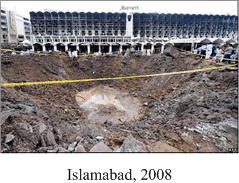
- The Marriott Hotel in Islamabad was bombed on 20 September 2008. A dump truck filled with explosives detonated in front of the hotel, killing at least 53 persons, injuring 266 more, and creating a 20m wide x 6m deep crater outside the hotel. Among the dead, in addition to many Pakistani nationals, were the Czech Ambassador, a Danish intelligence agent, and two American military personnel.
- The hotel had previously been attacked by a suicide bomber in 2007.
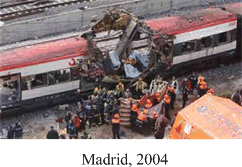
- On 11 March 2004 several trains serving Madrid were bombed during the commuter rush hour, killing 191 people and wounding 1,755. The official investigation blamed the attacks on al-Qaeda-inspired Moroccan extremists, who had purchased their explosives from Spanish nationals.
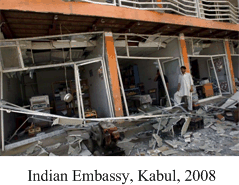
- On 07 July 2008, the Indian Embassy in Kabul was attacked by a suicide bomber, killing 58 people and wounding 141. The bombing occurred on a busy street where people usually line up at the embassy gates to apply for visas to India. This was the deadliest suicide bombing in Kabul since the fall of the Taliban in 2001.
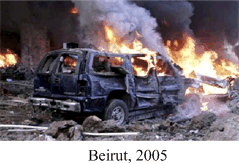
- Beirut has experienced many car bombings over a period of several decades. In 1995, a car bomb attack was carried out at the U.S. Marines compound, after which U.S. forces withdrew from Lebanon. On 14 February 14 2005 former Prime Minister Rafiq Hariri was assassinated, touching off civil rebellion and leading to the withdrawal of Syrian troops.
- UK citizens affiliated with extremist Muslim groups attempted to car bomb Glasgow International Airport on 30 June 2007 using an SUV loaded with propane canisters. The SUV was driven into the glass doors of the airport terminal and set ablaze, but security bollards outside the entrance prevented the car from entering the terminal itself. It was the first terrorist attack to take place in Scotland since the Lockerbie bombing in 1988. Two car bombs, believed to have been assembled by the Glasgow Airport attackers, were also discovered in the Haymarket area of London, and were diffused before they could explode.
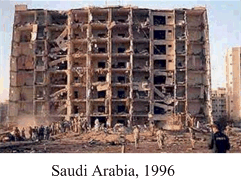
- On 25 June 1996, individuals later identified as members of Hizballah Al-Hijaz (Party of God in the Hijaz) by the United States, exploded a fuel truck adjacent to Building #131 in the Khobar Towers housing complex located near the national oil company (Saudi Aramco) headquarters of Dhahran, Saudi Arabia. In all, 19 U.S. servicemen and one Saudi were killed and 372 persons of many nationalities were wounded.
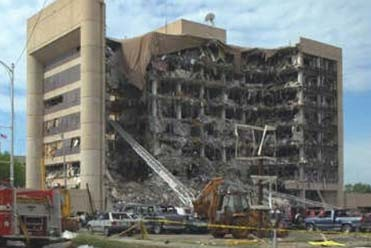
- On 19 April 1995, the Murrah Federal Building complex in downtown Oklahoma City was car bombed. The attack claimed 168 lives and left over 800 people injured. The blast destroyed a third of the building and created a 8 meter x 2.4 meter deep crater next to the building. The blast destroyed or damaged 324 buildings in a Oklahoma City, 1995
- 16-block radius, destroyed or burned 86 cars around the site, and shattered glass in 258 nearby buildings. The blast effects were equal to more than 2,300 kg of TNT, and could be heard and felt up to 89 km away. Until the September 11, 2001 attacks, it was the deadliest act of terrorism on U.S. soil.
This bombing caused the U.S. government to review the vulnerability of both civil and military facilities to such attacks. Physical protection criteria and standards for new construction were then established, including minimum building setback dimensions from roadways. Facilities which could not meet these criteria and standards were relocated to protected compounds or military bases, a process that is continuing to this day. Where major public roads passed near buildings which could not be relocated, road closures were adopted including the closure of a portion of Pennsylvania Avenue immediately in front of the White House in Washington, D.C.
The U.S. State Department has published a guide on car bomb awareness and established similar criteria and standards for protecting U.S. government facilities overseas.
Nature of the Threat
The standard North Atlantic Treaty Organization (NATO) definition of an IED is:
“A device placed or fabricated in an improvised manner incorporating destructive, lethal, noxious, pyrotechnic or incendiary chemicals and designed to destroy, incapacitate, harass or distract. It may incorporate military stores, but is normally devised from non-military components.” (NATO, 2007, Part 2, sec. I, p. 2)
The problem with IEDs is they can be easily made inconspicuous or disguised to look like common objects. They can also be deployed day or night, in any weather and visibility, by persons who are indistinguishable from the general population.
Explosives experts in Iraq give testimony to the inventiveness and resourcefulness of the threat by citing the following examples of IEDs which have been found:
- Black plastic garbage bags (with 130mm artillery rounds wired in series).
- A bus, with a grenade attached to the fuel tank (it failed to detonate).
- Milk cartons, Pepsi cans, cigarette cartons filled with explosives.
- Burlap bags (again using artillery rounds).
- A pothole in the road filled in with dirt and an explosive charge. Many former Iraqi Army artillery shells have been deployed this way.
- Refrigerator compressor – filled with high explosives and re-welded.
- Grocery and food bags – good bomb platforms; common items; easily disguised.
- Cars, trucks, vans (older models, so as not to draw attention). A vehicle with worn shocks and springs; overloaded, trash on seats; good tires on a junk car – this is a one-way trip, and the driver wants no flats.
- Pipe bombs (Some of the most expert IED military specialists have been killed by low yield pipe bombs).
- Dog carcasses filled with explosives.
A lone suicide bomber may carry an explosive charge weighing from 5 to 15 kg for a vest or a bag. The charge is commonly packed with nails, ball bearings and other metal fragments around the explosives selected to maximize casualties, and the site for detonation is often selected for the same purpose.
A VBIED typically carries from 50 kg up to 1000 kg but can exceed 6,000 kg, as the bomb used against the U.S. Marine compound in Lebanon demonstrated. Unlike a guided missile delivered by an airplane or other remote vehicle, the suicide driver can divert, call-off or simply postpone his mission.
Soft civilian targets are especially attractive to terrorists – and also especially vulnerable, because there are numerous possible threat scenarios and, in a civil environment, it is impossible to protect all of them like military facilities.
The means used for VBIEDs can vary widely. In the U.S, for example, the FBI issued warnings of VBIEDS, possibly disguised as limousines after a document was seized from al-Qaeda which described the use of limousines to deliver bombs equipped with cylinders of a flammable gas. The document recommended concealing bombs in these vehicles because they can ‘blend in’ and ‘can transport larger payloads than sedans, do not require special driving skill, … can ‘access underground parking structures that do not accommodate trucks, …and have tinted windows that can hide an improvised explosive device from outside.’ It also suggested painting the cylinders yellow to falsely ‘signify toxic gases to spread terror and chaos when emergency and hazardous materials teams arrive.’
Recipes for Terror –
a Taxonomy of the Threat
Basically, if it can explode it will be used.
The materials baseline for home-made bombs includes:
- Liquid hydrogen peroxide/ fuel formulations (HP/F) – (e.g., hydrogen peroxide with various fuels).
- Mixtures with solid oxidizers, (e.g., perchlorates and ammonium nitrate.)
- Mono-molecular mixtures, (e.g., urea nitrate, TATP, petric acids.)
- Nitrogen based explosives, (e.g., nitro glycerin, EGDN, and methyl nitrate.)
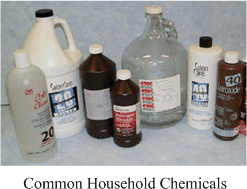
Explosives
The following diagram classifies explosives by type:
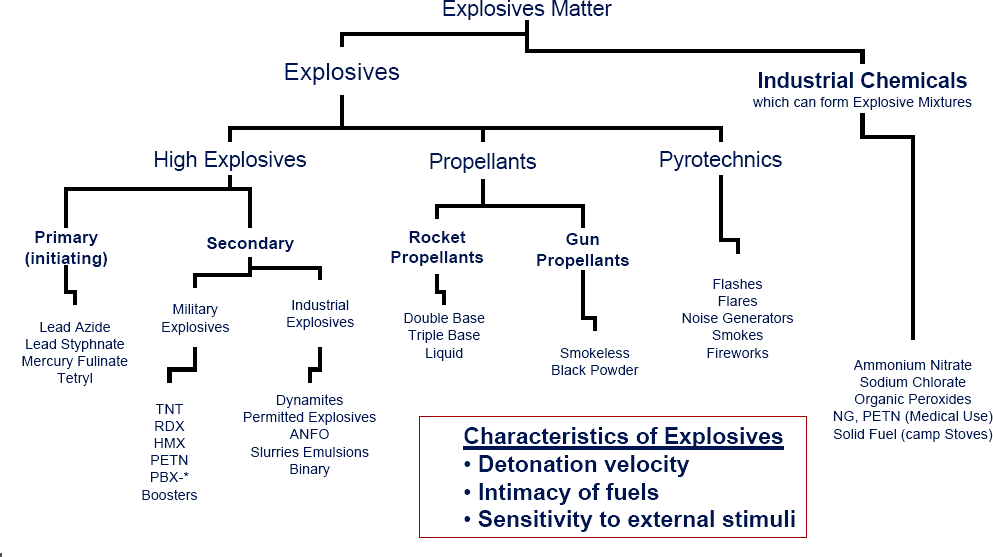
Ammonium nitrate, available as fertilizer, can be mixed with many different chemicals to create highly explosive mixtures. Some of the most common ones are:
- ANFO – mixed with Fuel Oil.
- ANAL– mixed with Aluminum powder.
- ANIC – mixed with Icing sugar.
- ANNIE – mixed with Nitrobenzine.
- ANS – mixed with sugar.
The volume in all the above mentioned ammonium nitrate mixtures makes them particularly suited to car bombs or VBIEDs.
Half of all bombings carried out in the USA are pipe bombings – simple devices which use black powder inside a container. Although the black powder (charcoal and potassium nitrate) is slow, the build up inside a sealed pipe creates tremendous pressure and then explodes releasing – beside the blast wave – a deadly wave of shrapnel. These bombs are also a favorite of suicide terrorists who may strap as many as six pipes to their chest and all will be detonated together, creating a simple but devastating weapon that can claim many victims. Everything required to build a pipe bomb is readily and commercially available – most of it at hardware stores, agricultural supply houses, and pharmacies.
Ammonium nitrate remains a popular explosive because of its ready availability, low cost, safety and lethality in quantities that can be carried by SUVs and small trucks. The original plan of the Oklahoma City bombers was to use the rocket fuel anhydrous hydrazine, but its expense was prohibitive. Disguised as a bike racer, Timothy McVeigh was able to obtain nitromethane on the pretense that he and some fellow bikers needed the fuel for racing. McVeigh made a prototype bomb using a plastic Gatorade jug with ammonium nitrate prills and liquid nitromethane. A piece of Tovex sausage and a blasting cap were used to ignite it. A truck was then loaded with in excess 2,800kg of ammonium nitrate fertilizer, nitromethane, and diesel fuel mixture, and detonated in front of the north side of the nine-story Murrah Federal Building – with lethal effectiveness.
Other explosives, which are generally available only with the consent (direct or indirect) of governmental agencies and which are popular with different terrorist groups, include:
- C4 – looks like dough and is composed of RDX and plasticizers.
- PETN is mixed with different materials to create sheet plastics – easily hidden in electrical devices like laptops and available in thin sheets.
- Semtex – looks like orange play dough, made in Czechoslovakia, very common in terrorist attacks.
The supply of high explosives such as C-4, is closely controlled by governmental agencies. They are an order of magnitude more difficult to obtain than obtaining ammonia nitrates without the assistance of an insider, or the tacit approval of a government, or by theft.
Terrorists can also make their own explosives – as they have been known to do using chemicals available on the open market. Ramzi Yousef of the 1993 World Trade Center bombing infamy and his Bojinka gang were doing just that in Manila, Philippines in late 1994, preparing to bomb U.S. airliners crossing the Pacific Ocean, when they made a mistake causing a fire. The fire department’s response caused Ramzi and his team to vacate the apartment and that subsequently led to the police discovering their makeshift bomb factory.
The methods of different VBIED attack and construction are currently described in such publications as the al-Qaeda Manual and several extremist websites, which can be accessed from Internet connections worldwide. The design and implementation of these devices are only limited by how much the bomber has surfed the Internet. Every country potentially faces such threats from dissident groups, not all of which are affiliated with international terrorist organizations such as al-Qaeda.
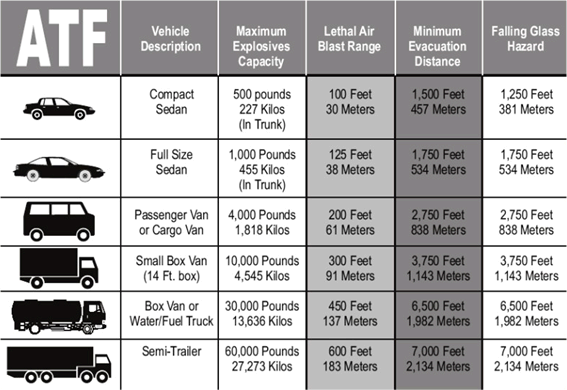
The potential effectiveness of VBIEDs varies with the delivery platform. The following table illustrates this by vehicle class (data from the U.S. Bureau of Alcohol, Tobacco, and Firearms).
Identifying and Recognizing the threat
Potential suicide and VBIED indicators include:
- License plates inconsistent with vehicle registration.
- Obviously carrying a heavy load, heavy rear end.
- Modification of truck or van with heavy duty springs to handle heavier loads.
- Rentals of vans with false papers for dry runs.
- Rental of self-storage space for storing chemicals or mixing apparatus.
- Delivery of chemicals directly from the manufacturer to a self-storage facility or unusual deliveries of chemicals to residential or rural addresses.
- Theft of explosives, blasting caps, or fuses, or certain chemicals used in the manufacture of explosives
- Chemical fires, toxic odors, brightly colored stains, or rusted metal fixtures in apartments, hotel/motel rooms, or self-storage units due to chemical activity.
- Small test explosions in rural wooded areas.
- Treatment of chemical burns or treatment for missing hands/fingers.
- Untreated chemical burns or missing hands/fingers.
Comprehensive surveillance of the targeted facility is a must condition for terrorists planning this kind of operation. Extensive surveillance preceded the Riyadh, Nasiriya and many Iraq VBIED attacks. Recognizing the types of surveillance terrorist’s use should help security forces to develop plans to thwart potential attacks more effectively.
Terrorist surveillance may be either fixed or mobile.
- Fixed surveillance is done from a static position, possibly an adjacent building, business, or other facility. In fixed surveillance scenarios, terrorists may establish themselves in a public location over an extended period of time or choose disguises or occupations such as street vendors, tourists, repair or deliverymen, photographers or even demonstrators.
- Mobile surveillance usually entails observing and following persons or individual human targets, although it can be conducted against non-mobile facilities (i.e. driving by an embassy to observe the building or compound). To enhance mobile surveillance, many terrorists have become more adept at progressive surveillance.
- Progressive surveillance is a technique whereby the terrorist will follow a target for a short period of time from point A to point B, withdraw for a time, possibly days or even weeks, and then resume surveillance from point B to point C. This will continue until the terrorist develops target suitability and/or noticeable patterns in the targets movements. This type of transient presence makes the surveillance much more difficult to detect or predict.
Sophisticated surveillance is likely to be accomplished over a long period of time. This tends to disrupt detection techniques and improve the quality of gathered information. Some terrorists are noted to perform surveillance of a target or target area over a period of months or even years.
Terrorists are known to use advanced technology such as modern optoelectronics, including commercial and military night-vision devices. communications equipment, video and infrared cameras, and other electronic equipment.
A tape discovered in Indonesia, possibly compiled over months, demonstrates the patience used to compile a viable plan and the attention to detail. Watching carefully the travel patterns of targeted personnel and detailing every possible thing that could help the attack, even the location and accessibility of manhole covers, the narrators points out in great detail how the attack might be carried out.
Trained, experienced security planning and threat analysis professional are requited to detect such surveillance, and to exploit new CCTV technology to record and re-play suspect and re-current activity.
Protecting Potential Targets
Terrorists seek to have their attacks create the maximum amount of damage in two ways: The first priority is causing innocent civilian casualties to spread terror and panic among the population, and the second is to maximize the economic impact of attacks by destroying infrastructure and government facilities.
High-value targets include electrical generating and transmission facilities; telecommunications centers; airports, rail and ground transportation hubs; the residences of prominent officials; well-known and symbolic business headquarters; malls, amusement parks, stadiums or historic sites attracting large crowds; and any infrastructure site where the on-going effects of blasts can have devastating – and public – effects.
Elements of a protection program should require:
- Examining every vehicle coming into a parking lot, especially underground should be standard practice in certain facilities. Increase the number of overt security personnel wherever possible.
- Re-arrange exterior vehicle barriers and roadblocks to change traffic patterns near facilities and cover by vigilant security staff. Arrange for security vehicles to be parked randomly near entrances and exits.
- Coordinating with and establishing partnerships with appropriate national, regional, and local authorities and organizations to develop intelligence and information sharing relationships, which must include interoperable communications at all levels in the decision chain.
Facility protection measures should include:
- Increased perimeter lighting.
- Deploying visible security cameras and/or motion sensors.
- Remove vegetation in and around perimeters, maintained regularly.
- Providing specialist vehicle inspection training and access control specifically for security personnel.
- Deploying explosive detection devices; possibly using both electronic and canine explosive detection.
- Conducting vulnerability studies focusing on physical security, structural engineering (blast mitigation) and infrastructure i.e. power, water, and air filtration if feasible.
- Initiating a system to enhance delivery, mail and package screening procedures (both announced and unannounced).
The use of VBIEDs allow terrorists to place large amounts of explosives against hard or soft targets with a high degree of mobility – in effect turning these VBIEDs into precision weapons that cause mass casualties and physical destruction. VBIED attacks require less coordination, planning, expertise, material, and money than the more spectacular type of terrorist methods, such as aircraft hijackings or employment of weapons of mass destruction, yet still can achieve the mass casualty objective.
There is no standard type of vehicle associated with vehicle borne improvised explosive devices (VBIEDs.) Vehicle selection depends on vehicles common to and available in a region, vehicles possessing routine access to the area, and the security posture of the intended target. The typical tactic for the employment of a VBIED is to drive a single vehicle to the target, park the vehicle, and allow the vehicle to detonate via time delay or by remote control. Another tactic is the use of suicide drivers, driving up to the target and detonating the vehicle by use of a “dead-man” switch. As evidenced by attacks in Iraq, terrorist may also use garbage trucks, ambulances or other emergency vehicles.
As illustrated by Riyadh attacks, terrorist groups may utilize police or military identification, uniforms, and vehicles as effective ways to increase access and decrease scrutiny in furtherance of planning and operations. Hundreds of official identification cards, badges, decals, uniforms, and government license plates have been reported stolen or lost. Additionally, a number of private companies have reported receiving suspicious inquiries about renting official delivery vehicles, and emergency services representatives have received unusual requests for detailed vehicle descriptions. There is no historical baseline to compare recent theft or suspicious inquiry data, and the intent or resolution of many of the thefts cannot be determined.
The worldwide proliferation of individuals or “companies” that traffic in high-quality imitations of official identification, uniforms, or vehicles is a related issue that increases the possibility such items could be used to facilitate future terrorist attacks and further complicates efforts to prevent their acquisition.
Recognizing that possession of some combination of official identification cards, badges, decals, uniforms, government license plates, and vehicles tends to reduce suspicion and might allow an individual or vehicle greater access to sensitive facilities, the following protective measures are suggested:
- Keep comprehensive records of all official identification cards, badges, decals, uniforms, and license plates distributed, documenting any anomalies, and canceling access to items that are lost or stolen.
- If possible, adopt biometric-type national ID and facility access control cards so that the user can be positively authenticated.
- Practice accountability of all vehicles, including tracking vehicles that are in service, in repair status, or sent to salvage.
- Safeguard uniforms, patches, badges, ID cards, and other forms of official identification to protect against unauthorized access to facilities, including stripping all decommissioned vehicles slated for resale and/or salvage of all agency identifying markings and emergency warning devices.
- Check multiple forms of valid identification for each facility visitor.
- Verify the legitimate business needs of all approaching vehicles and personnel.
- Improve identification card technology to eliminate reuse or unauthorized duplication.
- Alert uniform store vendors of the need to establish and verify the identities of individuals seeking to purchase uniform articles.
- Ensure all personnel are provided a security briefing regarding present and emerging threats.
Effective countermeasures must address the terrorist’s ability to learn about them and adapt to them. Through public websites and media reports insurgents can discover the number of countermeasures deployed, how they work, and even their performance specifications. Many governments, for example, use radio frequency jammers to protect their officials when traveling in personal vehicles or in convoys. Through Internet websites of the manufacturers, terrorists can learn details about the jammers that could be used to counter them, including their operating frequencies. Once discovered, the frequency range jammers can be blocked.
Optimizing countermeasures for specific threat configurations only assures that new configurations will arise, and it is impossible to different pieces of equipment for every threat modality. Shifts in tactics further complicates the use of countermeasures.
Not only is the evolutionary nature of the IED threat a challenge, but the sheer variety of IEDs is as well. Different bombmakers have their own preferences. For instance, some will use garage-door openers as their triggering mechanisms, whereas others might use, mobile phones as their radio-control (RC) devices. Add to this a convoy that could be tasked to drive through areas with different insurgent cells, each with its own preferred method of making their IEDs, and the situation gets even more complex.
Improved detection would also be a great step forward. Many veterans of the Iraq war believe that some 70-80 percent of all IEDs are being found with the human eyeball. Automating such detection using multispectral sensors, for instance, would not only provide a better detection capability, but it would also free up the soldier to perform other duties.
Applying Technology
Current explosive detection technology used by the U.S. government includes X-Ray machines; olfaction machines(gas chromatography and differential mobility spectrometry); neutron activation, in which the machines bombard the suspect explosives with neutrons and read the gamma radiation decay signatures to determine the chemical compositions of the sample; and specially trained dogs.
Commercially-available explosive scent detectors still lack the sophistication and sensitivity of a dog’s nose. Several technologies under development have shown the potential for improving explosive detection and identification. For example, when explosives are probed with microwave beams, the high energy levels in the explosive’s chemical bonds create resonance patterns in the reflection of the microwaves which reveal
the substance’s presence and identity. Terahertz imaging has demonstrated the ability to detect non-metallic weapons, but it is still very expensive, is sensitive to environmental conditions, and when used to screen passengers at airports raises serious issues of privacy. Increasing stand-off distance of these and other sensors remains a challenge.
Other promising countermeasures technologies, which can only be described in general terms because of security restrictions, include:
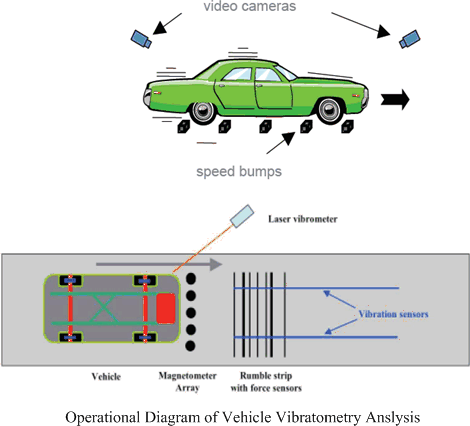
Vibrotometers for Assessing Suspicious Vehicles: Remote, mass-loading-free vibration measurements on targets that are difficult or impossible to access, are typical examples of applications where a laser-based vibration transducer might be best solution. The concept is shown in the following diagram:
The measurement principle of a laser vibrometer is based upon the Doppler Effect. When monochromatic laser light is scattered back from a vibrating target it undergoes a frequency shift proportional to the velocity of the target. As the target moves towards the light source, the back-scattered light undergoes an increase in frequency. As the target moves away, the back-scattered light undergoes a lowering of frequency. If the target is vibrating, the frequency of the back-scattered beam will be frequency modulated at the so-called Doppler frequency, and this signal can be utilized in systems measuring translational (linear) vibration as well as systems measuring tensional (angular) vibration.
Pulsed Neutron Analysis (PNA): PNA uses high-energy neutron output to cause nuclear excitation of materials within a vehicle and detectors to identify elements
within the subject cargo that indicate the presence of explosives. The whole process, which is designed to interrogate a vehicle for five minutes, can detect a fraction of the explosives used in Oklahoma City contained within a medium-sized vehicle. Through the combination of rapid neutron interrogation techniques and the use of high probability statistical inference, the PNA system has the ability to yield precise determination of the presence of explosives, while minimizing the indication of false positives.
Improved Hand-Held Substance Detectors: The current generation of hand-held detection equipment will be replaced with a new generation of solid state microsensor particle and trace detectors which can identify multiple types of explosives and narcotics and do it faster and with fewer false positives. Some of the new devices will use micro-cantilevers on silicon, others will be chip-size mass spectrometers, but collectively they will revolutionize trace substance detection.
Multispectral Imaging: Multispectral surveillance involves detecting objects and monitoring different wavelengths of radiation from an object going from visible to ultraviolet and infrared lights and combining all of those different radiation wavelengths to identify an object. An imagery-based surveillance technique which uses visible and infrared image combined with statistical pattern recognition algorithms is being developed to detect and classify suspicious objects, such as camouflaged bombs placed at roadside and in airports. Images are displayed on a computer screen via visible and infrared camera which detects the presence of hard objects inside camouflaged boxes. Statistical pattern recognition will then be used to determine whether an anomalous object is harmless or not. These system works on incoming video collected at different wavelengths, including visible, infrared, and synthetic aperture radar. Sensors can be located wherever necessary to improve the safety around a specified area.. When a suspect vehicle is detected, the system determines the level of threat it may represent and can then track the vehicle, alert personnel, check for previous instances of the vehicle, and update other networked systems with the threat information.
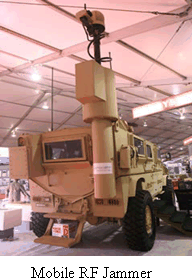
Mobile Communications Jammers: To counter the remote control of IEDs, several companies have developed a mobile jammer system which uses modular, programmable multi-band radio-frequency jamming to deny an enemy use of selected portions of the RF spectrum in the system’s vicinity. Mobile jammers previously used broadband or “barrage” jamming to block entire wavelengths associated with suspected radio-controlled IEDs, most of used radio communications and cellular phone frequencies. Newer systems use specific waveforms and can transmit in one or on all bands simultaneously, effectively countering a wide range of potential threats. Both civil and military configurations are available.Robotic ground vehicles: Robots can be equipped with visible and/or infrared sensors and a mechanical arm to inspect and relocate suspected IEDs. More than 100 remote-control robots are now being used in Iraq and Afghanistan, with more on order.
Blast Mitigation: Improved steels, composite structures, and transparent polymers will enable the facility designer to increase the level of protection for employees, customers, and visitors.
Technology is an enabler but it is not a panacea. Every IED situation is unique and must be dealt with on its own terms. The process starts with good intelligence, without which the selection and use of technical countermeasures cannot be effective. Intelligence must be combined with well-trained security professionals and an information system to support them. Intelligence and security operations are fundamentally human functions and that should be kept in mind in setting up an infrastructure protection program.
About the Authors
James McGuire is former Sr. Vice President of TranSecure International, Inc., a U.S. based international consultancy specializing in security regulatory requirements, operational planning, system design, and operator training for airports and other transportation facilities. He has provided security and IT engineering consulting services for both U.S. and international airports and is a member of committees advising the U.S. Transportation Security Administration on airport security standards. Before becoming a consultant, James spent 25 years designing and building security and communications systems, much of which was supplied to users in the Middle East. He is a member of the IEEE and SPIE professional engineering societies, and received a degree in Mechanical Engineering from Rensselaer Polytechnic Institute plus an MBA degree from Harvard University.
Mr. McGuire has a personal and continuing interest in IEDs, having lost a close relative to a roadside bomb in Iraq in 2005.
Milind Borkar is Strategic Advisor to Vicon, a leading supplier of CCTV equipment and video solutions for security projects around the world. He is a member of the American Society of Industrial Security (ASIS), holds a degree in Chemical Engineering from Bombay (Mumbai) University, and is fluent in several Indian languages as well as in English, Japanese, and Central African dialects.