

Gaurav Taywade
Managing Director – India, Vicon
From Vicon’s PTZ heritage to LiDAR-assisted autofocus, advanced stabilization, edge AI and thermal imaging, modern PTZ cameras are redefining how security teams monitor large and complex environments.
Pan-Tilt-Zoom (PTZ) cameras have long played an important role in professional video surveillance. Their ability to pan across wide areas, tilt to follow activity and zoom in on distant subjects makes them particularly valuable in environments where fixed cameras alone cannot provide sufficient coverage.
For Vicon, this journey has a long history. In 1995, the company introduced its Surveyor Series of compact, high-performance PTZ cameras, marking an important milestone in its surveillance technology portfolio. Today, that legacy continues with advanced PTZ solutions that bring together precision optics, intelligent imaging, stabilization technologies, AI analytics and specialised sensing.
The evolution is significant. It is no longer enough for a camera to move, zoom and deliver a clear image. Modern security teams need systems that can maintain image clarity at high magnification, respond intelligently to events, perform reliably in challenging conditions and help operators make faster, better-informed decisions.
A legacy of innovation, built for today
Since the introduction of the Surveyor Series, PTZ technology has continued to advance in response to changing security requirements. Modern cameras combine sophisticated optics, high-resolution sensors, improved image processing and intelligent automation in increasingly capable platforms.
Vicon’s Roughneck Pro PTZ range reflects this progression. With selected models offering 5MP imaging and 40x optical zoom, these cameras enable operators to move from a broad situational view to detailed observation of distant subjects. The objective is not simply to see further, but to obtain meaningful visual information across a wide range of operating conditions.
Seeing further is only the beginning
Optical zoom remains one of the most important capabilities of a PTZ camera. It allows operators to examine distant subjects without physically approaching the scene, making it valuable for monitoring perimeters, transportation facilities, industrial sites and large commercial campuses.
However, magnification alone does not guarantee usable footage. At high zoom levels, even small vibrations can affect image stability and detail. Features such as Electronic Image Stabilization (EIS), multi-exposure High Dynamic Range (HDR) and motion-compensated noise reduction help address these challenges. Servo-feedback technology supports precise positioning, helping the camera return to its intended viewing position during continuous operation.
Together, these capabilities make modern PTZ cameras more dependable imaging platforms—designed not just to reach further, but to maintain useful detail when it matters.
Ultimate stability: Mechanical and digital working together
A PTZ camera may have powerful zoom and advanced analytics, but its performance can still be compromised if vibration causes the camera to drift off target or makes the image difficult to interpret. This is particularly relevant for outdoor installations exposed to wind, vibration and other environmental movement.
Addressing this challenge involves more than one technology.
Servo feedback supports positional accuracy. By monitoring the camera’s movement and position, the system can correct deviations and help the PTZ return to its commanded viewing position. This is especially valuable when the camera is expected to maintain a preset or repeatedly return to a specific area.
Electronic Image Stabilization helps reduce image movement. EIS compensates for unwanted motion in the captured image, helping maintain clearer footage when vibration or movement affects the camera.
These technologies address different aspects of stability. Servo feedback helps control where the camera is pointing; EIS helps stabilize what the camera sees. Used together, they can support more consistent observation and improve the usability of recorded footage.
For surveillance operators, this distinction matters. A camera that returns accurately to its intended position and delivers stable images makes it easier to inspect details, review events and maintain situational awareness. In Vicon’s Roughneck Pro PTZ range, servo-feedback positioning and EIS are among the capabilities designed to support reliable performance in demanding environments.
LiDAR: A new dimension in Autofocus
Another notable development in advanced PTZ design is the integration of LiDAR with autofocus technology.
LiDAR, or Light Detection and Ranging, measures distance using reflected laser pulses. In Vicon’s Roughneck Pro PTZ model V2005PTZ-40XIR-B and V2008PTZ-30XIR-B, an integrated LiDAR module works alongside machine-learning-based contrast autofocus to improve focusing speed and accuracy.
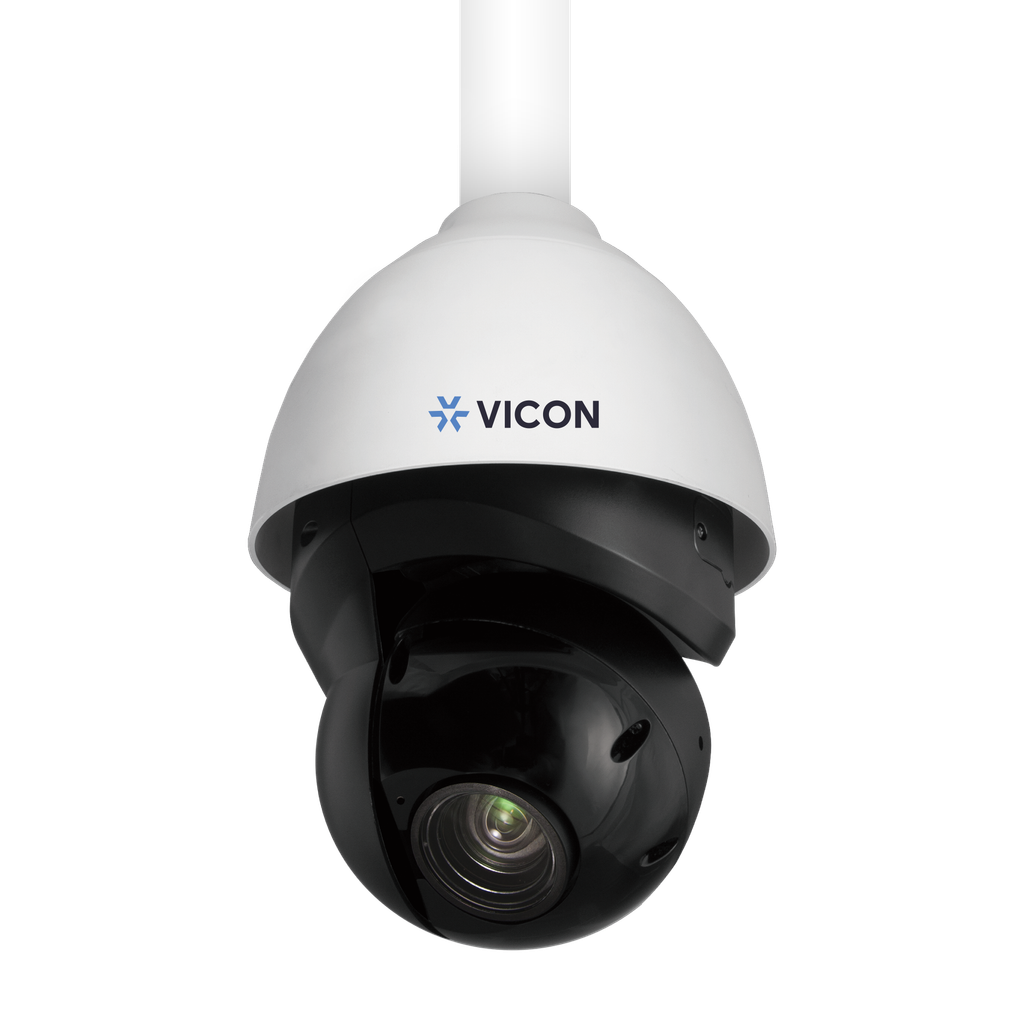
This is particularly useful when a camera moves between viewing positions or shifts from a wide scene to a distant subject. Achieving focus quickly helps operators obtain useful visual detail without unnecessary delay.
The significance lies in how specialised sensing and intelligent image processing complement conventional camera technology. Rather than treating autofocus as a basic function, this approach makes it an important part of overall imaging performance.
Intelligence at the Edge
The next stage in PTZ evolution is the ability to identify and interpret activity, rather than simply capture it. AI-based video analytics can help distinguish relevant events from routine movement and reduce the burden of continuous manual monitoring.
Capabilities documented across the Roughneck Pro PTZ range include people tracking, line crossing, occupancy and zone-related events, loitering detection, people gathering, vehicle recognition, licence plate recognition, face recognition and personal protective equipment (PPE) detection, among other analytics. Exact capabilities vary by model and configuration.
When combined with PTZ movement, these functions can help operators investigate events, follow people and vehicles, and focus attention on areas that require closer observation. Integrated with a compatible video management system, analytics can also support more efficient event review and response workflows.
The objective is not simply to add more features to a camera. It is to make surveillance more useful to the people responsible for operating it.
One PTZ range, Different operational needs
Not every surveillance environment presents the same challenge. An airport terminal has different requirements from an industrial perimeter, while a corporate interior may call for a discreet installation.
A flexible PTZ portfolio allows system designers to select technology according to the environment and operational objective.
Vicon’s PTZ range addresses several of these needs:
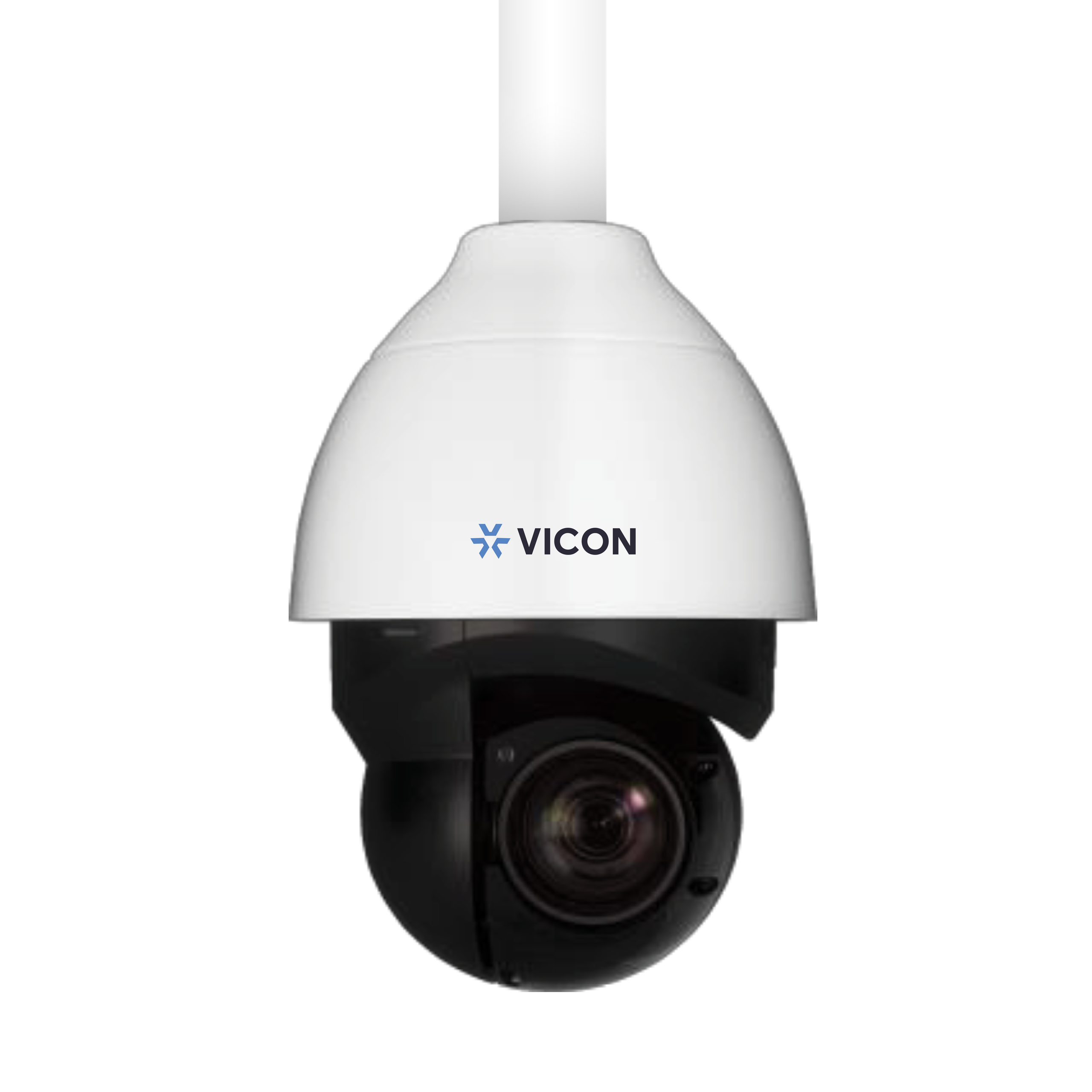
- Rugged outdoor surveillance: The Roughneck Pro 5MP PTZ Dome Camera, model V2005PTZ-40XIR-B, combines 40x optical zoom, LiDAR-assisted autofocus, image stabilization and Smart/Adaptive IR illumination with a specified range of up to 250 metres.
- Enterprise and architectural installations: The V2005PTZ-40XD-B offers a professional PTZ dome design, while the V2005PTZ-40XCM-B provides a recessed ceiling-mounted option for interiors where aesthetics and discreet installation are important.
- Thermal and visible-light surveillance: The V2005PTZ-40XVT-B bi-spectral thermal PTZ combines a 5MP visible camera with a thermal imaging sensor, supporting situational awareness in applications where conventional visible imaging may be insufficient.
These configurations demonstrate that PTZ capability is not defined by zoom alone. Sensor selection, mounting design, environmental protection, illumination and system integration all influence how effectively a camera serves its intended role.
Built for real-world deployments
Professional surveillance technology must perform consistently beyond the laboratory. Outdoor cameras may face rain, dust, temperature extremes, vibration and the risk of physical impact. Networked cameras must also meet expectations for cybersecurity, interoperability and operational continuity.
Depending on the model, Vicon’s Roughneck Pro PTZ range includes IP66 weather protection, IK10 impact resistance, H.265/ H.264 compression, edge storage and support for ONVIF Profiles S, G, T and M. Documented security capabilities include HTTPS encryption, access controls and TPM 2.0.
Integration with Vicon Valerus and compatible third-party video management systems enables PTZ cameras to become part of a broader security architecture rather than operating as isolated devices.
For system integrators and end users, this combination of imaging performance, stabilization, intelligent features and integration flexibility is essential when designing solutions for critical infrastructure, transportation, industrial facilities and commercial campuses.
The future is intelligent, stable and precise
The evolution of PTZ surveillance is being shaped by the convergence of optics, mechanical control, digital stabilization, AI and specialised sensing technologies. Servo feedback and EIS help maintain positional and image stability. LiDAR-assisted autofocus supports faster, more accurate focusing. Edge analytics and thermal imaging extend the camera’s ability to support different surveillance needs.
From the Surveyor Series introduced in 1995 to today’s Roughneck Pro PTZ range, the underlying objective remains consistent – helping security professionals monitor their environments with greater clarity, confidence and control.
As surveillance environments become more complex, the value of a PTZ camera will increasingly be measured by how effectively it helps operators see, interpret and respond – not simply by how far it can zoom.
At Vicon, decades of PTZ experience continue to inform the development of surveillance solutions that combine imaging performance, stability, practical intelligence and deployment flexibility for the changing demands of professional security.