UNLOCKING A NEW ERA FOR INDIA’S PRIVATE SECURITY INDUSTRY
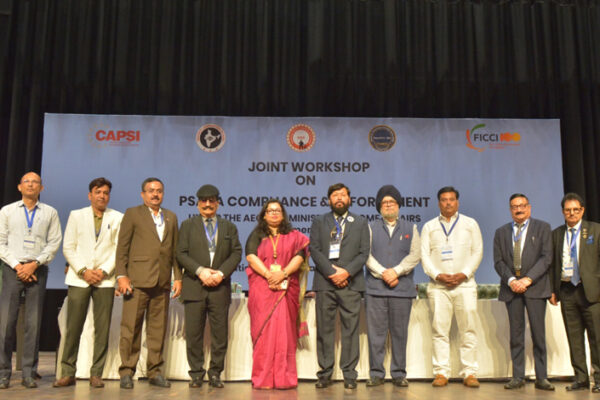
Kunwar Vikram SinghChairman, Central Association of Private Security Industry ( CAPSI ) How CAPSI’s Persistent Advocacy at MHA is Transforming the Sector A quiet revolution has begun On 2nd May 2026, the Ministry of Home Affairs (MHA) issued a notification that while understated in tone, carries profound significance for nearly 10 million private security professionals across India. With effect from 15th May 2026, two provisions of the Private Security Agencies (Regulation) Act, 2005 – Section 12 and Section 20(2) – stand omitted. In simple language – private security agencies and their personnel can no longer be criminally prosecuted for procedural lapses that were never truly criminal in nature. This is not a coincidence. It is the outcome of years of determined advocacy by the Central Association of Private Security Industry (CAPSI) – India’s apex body for the private security sector – and marks a turning point in the long journey to transform private security from a loosely organised trade into a respected, professionally governed industry. Understanding what has changed – And why it matters As for the security professional on the ground, legal language can be distant and irrelevant, let me explain here in the simple terms that what this amendment means. Until 14th May 2026, if a private security agency failed to display its licence at its office premises (as required under Section 12), it could be fined up to ₹25,000 – and face suspension or cancellation of its licence. The same penalty applied if an agency was found in violation of training norms (Section 9) or guard eligibility norms (Section 10). Earlier, these punishments were treated as criminal in nature. Let us think about for a moment: a guard deployment firm – struggling with delayed client payments, navigating 29 different state-level rules, managing thousands of guards across districts – could be hauled before a court and fined because a framed licence was not visibly hung on the wall – or because a guard’s training certificate was not updated on time. From 15th May 2026, this changes – the criminal sting has been removed from these procedural violations. The State Controlling Authority can still take regulatory action – suspend or cancel the licence – for genuine non-compliance. But the threat of criminal prosecution for technical lapses no longer hangs over agency owners and their staff. For the first time, the law recognises a crucial distinction – a regulatory failure is not the same as a criminal act. What still applies – and must be respected This is an important clarification for both industry professionals and the public. Decriminalization does not mean deregulation. The PSAR Act’s substantive obligations remain fully operative. Operating without a valid PSARA licence is still a criminal offence – punishable with up to one year of imprisonment and a fine. Training standards for guards and supervisors under Section 9 must still be met. Eligibility norms for guards – age, citizenship, character verification, physical fitness – under Section 10 remain mandatory. Unauthorised use of military or police uniforms is still a criminal offence – and the Controlling Authority retains full power to cancel or suspend licences for genuine non-compliance. The message is clear – the law trusts the industry more, but it still watches over it. Compliance is not optional – it is simply being enforced more intelligently. The force behind the change: CAPSI’s Role The amendment did not arrive on its own. It is the product of relentless, structured advocacy by CAPSI – an organisation that has been the conscience and voice of India’s private security sector for over two decades. CAPSI’s initiatives and relentless pursuit over the years played a decisive role in the Parliament enacting the PSAR Act itself in 2005, which was quickly followed by States adopting their PSARA Rules – taking the first step towards transforming the industry from an unorganised one to an organised sector. That foundational contribution was only the beginning. CAPSI has since been playing a leadership role in the formulation of global standards and best practices for the private security industry worldwide, and was invited by the United Nations Office on Drugs and Crime (UNODC) to participate in a planning meeting for civilian private security services at Abu Dhabi, where it was taken as a member of the Standing Committee to take that UN initiative further. Closer home, CAPSI has remained in constant touc h with MHA and State Controlling Authorities to modify Model Rules in order to ensure ease of business for private security agencies. More recently, CAPSI has been consistently raising the agenda of amendments to PSARA and its rules at the highest levels, including in direct meetings with senior MHA officials, where it was informed that a grand review of PSARA is being undertaken on the instructions of the Hon’ble Home Minister himself, with senior MHA officials assigned to complete the exercise within a stipulated timeframe. The decriminalization notification of 2nd May 2026 is a direct and tangible fruit of this sustained engagement. The March 2026 – A turning point The momentum behind this reform received further impetus from a landmark review meeting held at MHA on 13th March 2026. The meeting was held under the chairmanship of Joint Secretary (Police Modernization) R. Prasanna, IAS, with participation from CAPSI, FICCI and others stakeholders. The initiatives taken by MHA through issuance of advisories to State/ UT Controlling Authorities and inter-Division/ Ministry consultations to resolve various issues of private security associations were conveyed at the meeting. Stakeholders raised several critical operational challenges – delays in licence approvals and renewals with significant pendency across states; inconsistent implementation of PSARA provisions; non-uniform training requirements; challenges with GST – particularly the Reverse Charge Mechanism; repeated police verification processes; delayed payments to security agencies and guards; and operational inefficiencies including manual submission of guard data in some states. Acknowledging that licence pendency remains a major issue, the MHA emphasised alignment with the government’s broader vision of ‘Minimum Government, Maximum Governance.’ Key follow-up actions announced include – a joint meeting with…