Capt Garry Singh
President
IIRIS Consulting
Why Human Responsibility Must Rise as AI Transforms the World
New Age Imperatives for Upskilling & Readiness
Artificial Intelligence is no longer a future possibility – it is the world’s new operating system. Nations, companies, and individuals are rapidly integrating AI across decision-making, security, healthcare, finance, governance, and even warfare. What was once considered an emerging technology has now become a defining force shaping the future of economies, industries, and societies worldwide.
However, with this historic technological transformation comes an equally important responsibility. As Artificial Intelligence grows stronger and more influential, human intelligence must become more accountable, more skilled, and more prepared than ever before. AI can accelerate processes, optimise systems, and analyse data at unimaginable speed, but it still depends on human judgment, ethics, and responsibility for meaningful and safe outcomes.
Like every powerful tool in history, AI amplifies the intent and capability of those who wield it – whether governments, corporations, professionals, or cybercriminal organisations. This makes human oversight, strategic thinking, and ethical decision-making the most critical assets of the coming decade.
Present Stage
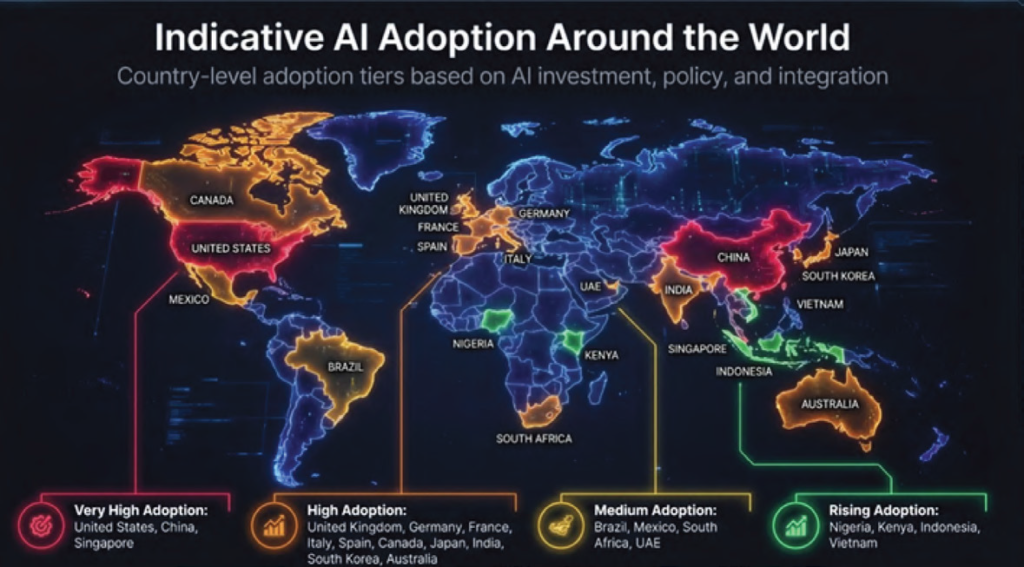
The world is already witnessing an unprecedented shift towards AI-driven ecosystems. According to global studies, nearly 58% of employees worldwide are already using AI regularly at work as of 2025, with adoption rates highest in countries such as India, China, Nigeria, and Brazil. This clearly indicates that AI is no longer limited to technology companies alone – it has become a mainstream workplace reality.
At the same time, experts estimate that nearly 80% of the global workforce will require reskilling or upskilling by 2026 in order to work effectively alongside AI systems. Traditional job roles are evolving rapidly, and new-age capabilities such as AI literacy, data understanding, cybersecurity awareness, and critical thinking are becoming essential across industries.
The economic implications are equally massive. The World Economic Forum estimates that Artificial Intelligence could contribute nearly $15 trillion to the global economy, but only those countries and organisations that invest heavily in human learning and workforce preparedness will truly benefit from this transformation.
The message is becoming increasingly clear – AI is not simply changing industries – it is redefining national competitiveness and future readiness.
Global Pivot Towards AI
The world is not just adopting AI; it is reorganising itself around it. Governments across the globe are embedding Artificial Intelligence into healthcare systems, defence strategies, public services, national security operations, and economic planning. Corporates are redesigning workflows, business models, operational systems, and workforce structures to maximise AI-driven efficiencies. Even small and medium businesses are using AI tools for sales forecasting, customer engagement, cyber protection, and financial management.
This global pivot towards AI is creating a new international reality where technological leadership is becoming a strategic advantage. Nations that master AI ecosystems will shape future economic and geopolitical influence, while those that fail to adapt risk being left behind.
The message is unmistakable: AI leadership is becoming national strategy.
Artificial Intelligence is no longer a future possibility – it is the world’s new operating system. Nations, companies, and individuals are rapidly integrating AI across decision-making, security, healthcare, finance, governance, and even warfare. What was once considered an emerging technology has now become a defining force shaping the future of economies, industries, and societies worldwide
The Skills Crisis
Even as AI capability rises exponentially, human capability is struggling to keep pace. This widening gap is emerging as one of the biggest challenges of the modern era.
Reports reveal that only 1 in 50 AI investments succeeds effectively, largely due to the lack of adequate human capability, training, and organisational preparedness. Many institutions are investing heavily in technology without equally investing in the people who must manage, govern, and work alongside these systems.
Furthermore, nearly 70% of employers now consider AI skills more important than traditional computer literacy. This marks a significant shift in workforce expectations, where adaptability and technological understanding are becoming essential employability criteria.
Interestingly, organisations that actively provide AI learning and development opportunities are witnessing approximately 34% higher employee retention, demonstrating that workforce empowerment and learning culture are becoming competitive advantages in themselves.
The skills crisis therefore is not only a technological issue – it is a leadership, education, and policy challenge.
Significance
Despite its immense capabilities, Artificial Intelligence still has fundamental limitations. AI can calculate, predict, analyse, automate, and optimise – but it cannot be morally accountable. It cannot independently understand ethics, empathy, responsibility, or the broader human consequences of decisions.
This is precisely why human intelligence becomes even more significant in the age of AI.
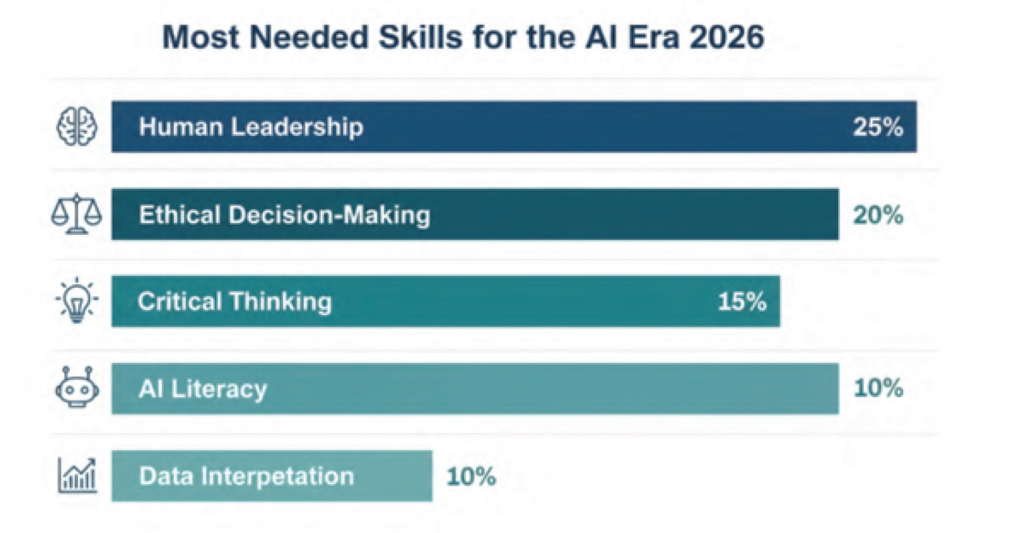
Humans must continue to lead in areas that require setting strategic direction, exercising judgment. managing ambiguity, owning consequences, ethical decision-making, and human-centric governance.
Without strong human capability and oversight, AI systems can unintentionally accelerate errors, bias, fraud, cyber manipulation, misinformation, and systemic risks at massive scale. In critical sectors such as healthcare, defence, policing, and finance, irresponsible or unchecked AI deployment can have serious societal and national consequences.
The challenge therefore is not whether AI will replace humans, but whether humans will prepare themselves adequately to lead AI responsibly.
Where is the Solution?
The solution lies in building stronger human intelligence alongside stronger artificial intelligence.
Mass upskilling & reskilling
AI literacy, data literacy, cybersecurity basics, analytical capability, and critical thinking must become mainstream skills across sectors and professions. Continuous learning can no longer remain optional in the AI era.
Policy modernisation
Governments must establish national AI standards, responsible-use regulations, workforce readiness mandates, and ethical governance frameworks to ensure balanced and secure AI growth.
Industry responsibility
Corporates must treat AI training and workforce development as essential infrastructure investment rather than optional learning expenditure. Organisations that empower employees with AI readiness will remain future competitive.
Human-centric AI governance
Humans must continue to remain in control of critical decisions, particularly in sectors such as healthcare, finance, policing, defence, and public safety. AI should augment human intelligence—not replace human accountability.
Conclusion
Human intelligence must not shrink in the age of Artificial Intelligence. Instead, it must rise—stronger, sharper, more ethical, and more accountable.
The future will not belong merely to the most advanced AI systems. It will belong to those humans, organisations, and nations that understand how to think with AI, govern it responsibly, and use it wisely for collective progress.
Artificial Intelligence may define the tools of the future, but human intelligence will continue to define the direction of civilisation itself.