
Sunjoy Nath
CSM Counter-Terrorism and Intelligence Anyalist
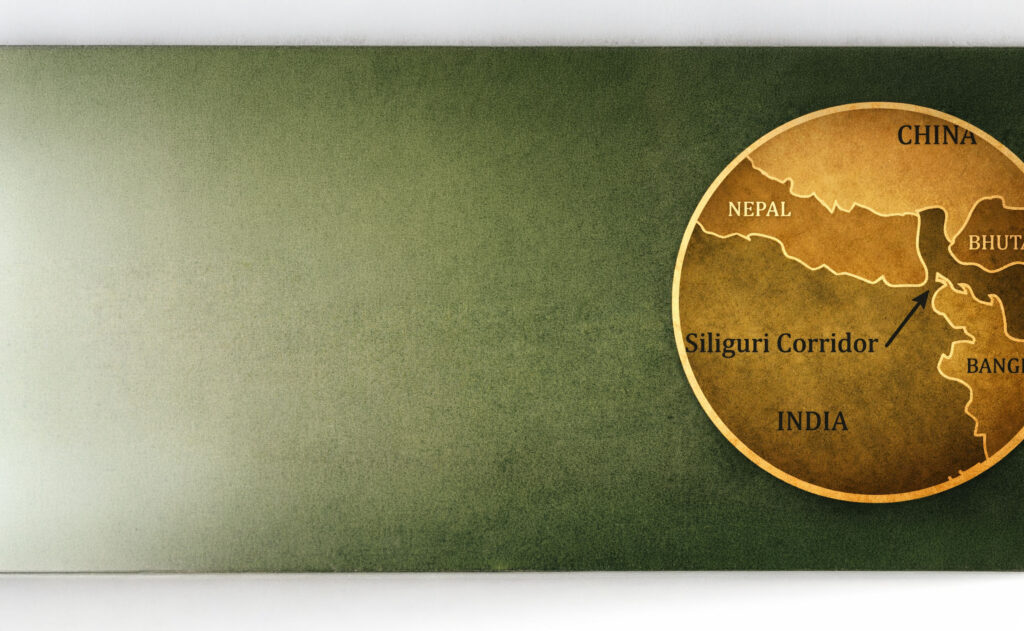
The Siliguri Corridor (commonly called the ‘Chicken’s Neck’) is indeed one of India’s most critical strategic vulnerabilities. This narrow strip of land, roughly 20-40km wide at points, serves as the primary overland lifeline connecting mainland India to the eight Northeastern states (the ‘Seven Sisters’ plus Sikkim), as well as providing key access routes toward Nepal and Bhutan. National Highway – 12 (NH-12) forms a vital artery along this corridor, carrying civilian logistics, essential supplies, and military movement. Any sustained disruption here could isolate millions, hamper troop deployments, and create severe economic and security risks – especially given the region’s proximity to international borders with China, Bangladesh, Nepal, and Bhutan.
Recent incidents on NH-12
Recent reports indicate that mobs in Malda district, West Bengal – described in various accounts as involving radical Islamists and suspected illegal Bangladeshi immigrants – blocked NH-12 for up to 18 hours in areas like Sujapur and Mothabari. Protesters allegedly used bamboo poles, burning tires, and stone-pelting, halting traffic including Indian Army convoys heading toward the Northeast and border areas. This was reportedly triggered by local grievances (such as incidents involving migrant workers elsewhere), but the location in a sensitive border district with a history of demographic shifts, smuggling, and cross-border issues amplified concerns. Central forces and state police eventually intervened, but the episode highlighted law-and-order gaps on a nationally vital route.
Similar protests and blockades have occurred in nearby Murshidabad district (e.g., in Beldanga), often over local issues like migrant worker deaths, leading to temporary halts in road and rail traffic. These are not unprecedented in West Bengal, where highway disruptions have been used as protest tactics.
Broader context and long-standing concerns
This is not an isolated or entirely new threat. Analysts and officials have warned for years about the risks of demographic changes in North Bengal and the corridor region due to large-scale illegal immigration from Bangladesh. Radical Islamist voices (e.g., statements during past agitations like anti-CAA protests by figures such as Sharjeel Imam) have explicitly discussed ‘choking’ the corridor to isolate the Northeast. Radical Islamist networks linked to groups in Bangladesh have been flagged in intelligence reports for potential interest in disrupting this chokepoint.
Assam Chief Minister Himanta Biswa Sarma and others have publicly highlighted how unchecked infiltration could lead to areas where loyalty in a crisis might not align with India, especially if Hindu populations drop below critical thresholds in key pockets. Malda and Murshidabad have long been noted for porous borders, smuggling (including fake currency), and demographic shifts that complicate security. Broader geopolitical angles include China’s interest in the area (via Doklam and infrastructure), post-2024 shifts in Bangladesh politics, and occasional rhetoric from across the border about the corridor’s vulnerability.
India has responded with measures like:
- Deportation drives targeting illegal immigrants.
- Calls for NRC-like processes in border states.
- Military infrastructure upgrades (new bases, emergency landing facilities, troop reinforcements).
- Highway and rail enhancements for redundancy.
However, enforcement remains uneven, particularly in West Bengal, where state-central tensions often play out.
Realistic assessment
A full, coordinated ‘plan’ by radical Islamists and illegal immigrants to permanently sever NH-12 and cut off the Northeast would face massive practical hurdles – India’s security apparatus (Army, paramilitary, intelligence), alternative air/ rail options (though limited in scale), and the political fallout. Short-term disruptions, however – like the recent Malda blockade – are feasible and dangerous as proof-of-concept or pressure tactics, especially amid local politics or communal tensions. They erode deterrence and signal weakness.
The core issue is structural – porous borders + demographic engineering + radical ideology + weak local governance = heightened risk in a hyper-sensitive geography. Sustained illegal immigration has altered voting patterns, land control, and social dynamics in parts of the corridor, making internal sabotage more plausible than pure external invasion.
Sunjoy Nath, CSM Counter-Terrorism and Intelligence Anyalist, has over 28 years of experience in Physical Security, Open-Source Intelligence (OSINT), Social Media Intelligence, and fraud investigations. He is a military veteran and a member of the INTERPOL Metaverse Expert Group.
He is also a member of APDI and ASIS, and serves as the State Councillor (West Bengal) for ICISSM. Mr. Nath is qualified in Counter Insurgency and Counter Terrorism from Rashtriya Raksha University.
Additionally, he is an Sectional Committee member of BIS in the subject of Banking and Finance and Mentor of Niti Aayog. He is the Founder of EDCI, Kolkata. (www.edci.co.in).
What should happen
- Immediate: Swift, impartial action against those responsible for the recent blockade – prosecutions, not political shielding. Enhanced patrolling and quick-response forces on NH-12 and parallel routes.
- Medium-term: Accelerated identification and deportation of illegal immigrants (with due process to avoid targeting genuine citizens). Stronger border fencing, surveillance, and intelligence penetration in vulnerable districts.
- Long-term: Strategic hardening of the corridor – more all-weather roads, tunnels, rail redundancy, military bases, and possibly administrative changes (e.g., greater central oversight in critical pockets). Political will to prioritize national security over vote-bank politics is essential; half-measures have already allowed the situation to fester for decades.
India cannot afford complacency here. The Northeast’s integration depends on reliable connectivity; its defense depends on preventing the Chicken’s Neck from becoming a noose. Public pressure, transparent reporting, and accountability for failures in law enforcement matter more than alarmism. If specific new intelligence or developments emerge beyond these reports, they should be scrutinized rigorously by authorities rather than amplified unchecked.