The year gone by was marked with geopolitical changes and turbulence of a high order. The events in Syria, Lebanon, Ukraine and closer home in Bangladesh, Myanmar and surrounding geographies will cast a telling shadow on the events of 2025. A multitude of elections across the globe and in India, have thrown up diverse results which challenge the old order. While the Narendra Modi-led Bharatiya Janata Party (BJP) emerged from the 2024 General Elections weakened, Donald Trump in the United States of America (USA) came out much stronger and with an agenda which threatens to challenge and reshape the world order. The year ahead is likely to be challenging for India both domestically and in the geostrategic domain. Conversely it would also be a year of multidimensional opportunities which will not only demand deft handling but may also result in new alignments and need for course correction.
Economic paradigms may need a fresh approach should President-elect Trump go ahead with his policies of punitive/ reciprocal tariffs and mass deportation of illegal migrants. On the geostrategic front, a more muscular QUAD is at odds with an expanding BRICS and the two may be on a collision trajectory.
With the QUAD leaders’ summit planned in 2025 in India, strong anti-China posturing may strain India’s prominence both in SCO and BRICS. The geopolitical tightrope that India has to walk can be gauged by the likely visit of Vladimir Putin to India in first quarter of 2025, followed by PM Modi traveling to China for the SCO summit and hosting the QUAD leaders in October 2025. One misstep or a belligerent statement can derail or alter the outcome of these significant events. In a similar vein India’s image abroad was dented by accusations of targeted killings/attempted murder by alleged government agencies, coupled with bribery allegations against the biggest business house of India.
On the domestic front, peaceful elections in J&K and a smooth transition to power of an opposition led government bodes well for the overall security dynamics of the sensitive region and its continued progress in 2025 would be a big boost to stability. The vigorous efforts taken by the BJP-led government to root out Left-Wing Extremism (LWE) would continue in 2025 and may result in weakening this antinational movement significantly.
The overthrow of the Sheikh Hasina government has been a big setback as India had backed her government fully. The relations currently are rather fragile with a widening trust deficit on the back of reports of attacks on minorities, and their places of worship. The recent visit of the Foreign Secretary of India has smoothened some issues but more needs to be done in 2025 to bring the relations back to a semblance of normalcy. However, tense relations between the two neighbours in 2025 are likely to continue. On the more complex Indo-China front the disengagement and pull back by both armies from Ladakh has been a very positive development. The recent visit of the National Security Advisor (NSA) to China has given further momentum to an improvement in ties. No dramatic development or normalisation of relations are likely in 2025 and few baby steps to rebuild trust can at best be expected.
On the internal front, the BJP-led government is weaker, and despite all odds the opposition INDI alliance has posed significant challenges to the government. This has led to further polarization and widening of communal fault lines. If this remains unchecked, it may lead to social unrest in some historically sensitive areas. The farmers protest continues and will not give much room to the government in 2025 to address the much-needed agricultural reforms.
Despite all this 2025 will be a pivotal year for India as it will become the fourth largest economy growing at a rate of 6.5-7 percent in the coming years. Artificial Intelligence (AI) and quantum-based technologies and semi conductor manufacturing will play a big part in the economic resurgence of India, the problems of wealth distribution, population, climate risks and inflation will continue to pose challenges. Overall, a year of stability, steady growth, some geopolitical risks mixed with opportunities is forecast for 2025.
Executive Summary
The year 2024 was characterized by elections in more than 70 countries and persistence of several geopolitical conflicts. With the series of elections that too k place, the discussion on the spirit and quality of democracy took center stage as leaderships in these countries either used elections to tighten grip on power, gain legitimacy or display illiberal tendencies. The Russia-Ukraine and Israel-Palestine conflicts continued to worsen and have spillover effects in other states, impeding any global efforts towards restoring peace. The Global economy is riddled with stagnant major economies and growing global debt which is already at a record level due to the COVID-19 pandemic. Several governments are offering increased spending and tax cuts as a part of political campaigns, which will only add on to the global debt. There are alarming trends of increasing cost of living, increasing defense expenditure, backsliding on international commitments, and increasing vulnerability to climate variability.
Against the backdrop of global disorder, multiplying geopolitical complications and internal challenges, India successfully conducted its general elections. India took strategic measures to protect its integrity, propel its regional influence and maintain a considerable global presence while facing new risks and threats.
On the geopolitical front, the diplomatic friction between India and Canada has heightened after the Canadian government accused the Indian High Commissioner and five other diplomats of being ‘persons of interest’ in the murder case of Hardeep Singh Nijjar, a Canadian citizen allegedly involved in Khalistani activities. India responded by recalling its diplomats and by expelling the Canadian High Commission in India, citing its interference in internal affairs as the reason. There are speculations that this diplomatic fallout between the two nations could have spillover effects in other domains, particularly in trade.
In late October, India and China established a temporary truce regarding the ongoing conflict along the Line of Actual Control (LAC), with a border disengagement agreement. There will be pulling back of troops, dismantling of temporary infrastructure and resumption of pre-2020 patrols in contested areas of Ladakh (Depsang and Demchok). This is an establishment of a new normal between the two nations to facilitate better trade relations.
Relations with Pakistan remained distant, but with the Modi government failing to gain absolute majority and the Pakistani military’s waning public support, there is a possibility of renewal of bilateral ties. India continues to maintain a strong position in the Asia-Pacific region through cooperation and strategic measures. Along with other members of the QUAD, India released a joint statement expressing its commitment to keep out destabilizing forces in the region. In the coming year, however, escalations inthe South China Sea and the rhetoric amidst the QUAD may escalate with the election of Donald Trump as US President.
The results of the 2024 General Elections illustrated a change in the political landscape of India. For the first time since 2014, the Bharatiya Janata Party (BJP) lost its outright majority forcing Prime Minister Modi to form a coalition government to secure the required seats. The BJP also lost in key states such as Uttar Pradesh, Maharashtra and Manipur, and failed to make significant gains in Tamil Nadu.
There are deliberations that the BJP’s prominent coalition allies – the Telugu Desam Party (TDP) from Andhra Pradesh and Janata Dal (United) [JD(U)] from Bihar – may result in redefined political procedures in Parliament, especially concerning contentious laws and their implementation.
The BJP also faces a stronger opposition this time as the Indian National Congress (INC) led Indian National Developmental Inclusive Alliance (INDIA) won 232 seats, with the number of seats won by the INC doubling since 2019.
The Khalistan movement has gained more momentum in Canada and has proven to be a destabilizing influence in bilateral ties. In November, there were clashes between pro-Khalistan elements and a consular camp in a Hindu Sabha Temple in Brampton. This forced the cancellation of consular camps by India and led to a series of protests in Canada and outside the Canadian consulate in India demanding a resolution.
A concerning trend in the insurgency in Kashmir was the shifting of militant activity from Kashmir Valley to the relatively less-affected Jammu area. The targeting of migrant labourers, as well as the attacks perpetrated on security forces prompted major security considerations. It will be interesting to witness extremism trends in the Union Territory following the elections held in October.
The insurgency in the North-East is proving to be a challenge to the security agencies due to the multitude of groups involved and the frequency of violence, especially in the state of Manipur. The sophistication of weaponry and hardware seized from terrorists and rebels in Manipur points towards a concerning trend in North-East India of cross border support from Myanmar.
“The year gone by was marked with geopolitical changes and turbulence of a high order. The events in Syria, Lebanon, Ukraine and closer home in Bangladesh, Myanmar and surrounding geographies will cast a telling shadow on the events of 2025. A multitude of elections across the globe and in India, have thrown up diverse results which challenge the old order. While the Narendra Modi-led Bharatiya Janata Party (BJP) emerged from the 2024 General Elections weakened, Donald Trump in the United States of America (USA) came out much stronger and with an agenda which threatens to challenge and reshape the world order. The year ahead is likely to be challenging for India both domestically and in the geostrategic domain. Conversely it would also be a year of multidimensional opportunities which will not only demand deft handling but may also result in new alignments and need for course correction”
The Union Home Minister Amit Shah had declared that India would be free from Left Wing Extremism (LWE) by March 2026. Challenges such as terror financing and the new threat of cryptocurrencies have to be addressed and resolved through a coordinated approach of the police department. There has been an increase of hoax bomb threats made to the airports – from 122 calls in 2023 to 994 in 2024. The areas most affected by these calls are Delhi, Maharashtra and Karnataka. While investigations into these continue, it would be imprudent to associate it directly with extremism or significant criminal network trends, and airports have developed measures to implement appropriate security protocols whilst minimizing operational and travel delays.
Law enforcement agencies had to contend with threats made in the urban cities of Delhi, Bengaluru, Chennai, Mumbai and others. Bengaluru and Delhi witnessed bomb attacks resulting in a few injuries, while other cities received numerous threats to banks, schools, and other important institutions. Mumbai witnessed the assassination of prominent politician Baba Siddique in a well populated suburb by assailants belonging to the Lawrence Bishnoi gang, prompting apprehensions over the security apparatus of the city.
There have been instances of civil unrest in the form of ethnic conflicts, religious violence and river water disputes spread throughout the year. In the month of November, the Meitei-Kuki conflict escalated once again leading to an increased deployment of security forces and the enforcement of the The Armed Forces Special Power Act (AFSPA) in specific areas of Manipur. Protests outside legislators’ houses, increased recruitment to insurgent groups and financing through organized crime are a few indicators of the increasing unrest and disorder within the region.
Protestors and the police clashed in the Sambhal city of Uttar Pradesh amidst a dispute over the site of a mosque, resulting in several deaths and injuries. Communal clashes were also witnessed in Himachal Pradesh over a similar issue, forcing shutdowns and prohibitory orders. Similar clashes were also reported in Odisha’s Bhadrak, where internet was snapped, and movement was curtailed.
“On the geopolitical front, the diplomatic friction between India and Canada has heightened after the Canadian government accused the Indian High Commissioner and five other diplomats of being ‘persons of interest’ in the murder case of Hardeep Singh Nijjar, a Canadian citizen allegedly involved in Khalistani activities. India responded by recalling its diplomats and by expelling the Canadian High Commission in India, citing its interference in internal affairs as the reason. There are speculations that this diplomatic fallout between the two nations could have spillover effects in other domains, particularly in trade”
Bengaluru and most of Karnataka faced a severe water crisis at the beginning of 2024 which soon escalated into an interstate water dispute between Karnataka and Tamil Nadu. There were shutdowns and strikes held in Bengaluru and some other parts of Karnataka protesting the release of Cauvery river water to Tamil Nadu.
India has become vulnerable to extreme weather events (EWE) caused by climate change and global warming. There were flash floods in the states of Punjab, Haryana, Telangana, Andhra Pradesh and Tamil Nadu that resulted in destruction of crops and villages. Landslides in Uttar Pradesh, Kerala (Wayanad) and Himachal Pradesh led to closure of several roads and national highways. States such as Odisha, West Bengal and Tamil Nadu faced severe flooding, infrastructure damages, power outages and disruptions to daily lives after being hit by cyclones.
Delhi and Chennai experienced severe flooding due to heavy rainfall which caused waterlogging, disrupted traffic, damaged infrastructure and caused a few deaths. Cities such as Bengaluru and Lucknow experienced floods too, bringing focus on the need for major cities to implement better stormwater management, sewage systems and sustainable urban planning. In 2024, India experienced the longest heatwave and recorded the highest temperature of 52.3 degree celsius in Delhi. There were numerous reports of heat strokes and deaths which emphasize the urgent need for improved heatwave preparedness and response measures to prevent future tragedies. The year 2025 is predicted to be a slightly cooler year than 2024 due to a La Nina development.
India’s economy grew 8.2 percent in fiscal year (FY 2023-24), continuing to be the fastest growing major economy in the world. Due to global uncertainties and domestic challenges, the growth rate is estimated to be 6.5-7 percent for the ongoing year, boosted by a recovery in the agricultural sector, private consumption, and rural demand. External threats such as uncertainties in advanced and emerging economies, crises in the Middle East and West Asia, ongoing supply chain disruptions and potential protectionist policies may affect exports in 2025. In the April-June quarter, there was reduced government spending during the general elections which negatively affected infrastructure and capital expenditure.
For infrastructure development, an amount equaling 3.4 percent of the GDP has been allotted this year. The combined Index of Eight Core Industries (ICI) increased by 2.0 percent (provisional) in September when compared to the index from September 2023. To foster growth at a desired rate, the government is supporting innovative financing mechanisms such as Public Private Partnerships (PPPs), viability gap funding and market-based financing framework to encourage private sector participation.
Lastly, on the technological front, India’s improved ranking in the Network Readiness Index (NRI) and tier 1 status on the Global Cybersecurity index indicate substantial growth, commitment, and innovation.
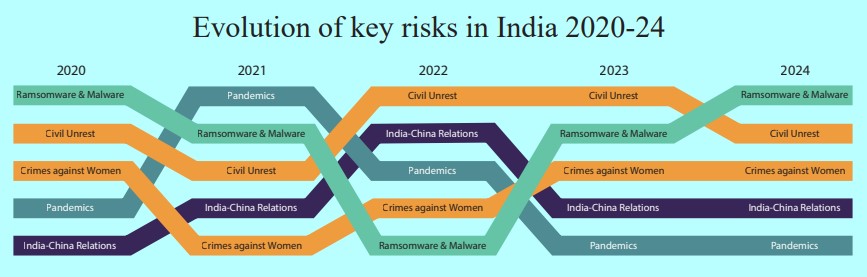
Evolution of key risks in India 2020-24
As a part of Government’s ‘Viksit Bharat’ i.e. Developed India 2047 vision, the future digital infrastructure will not only progress but transform in the domains of broadband connectivity, high-speed data services, cloud computing, cybersecurity, artificial intelligence (AI), machine learning, and Internet of Things (IoT). The Digital Public Infrastructure (DPI) applications in sectors like agriculture, logistics, MSME, education, health and urban governance is expected to have a multiplier effect on the overall economy.
With advancement in digital infrastructure, India has become a target for cyber-attacks that may rise to one trillion per annum in 2033. Trojan threats, Artificial Intelligence (AI) driven phishing campaigns and fake videos or audios using deepfake technology will particularly target and disrupt the health, finance and energy sectors. Currently as a part of QUAD and Cyber Surakshit Bharat i.e. Cyber Safe India program, the government is focusing on cybersecurity education and youth talent development in this field.
“A concerning trend in the insurgency in Kashmir was the shifting of militant activity from Kashmir Valley to the relatively less-affected Jammu area. The targeting of migrant labourers, as well as the attacks perpetrated on security forces prompted major security considerations. It will be interesting to witness extremism trends in the Union Territory following the elections held in October”
Conclusion
Given the staggering number and variety of risks, businesses have to formulate and execute policies to ensure resilience, preparedness, and sustainability. Businesses also have to promote the well-being of employees, sustain remote working options, and ease employees’ return to prepandemic working environment when necessary. In this age of globalization, prevention of political, economic and environmental shocks is unrealistic which means businesses need to be vigilant and pragmatic with their operations and visions.
India being the world’s fastest growing major economy, faces myriad opportunities and risks that can boost its position on the global order, if handled well. Businesses in India have to design goals to aid the economic growth and to also coast any future shocks. With the election of second Trump government, a degree of unpredictability coats the globe which means that businesses have to prioritize innovation and resilience to survive and flourish.