
By Anand Bhat, Chairman & Managing Director, BNB Security & Automation Solutions
Why the conversation is shifting
Until recently the goal of most safety or security projects was clear-cut – install the right sensors & equipment, route alarms to a control room, keep false positives manageable and respond within a written SLA. That formula is no longer enough.
Three forces are reshaping expectations:
1. Data saturation Modern campuses already host thousands of points – surveillance cameras, access control systems & readers, fire smoke & heat detectors, intrusion & occupancy sensors, range of ambient & energy measurement sensors – yet nearly 70 percent of that data is never correlated.
2. Business continuity pressures Downtime is now measured in reputation minutes as much as in rupees. Stakeholders want documented proof that small incidents are isolated before they interrupt service.
3. Regulatory tightening India’s Digital Personal Data Protection Act, the revised National Building Code, Public Safety Act and emerging ESG disclosure norms all require real-time evidence, not retrospective logbooks.

Sensor orchestration – turning every sense point into a single, contextual feed for the operations centre – moves from ‘nice to have’ to ‘table stakes.’
A simple definition
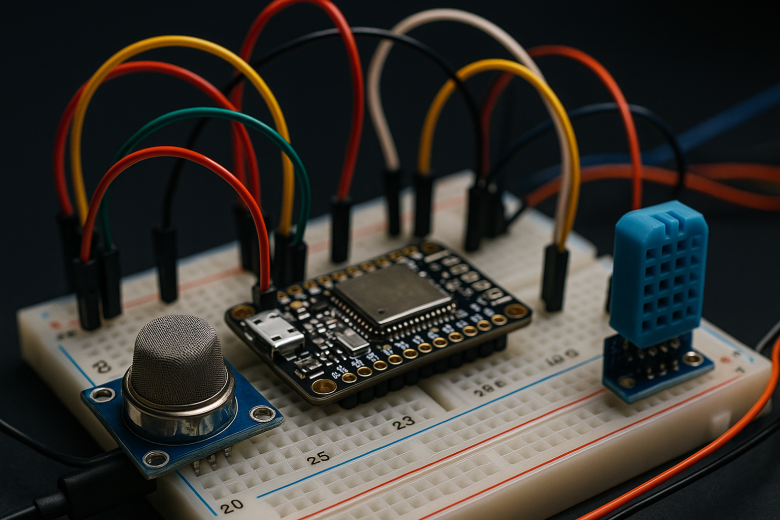
Sensor orchestration is the practice of:
● Collecting data from every relevant safety, security or environment- related sensor, regardless of brand. ● Normalising it into a common, time-aligned stream.
● Fusing multiple streams into a higher-level event (e.g., ‘over-temperature + carbon-monoxide rise + camera flame pattern = verified fire’).
● Responding according to a playbook that blends automation (doors release, HVAC dampers close) with human escalation.
● Auditing the entire chain in a way that regulators and insurers can examine the audit trail.
A typical 3-6-9-year outlook (next decade)
| Timeframe | What will change | Implications for professionals |
| Next 0-3 years – Integration phase | •Most large projects will specify open protocols (MQTT, ONVIF, BACnet/ IP) as mandatory. •Sensor fusion will tackle the everyday irritants first – false fire alarms, redundant guard patrols, energy waste. | •Engineers must learn basic data normalisation and security segmentation. •Engineering design spec teams must/ will write ‘deliver raw API data’ into ‘actionable intelligence’ and ‘performance contracts.’ |
| Next 0-3 years – Integration phase | •AI models trained on multi-sensor data sets become common in GSOCs. • Routine incidents (80% today) trigger full closed-loop responses without operator intervention. • Insurers start discounting premiums when buildings prove sub-10-second incident containment. | •Security & Facility managers’ upskill in AI ‘explainability’ – being able to justify how a model chose an action. •Legal and data-privacy officers are increasingly involved in sensor placement and data retention policies. |
| Next 6-9 years – Predict-and prevent phase | •Digital twins combine BIM, real-time sensors and historical fault data. •Regulations shift from ‘respond within x seconds’ to ‘show that you can predict and avoid.’ •Smart-city feeds (weather, crowd density, air quality) mesh with building sensors. | •Risk managers prioritise scenario modelling over traditional checklist audits. •Vendors differentiate through ‘micro-services’ (e.g., lithium-battery thermal-runaway predictor) that plug into a common orchestration platform. |
Key capability gaps to close now
1. Open data skills
Most teams still rely on proprietary GUIs now. They need fundamentals in:
● Time-series basics – sampling, latency, synchronisation.
● Lightweight messaging – MQTT topics, REST calls, simple JSON parsing.
An operator does not need to code AI models, but must understand how ‘sensor A’ synchronises with ‘sensor B’ and what happens if one timestamp drifts.
2. Cyber-physical discipline
Multiple small breaches in the last 24 months began with an unsecured surveillance camera and ended in an HVAC shutdown. OT segregation, encrypted NFC-enabled devices, certificate management and patch cadence must become part of the FM playbook, not an afterthought delegated to IT. Those low-code design inclusion competencies must now be at the edge.
3. Playbook design
Automated response is only as good as the playbook behind it. Each event class requires:
● Threshold (when to trigger).
● Dependencies (which other sensors confirm or cancel).
● First automated act.
● Operator escalation path.
● Audit closure.
Writing clear, testable playbooks is a new professional skill set somewhere between process engineering and emergency planning.

Until recently the goal of most safety or security projects was clear-cut – install the right sensors & equipment, route alarms to a control room, keep false positives manageable and respond within a written SLA. That formula is no longer enough
4. Continuous audit culture
The future regulator will ask for a digital traceability, audit trail & explainability, not a binder. Life-safety drills, valve closings, data-retention decisions – all must leave an immutable log. Building teams should practice incident retrospectives the way airlines analyse near misses.
Product and solution directions
BNB and its OEM partners will plan to collaborate on four solution stacks aligned to the roadmap above.
1. Multi-sensor edge gateways – Devices that accept legacy 4-20 mA loops, modern IP streams and encrypted wireless payloads in one enclosure, forwarding normalised MQTT to the GSOC.
2. AI-ready data lake – A dedicated cloud or on-prem storage that keeps raw and derived sensor data for at least five years for customers, ready for carbon reporting, forensic analysis or model retraining.
3. Low-code playbook engine – Drag-and-drop logic so security supervisors, not programmers, can update responses when floor layouts or customer needs change.
4. Assurance dashboards – Simple widgets: average response time this week; top three sensor faults; compliance score against energy, water, wellness targets.
Modern campuses already host thousands of points – surveillance cameras, access control systems & readers, fire smoke & heat detectors, intrusion & occupancy sensors, range of ambient & energy measurement sensors – yet nearly 70 percent of that data is never correlated
Preparing the workforce
1. Short, targeted training – Certified 20-hour or similar micro-courses on basic sensor networking, AI alarm correlation and OT cyber hygiene.
2. Cross-functional drills – Quarterly exercises where security, MEP, IT and data-privacy teams walk through one orchestrated event.
3. Graduate outreach – Partnering with universities to include sensor-network basics in mechanical and electrical engineering electives.

How the industry should cooperate
1. Shared taxonomies & ontologies – Agree on naming conventions for devices and events. If every project invents its own tag for ‘Fire.Smoke.Detected,’ AI portability suffers.
2. Joint certification path – Sensor vendors, integrators and commissioning agents should develop a simple ‘Orchestration-Ready’ label similar to ‘Wi-Fi Certified’ – an example.
3. Transparent incident sharing – Non-competitive data on response times and lessons learned helps raise the baseline for everyone.
Practical first steps
1. Run a one-day sensor map workshop – Identify where data already exists and where gaps remain.
2. Select one pain-point – e.g., nuisance fire alarms in the food court. Combine heat sensor, camera and VOC reader. Automate a limited response.
3. Measure the outcome – How many false alarms avoided, how much guard time saved.
4. Iterate and expand – Once ROI is shown, extend fusion to leaks, power anomalies or perimeter breaches.
Preparing for the Future
Sensor orchestration is not a silver bullet, yet it quickly becomes the silent backbone of credible safety and security operations. Over the next decade, buildings that treat sensors as isolated gadgets will increasingly struggle with costs, downtime and compliance. Those that treat sensors as shared data stakeholders that are able to collaborate in real time – will find their GSOCs calmer, quicker and measurably more effective.
Preparing for that world means small but deliberate changes in skills, processes and procurement language right now. The technology is ready; the difference will lie in how well professionals move from owning sensors to orchestrating them.