

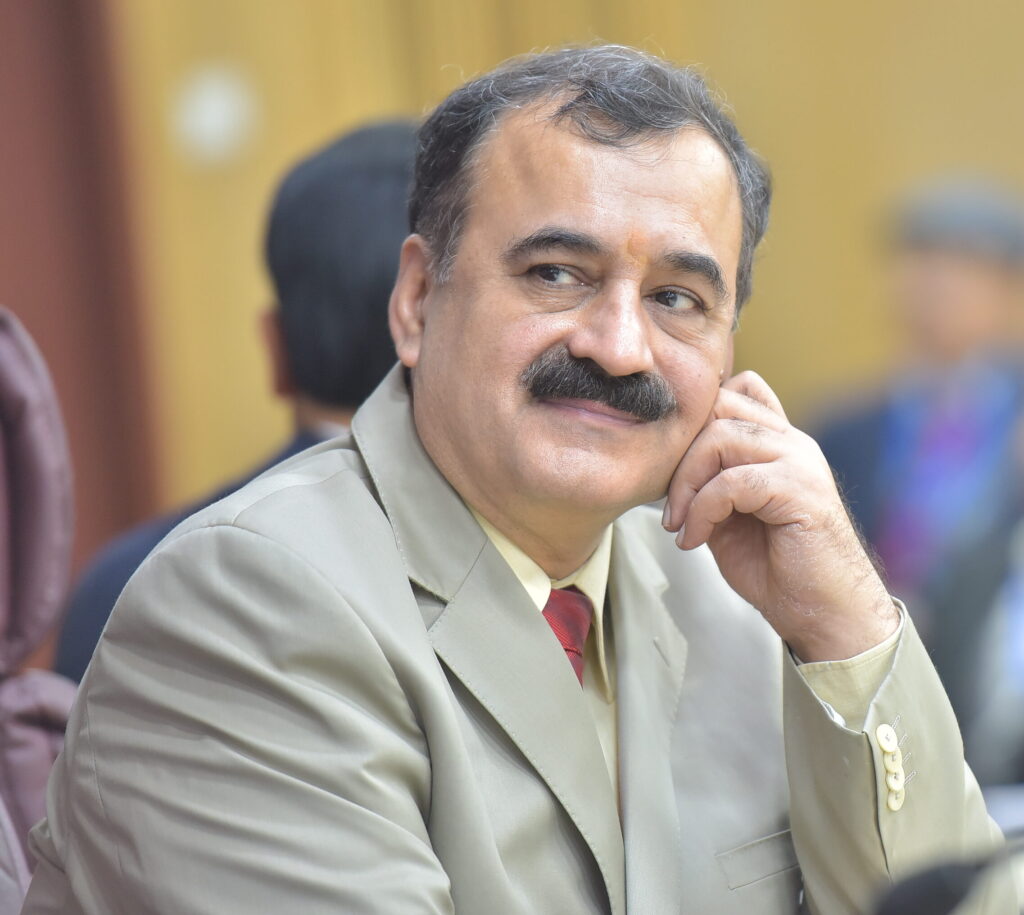
Dr. Pavan Duggal
Senior Advocate, Supreme Court of India;
Founding Forum Director & Global Chair, International AI Accountability Forum
India has chosen its path on artificial intelligence governance, and there is no denying the fact that the choice is deliberate. We have not rushed into a standalone AI statute on the European model. Instead, India is governing AI through existing legislation, sectoral regulators and technical safeguards, an approach the Government describes as techno-legal. I have been advocating for many years that this approach has real merit. But the fact remains that any governance model without an accountability core is, at best, incomplete.
Consider what has been achieved. MeitY’s India AI Governance Guidelines, published in November 2025, set out a pro-innovation framework built on seven ethical principles and six governance pillars. Then, on 10 February 2026, MeitY notified amendments to the IT Rules, 2021, taking effect on 20 February, which bring AI-generated text, images, audio and video within the due diligence obligations of intermediaries. AI-generated or modified content must now be labelled or carry provenance metadata. Sectoral regulators have also moved.
The Reserve Bank of India (RBI) released the FREE-AI Committee Report – the Framework for Responsible and Ethical Enablement of Artificial Intelligence in the Financial Sector – in August 2025. Separately, the Securities and Exchange Board of India (SEBI) issued a consultation paper on proposed Guidelines for Responsible Usage of AI/ ML in Indian Securities Markets.
These are significant steps. But look carefully at what they actually regulate. They are rules about content, not conduct. They govern AI that speaks, not AI that acts. They ask whether a video was synthetic, whether it carried a label, whether it was removed in time. They do not answer the question that every victim of an AI system will ultimately ask – who pays when an AI system denies my loan, empties my account or misdirects my medical treatment?
Transparency, labelling and audit – all ultimately depend on there being someone who answers when things go wrong.
The consequences of this gap are already visible. India has not yet seen a significant volume of AI-specific enforcement actions, particularly in relation to agentic AI systems. We must not mistake the absence of cases for the absence of harm. What is absent is a pathway. Today a victim must stitch together a claim from the law of torts, the Indian Contract Act, 1872, the Consumer Protection Act, 2019 and the Digital Personal Data Protection Act, 2023. Every one of these legal instruments was designed around human actors whose intention can be inferred and whose fault can be proved.
This is the problem of the actor that cannot answer. An AI system can act, and increasingly acts on its own plan, but it cannot be summoned, cross-examined or made to pay. The law has confronted this problem before. Roman law allowed claims against a master for dealings conducted through a slave’s peculium. Admiralty law proceeded in rem against the ship itself. English law treated the instrument of a fatal accident as forfeit until the deodand was abolished in 1846 and replaced by statutory compensation. In none of these cases did the law wait to decide whether the actor was a person. It fixed responsibility on those who controlled the actor and profited from it. The same logic must now apply to AI, entirely independent of debates about machine consciousness or legal personhood.
“Consider what has been achieved. MeitY’s India AI Governance Guidelines, published in November 2025, set out a pro-innovation framework built on seven ethical principles and six governance pillars. Then, on 10 February 2026, MeitY notified amendments to the IT Rules, 2021, taking effect on 20 February, which bring AI-generated text, images, audio and video within the due diligence obligations of intermediaries. AI-generated or modified content must now be labelled or carry provenance metadata. Sectoral regulators have also moved“
I therefore propose four principles for India’s consideration.
Closest control: The party with the closest control over an AI system at the point of harm must answer the victim’s claim. Contribution among developers, deployers and operators should then be calibrated by role, control, foreseeability and commercial benefit.
Strict, non-delegable responsibility: Deployers of high-impact AI should carry strict, non-delegable responsibility rather than vicarious liability borrowed from employment law.
A narrow backstop: Joint and several liability should be available only where the primarily liable party is insolvent or otherwise unable to satisfy an adjudicated claim; it should not become a mechanism for targeting the party with the greatest financial resources.
The whole lifecycle: Accountability must run across the entire life of a system, including its withdrawal, with duties of notice, portability and continuity when AI services on which people depend are discontinued.
However, national action alone will not suffice. The European Commission withdrew its proposed AI Liability Directive in 2025, leaving the world’s most elaborate AI regulatory regime without a dedicated liability layer. At the same time, AI systems are built in one country, trained on data from dozens, deployed from servers in yet another, and cause harm wherever their users happen to be. No national legislature can close that gap by itself.
This is why India must not remain a passive recipient of frameworks written elsewhere. India is the world’s largest democracy and its most populous nation, and what it does on AI accountability will set a benchmark for the Global South. India is ideally placed to champion an International Convention on Agentic AI, AGI and Superintelligence. It would be deliberately confined to those three, because that is where autonomous, transboundary and potentially uncontrollable risk resides. The groundwork is already in the public domain through the AI Accountability Framework 2026, the Universal Declaration of AI Accountability Rights and the New Delhi Compact on AI Accountability. What remains missing is the will to make common principles binding.
The time has come for MeitY, sectoral regulators, courts, the Bar and industry to begin working in right earnest on a liability architecture worthy of the AI age. Labels tell us what a piece of content is. Liability tells us who stands behind the machine. India has done important work on the first. It must now address the second, before the first major AI harm reaches our courts with no legal framework waiting to receive it.
Let us wait and watch how things evolve in this regard in the coming times.
Dr. Pavan Duggal, Senior Advocate, Supreme Court of India and Founder and Global Chair, International AI Accountability Forum, is an internationally renowned expert on artificial intelligence law and agentic AI regulation and accountability. With 37 years of legal practice and having done pioneering work on Cyberlaw, Cybersecurity Law, AI law and emerging tech law, Dr. Pavan Duggal’s current work focuses on the legal regulation of agentic AI and the development of international AI accountability frameworks, including the New Delhi Compact on AI Accountability and the Universal Declaration of AI Accountability Rights. He can be contacted at pavan@pavanduggal.com.