securitylinkindia

Comnet Fiber Optic Transmission

All ITS and transportation-related communications networks demand transmission equipment that will perform reliably over the lifetime of the installation and with the lowest possible life-cycle costs to the owner of the system. ComNet designs, builds, and tests this equipment to exceed the industry-accepted standards of NEMA TS-1 and TS-2, as well as the Caltrans specification for traffic signal control equipment. Full compliance with the environmental specifications defined by these standards are provided with ComNet equipment, including ambient operating temperature, mechanical shock, vibration, humidity with condensation, high-line/ low-line voltage conditions, and voltage transient protection. Compliance with these parameters is certified by an accredited independent testing facility. All ComNet products are provided with exclusive lifetime warranty. They have so much confidence in the long-term reliability of their equipment when fielded in the typical out-of-plant or unconditioned roadside environment, that they offer this generous warranty. As such, the owner of the system is assured of the lowest possible life-cycle and maintenance costs within the industry. ITS and transportation applications for ComNet products include: Closed-loop traffic signalization networks and electronic toll collection systems. Products for these applications include serial data (RS-232/ RS-422/ RS-485) point-to-point, linear add-drop/ point-to-multipoint, and self-healing ring transmission equipment. 10/100/1000 Mbps Ethernet media converters, managed, semi-managed and unmanaged switches are also available. Other product used are CCTV for video detection systems, roadside surveillance and incident detection; and video transmission utilizing AM or up to 10-bit digital encoding. Products include conventional point-to-point and video multiplexing equipment, with or without the pan-tilt-zoom data control channel, as well as video insert-and-repeat products for more specialized applications where the video and data inputs and outputs exist anywhere within the network. State DOT approved The Georgia Department of Transportation, North Carolina Department of Transportation and Florida Department of Transportation have put a core group of ComNet products through a strict and thorough evaluation and are now approved for use on roads throughout these states, including Georgia DOT approval of the managed Ethernet switches.

Read More

Uniview Ultra 265 Technology

The new technology showcased at security exhibition & conference in Australia Uniview has launched a new technology of Ultra 265, and a series of products including 4K, starlight, super NVR etc., at the recently held security exhibition & conference in Australia. UNV Ultra 265 is more than a compression technology that combines H.265 and U-Code encoding technology, helping reduce up to 95% bandwidth compared with common encoding algorithm with no compromise on the details. Ultra 265 brings users more benefit than ever by saving up to 95% storage cost. Ultra 265 has been applied in UNV’s cameras and NVRs that works perfectly well with the smart functions such as Starlight, 4K, long range PoE technologies etc. Starlight: See clear in the dark Uniview presents the entire Starlight series including Super Starlight Bullet IPC2222ER5-DUPF40(60). The recently launched Super Starlight camera reaches a new level of image quality, redefines the commonly used starlight technology. It is able to produce crystal clear images at up to 0.0005 lux low illumination during the night for both static and moving scene. It is incredibly easy to set Starlight mode with only one click. And most importantly, the Super Starlight Bullet has a more affordable price. Super NVR516: Gigantic, loyal and powerful UNV NVR516 supports up to 128 cameras, 48 HDDs with disk enclosures, hot-swap RAID, 14 HDMI outputs with decode cards for video wall, intelligent VCA and N+1 backup. With such abundant and powerful ability, it would be a loyal and reliable guard for medium sized solutions such as building, campus, and hotel and so on.

Read More

SH iSTAR Ultra LT Door Controller

Special edition iSTAR Ultra door controller brings scalable IP architecture to smaller security deployments Johnson Controls introduces the iSTAR Ultra LT door controller from Software House, a special edition iSTAR Ultra door controller that provides a full IP architecture and enterprise level features for small to mid-sized access control deployments. iSTAR Ultra LT centralizes all access control decision processing and secures network communications while allowing end users to use existing infrastructure and Power-over-Ethernet capabilities to reduce costs. With a scalable architecture that includes support for up to eight card readers and 500,000 cardholders, iSTAR Ultra LT is ideal for businesses seeking a flexible, future-proof access control system that can be expanded as needed. iSTAR Ultra LT’s control module maintains the local access control database and makes all access decisions, centralizing access control management for operators. iSTAR Ultra LT can be shared with several Ethernet door modules, providing added costs savings. Its advanced encryption and authentication ensure that communications between access controllers and doors are cyber secure. iSTAR Ultra LT also includes a Bluetooth low energy (BLE) smart phone application that allows operators to easily configure and manage controllers and locks, lowering commissioning, and saving time and effort. “iSTAR Ultra LT brings the best the iSTAR Ultra product line has to offer to our customers who need a powerful access control system capable of meeting their current and projected security and business needs,” said Rick Focke, Senior Product Manager, Access Control Hardware, Building Technologies & Solutions, Johnson Controls, “iSTAR Ultra LT’s enhanced cybersecurity, IP architecture and generous scalability provide our customers with the building blocks they need for the future.” Similar to iSTAR Ultra, iSTAR Ultra LT combines support for traditional hard-wired access control doors with support for wireless lock sets, all in the same controller. iSTAR Ultra LT supports both ASSA ABLOY Aperio and Schlage NDE, AD300 and AD400 wireless locks for added flexibility and installation savings, and use of the controller’s PoE Plus capabilities lowers installation costs further. iSTAR Ultra includes two gigabits of memory and 16 gigabits of storage, as well as a single host/ database connection for every eight doors. End users can use iSTAR Ultra LT with the C•CURE 9000 Security and Event Management platform from Software House.

Read More

Avigilon Appearance Video Analytics

Winner of Benchmark Innovation Awards 2017 Avigilon Appearance Search technology has been selected as the winner of the Intelligent Systems category in the Benchmark Innovation Awards 2017. The Benchmark Innovation Awards is an annual showcase that recognizes and rewards innovative thinking and the delivery of benefits through advanced security solutions. Appearance Search is Avigilon’s newest and most advanced video analytics technology. It is a sophisticated deep learning artificial intelligence (AI) search engine that sorts through hours of footage with ease, allowing users to quickly locate a specific person or vehicle of interest across all cameras on an entire site. It can save time and effort during critical investigations as it intelligently analyzes large volumes of video data in seconds, helping to track a person’s or vehicle’s route and identify previous and last-known locations. “Avigilon’s commitment to innovation and developing deep learning AI technology is taking video analytics to new levels,” said Dr. Mahesh Saptharishi, Avigilon’s Chief Technology Officer, “We are honored that Avigilon Appearance Search has received this award and we continue to focus on introducing new video analytics technology to change how users interact with security systems.”

Read More

Optex RLS-2020S Laser Detectors

Wins Award in Benchmark Magazine’s Innovation Awards 2017 in the site protection, hardware category Previously many laser detectors were costly and bulky, making them suitable only for high risk industrial applications. The RLS-2020S laser detector makes the technology more accessible for mainstream applications, delivers a small and discreet cost-effective option and also provides an enhanced level of performance in terms of catch performance and reliability. The RLS-2020S can be used for both outdoor and indoor applications, giving it a good degree of flexibility with regard to system design. It delivers a 20×20 metre detection range and allows a number of set-up configurations to provide highly accurate sensing which can be adjusted to suit a variety of site needs, including many that traditional sensors would struggle with. Because laser-based sensors can accurately detect objects and map them using X and Y coordinates, people or objects detected passing through the protected area can trigger linked PTZ cameras which can not only pinpoint the intruders but can also track them in real-time across detection zones. Laser sensors are very accurate, and when deployed in internal spaces, objects as small as 2cm can be detected by the RLS-2020S. Additionally, thrown objects can also be sensed, making it ideal for a wider range of high security applications. The sensor features an enhanced microprocessor that provides powerful detection capabilities. Designed to integrate with a wide range of security or safety systems, the fully customisable detection area has a high degree of flexibility and can be used to create virtual walls or panes of detection. It can also be deployed to protect perimeters, flat roofs, skylights etc. The sensor is PoE compliant, and can send alarms via traditional relay outputs or by using its IP-based Redwall event code that is integrated with all of the major VMS platforms. The RLS-2020S has a number of environmental resistance features to minimise false alarms which might be caused by hostile weather conditions. In external applications a mounting height of four metres or more is recommended; this falls to two metres when used indoors. The sensor can be configured for vertical and horizontal detection modes, with four adjustable detection areas when the detector is used with an IP-based connection. Three outputs can be assigned, with selectable anti-rotation, anti-masking, soiling, trouble, tamper or DQ (environmental disqualification circuit) outputs. The IP66 unit also features a paintable housing to suit a wide range of aesthetic needs.

Read More

Moxa New Wireless AP/ Client

Facilitates Seamless Train-to-Ground Communication Moxa, a leading provider of industrial wireless solutions worldwide, recently unveiled the TAP-213, a new WLAN-based solution for efficient train-to-ground communication. Designed to fulfill both onboard and trackside requirements, the WLAN solution comes with IP68-rated waterproofing and a wide operating temperature of -40 to 75°C, making it suitable for outdoor applications. The anti-vibration design of its M12 connector or PoE ports, and dual DC power inputs are ideal for rail onboard operations. To ensure continuous availability of a network on fast-moving trains, the controller-based Turbo Roaming technology provides 50 millisecond handoff times. According to Zone Wang, Product Manager in Moxa’s Industrial Wireless Division, “Wireless train-to-ground rail communication systems such as CBTC and CCTV applications, require rail-certified wireless APs and clients to establish seamless wireless connections. Our new TAP-213 Series comes with a rugged design that includes IP68-rated waterproofing, -40 to 75°C operating temperature range, vibration-proof M12 connectors or PoE ports, and dual DC power inputs, ensuring device availability in critical onboard and trackside environments. To achieve network reliability and redundancy, the TAP-213 Series supports controller based Turbo Roaming technology that provides 50 millisecond handoff times and AeroLink Protection that enables millisecond-level failover. The TAP-213 wireless AP/ client is ideal for transmitting your critical data between rail onboard and trackside applications.” TAP-213 Rail WLAN AP/ Client features and benefits IEEE 802.11a/b/g/n compliant. Redundant dual DC power inputs or PoE ports. Rugged IP68-rated housing. -40 to 75°C wide operating temperature models (-T) available. Compliance with the mandatory test items of the EN 50155 standard. Compliant with the EN 50121-4 standard. Controller-based Turbo Roaming technology that ensures roaming times < 50 ms. Support both layer 2 and 3 networks QoS (WMM) and VLAN to process network traffic efficiently. Wireless network redundancy provided by Moxa’s AeroLink Protection function.

Read More

Raytec Hybrid Network Illuminators

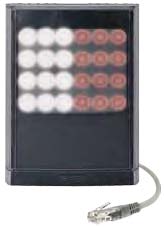
Raytec have released their new range of VARIO2 IP Hybrid Illuminators that combine 4 key technologies into a single package, and immediately becomes the smartest and most connected illuminator in the security market today. Each illuminator combines infra-red, white-light, IP connectivity and PoE technology into a single networked package – designed to deliver the right light for any situation, at any time. VARIO2 IP Hybrid utilises Raytec’s latest PLATINUM Elite twin-core SMT LEDs which are individually over 200% more powerful than previous generation LEDs. This allows Raytec to integrate all the performance of two full size illuminators (one infra-red and one white-light) into one much smaller hybrid platform. Now security professionals get all the performance of two illuminators from a single package whilst reducing capital outlay, infrastructure and running costs. Fully IP addressable, VARIO2 IP Hybrid allows one to stay connected with the site at all times. Operated remotely via a user friendly GUI, one can take control of the lighting at any time to respond to live events or make easy remote adjustments. VARIO2 IP Hybrid can also be fully integrated with the VMS, BMS or other 3rd party devices, and it can be automated to respond to any incident, there and then, even if the site is unmanned. “We are exceptionally proud of VARIO2 IP Hybrid,” comments David Lambert, Raytec’s Managing Director (Joint), “It represents all of the best Raytec technology in a single platform that can deliver the right amount of light, and the right type of light, where and when the situation demands. Whether the goal is covert infra-red, close range facial recognition or white-light as a visual deterrent, one illuminator can now do it all.We believe that Hybrid IP is the future of lighting in the security market. No longer will security professionals have to choose between infra-red or white-light, they will choose Hybrid IP lighting that can be easily integrated into the wider security system and deliver any light that is required.” VARIO2 IP Hybrid represents an evolution of Raytec’s award-winning VARIO IP range, becoming the only IP- enabled Hybrid illuminator in the market.

Read More

AMG Ethernet Range

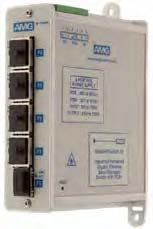
Calming the data storm Available with 2, 4 & 8 Ethernet ports, AMG’s Semi-managed switches provide a 100Mbps or Gigabit Ethernet uplink across multi-mode or single-mode fibre Via the SFP port. With Pre-programmed software to direct traffic only to the SFP upload port, the need for configuration to manage effective switching is eliminated. The semi-managed options eliminate multicast flooding to local Ethernet connected devices, which makes them ideal for larger CCTV applications where unmanaged switches are not sophisticated enough to handle multicast traffic, and where fully managed switches demand an unwelcome overhead of individual programing, additional cost and network complexity. All models can be quickly surface mounted or simply clipped on to a DIN rail for rapid installation and servicing. AMG’s wide range of compatible SFPs offer huge flexibility in choice of optical media, including multi-mode and single-mode optical fibre and extended copper Ethernet allowing up to 500m at 100Mbps using CAT5e.

Read More

Dialog on the Need of Surveillance

Western Digital has recently co-hosted a roundtable conference on ‘Technology Modernization for Safer and Smarter Cities’ with Smart Cities Council at Mumbai. The conference primarily aimed at discussing initiatives to fuel the growth of surveillance security in India, the challenges faced, and the methods to address them. The discussions also focused around numerous initiatives that support and accelerate the vision of ‘Smart Cities;’ and help urban planners understand the framework of a smart city and take steps for collective and progressive growth. The roundtable for ‘Role of Video Surveillance Systems in making cities safer’ was moderated by Satish Mathur, Director General, Maharashtra Police. Other esteemed panenlists were Arun Unhale, Director, State Disaster Management Authority; Keshava Sharma, Regional Executive Director, Airport Authority of India; Khwaja Saifuddin, Senior Sales Director – South Asia, Middle East and Africa, Western Digital; Amitesh Kumar, JT. C.P. (Traffic) Mumbai Police; and D.R. Bhade, Senior Planner (NAINA), CIDCO. Stalwarts from the technology, security and urban development backgrounds appreciated the role of the organizers who provided such a multi-stakeholder platform to promote discussions on the surveillance for safer and smarter cities. Speaking at the event, KhwajaSaifuddin said, “The surveillance sector in india is expected to witnesses a robust growth due to rise of urban infratsructure accompanied by increasing spending on IT and security. Therefore it becomes imperative at this stage to set the video surveillance standards in place to achieve a common goal of enabling smarter and safer cities at a faster pace.” The discussion centred on the need of smart surveillance shaping smart cities, and how to transform surveillance video from cost burden to value-added asset. Additionally, the need of city administrations to focus on installing and upgrading defined specification of cameras, storage systems and allied technologies, and incentive to help propel the formation of sustainable smart cities were also talked about. Pratap Padode, Executive Director & Founder, Smart Cities Council India, said, “There is a correlation between crime and urban density. Mumbai has witnessed a drop in crime reported in 2016 over the previous year by 7.7% and CCTV surveillance has had a role to play in the deterrence of crime. For a safer city we need to have safer infrastructure and CCTV survelliance is an integral part of ensuring a safer surroundings. Mumbai has always been a great example of safe and secure city. Given the Smart Cities Mission drive, city administrations need to focus on installing and upgrading defined specification of cameras, storage systems and allied technologies. There is need a for cameras that can assist in ‘Crime detection’ and ‘Community watch;’ while crime prevention, traffic management and women safety are other objectives that are deemed important.” The stakeholders in unison concurred that investing in the latest video surveillance technology with highest resolution cameras, best quality analytical tools and highest capacity storage will help lead to smart surveillance systems for secure and safe areas, with a goal of achieving less crimes, 24×7 surveillance, and safer environments for city inhabitants.

Read More

Vehant Vehicle Speed Detection

Over speeding is one of the major factors of road crashes and fatalities around the world including India. Speed violation detection system, which is basically a part of intelligent traffic enforcement systems, is a highly advisable tool today to overcome this issue. The system has a centralized approach to modern traffic management and it is capable of reducing such mishappenings. There are three variants of speed detection technologies available in the market today. Radar based SDS Radar based speed detection system works on the principal of Doppler Effect. The device emits the radio wave at a set frequency which is reflected by the target vehicle. The frequency of the reflected radio waves is different from the transmitted waves, and from that difference speed of the vehicle is calculated. Laser based SDS Laser based speed detection system emits a narrow, focused laser beam comprising a series of pulses which the target vehicles reflect back to the source. The time of complete trip of these pulses from emission to bouncing back is measured and that becomes the basis for the calculation of the speed of the vehicle. The Radar and Laser based speed detections are though so efficient but they have certain limitations as well. Cosine factor – Radar and laser based speed detection systems can record true speed only if they are in the line of the vehicles path which is not suitable for unorganized non-lane based traffic scenario like in India. If the radar is positioned at an angle to the path of the vehicle, the apparent speed of the vehicle is reduced. The reduction in speed is proportional to the cosine of the angle. The Radar based speed system cannot differentiate between two vehicles which are at different speed but are adjacent to each other. Hence, the speed detected through this system cannot be relied upon for evidence in the Indian court of law. Laser system works well when triggered straight to the vehicles. In gantry architecture it does not follow its own principle, hence its accuracy cannot be relied upon. Both Laser and Radar systems are calibrated while running parallel to the ground and in the direction of the moving vehicle; when they are fitted at 6.5mtrs height they contradict their own calibrating methodology. Both Laser and Radar system requires yearly calibration. Since, these systems are not manufactured in India; they are sent outside, and during that course of time the system does not work. Both Laser and Radar systems require at least 3 feet of horizontal separation between two vehicles to detect speed, which is not really possible in bumper to bumper traffic as seen on Indian roads. Video based speed detection system Video based speed detection system works on speed-time-distance concept and uses image processing technique. It uses a video scene, comprising starting reference point of moving vehicle (e.g.,Y1(Yth, Xth)) and end point of reference (e.g., Y2(Yte,Xte). The distance (D) between Y1 and Y2 is already known. The vehicle is detected at Y1 at time t1, and Y2 at t2; the difference (T=t2-t1) of time is procured. Vehicle speed (S) is then calculated on the simple formula of Speed=Distance/ Time. The control processor activates the camera to capture the image of the speeding vehicle in accordance with the speed controls. Features of video based speed detection system Cameras are used for speed detection and each vehicle is captured individually. Calibration methodology is as per the ground installation.. Since video based speed detection system track number plates only and each number plate is an individual transaction, hence, horizontal separation does not make a factor in calculating the speed of the vehicle. Doesn’t require periodic calibration. Does not use any inductive loop sensors/ radar/ laser. Conclusion Considering various aspects of the speed detection technologies, video based speed detection system is most suitable for accuracy of speed with the details of vehicle number plates, for the road scenario like that in India where traffic is not so disciplined and there is a prevalence of non-lane based traffic incidences.

Read More