
Smart Coding Technology
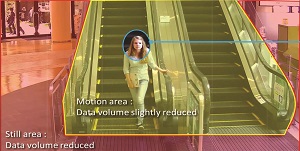
Video surveillance techniques since the launch of IP cameras have seen many technological advances that have delivered increased resolution and improved picture quality through better lenses, sensor and image processing technology. These advancements are capable of bringing much needed improvements in evidential image quality and enable the user to realize the investments made in CCTV through deliverable results in terms of clear identification. Delivering these advancements requires additional design thinking in terms of total bit rate throughput. Typically higher resolutions FHD & 4K require much greater bandwidths that impact on the design and cost of both the network to stream high definition images across and the recording hard drive capacity needed to store them on. System designers now not only need to think in terms of the angle of view or depth of field that a camera needs to produce but also to think of the content within the camera image in terms of what is useful and what is not. For example, streaming and recording scenes in high definition of empty streets devoid of movement, people or cars, or the skyline create lots of useless image data that requires lots of bandwidth to stream and store. Panasonic have now developed a cost viable solution to the high definition bandwidth problem by enabling important content to stream as high definition whilst economizing or eliminating on unimportant content in an image. This technology is called Panasonic Smart Coding and its employment reduces the total cost of ownership and makes the investment in high definition within the reach of a much wider section of the video surveillance marketplace. Smart Coding Technology Smart Coding is a license free feature available on Panasonic i-PRO and i-PRO Extreme cameras. Total bit rate throughput can be reduced by combining the two main technologies that make up the Panasonic Smart Coding innovation; Technology that assigns high resolution data to important content such as people or cars. Technology to reduce noise generated in low-illumination environments or at night, therefore eliminating the streaming of noise seen as movement in current compression algorisms. As we are eliminating the unnecessary streaming or high resolution data, even greater results in overall bit rate throughput can be saved by combining Smart Coding with Panasonic high-resolution 4K surveillance cameras. Panasonic’s Smart Coding Technology is based on the coding of the moving video standard, and as such special modules and the likes are not needed for display or playback by a client who is employing this technology. The two technologies that make up the Panasonic Smart Coding innovation are made of several elements that are described as follows; Technology to assign data only to subjects to be monitored Bit rate is sufficiently assigned to subject matter that is important such as people or cars, and therefore it needs to be streamed and recorded as high definition video. However, so-called background elements such as walls and roads are not so important therefore they don’t really need to be as sharp as content, and so a lower or no bit rate is assigned to them. Overall the total bit rate that needs to be streamed and recorded is reduced. This technology uses various techniques to accomplish the overall reduction in throughput. GoP Control The video stream comprises I-frame data encoded closed in the screen (as still image) and P-frame data where the difference from the previous frame is encoded. If the refresh cycle is set to 1 second (the default setting for Panasonic cameras) at a frame rate of 30fps, stream data is generated where 29 P-frames follow after one I-frame. The data from this I-frame to the next I-frame is called Group of Picture (GoP). To playback stream data generated in this way, decoding must be done in order from the I-frame. For that reason, the I-frame is also called the reference frame. If the refresh interval (interval between I-frames) is long, much decoding is performed until playing back the end frame of that GoP. I-frames encode the entire screen, so the volume of data is large. P-frames encode the difference from the previous frame, so the volume of data becomes smaller. The GoP Control function detects motion of subjects. It makes the interval between I-frames shorter if there is a motion or longer if there is no motion. By making the interval longer in scenes with no motion, the number of I-frames with large data volume can be reduced, greatly reducing the total bit rate. In scenes with motion, the interval is made shorter to secure accessibility to scenes the user wants to view. Advanced mode utilizes the concept of long term prediction frames. Its reference frame structure consists of I-frames, and P-frames, which reference two frames (an I-frame and the previous P-frame), and key frames (P#30,#60), which reference the first I-frame (IDR) in the GoP. Figure 4 shows the reference relationship at 30fps with an I-frame interval of 60 sec and key frame interval of 1 sec. If there are no key frames in the GoP, decoding needs to be done sequentially from the I-frame at the head of the GoP. However, key frames can be decoded using just the I-frame. For example, if key frames are present in the GoP, #61 can be displayed by decoding just IDR#0, P#60, and P#61. Additionally, by inserting key frames, random accessibility can be secured. The advanced mode improves prediction efficiency by using two reference P-frames and reduces the bit rate by expanding the I-frame interval whilst maintaining random accessibility. Auto-VIQS Control Auto-VIQS (variable image quality on specified area) Control can automatically deter mine areas with and without motion and therefore reduces the data volume of those without motion. In the example below Auto-VIQS has realized two areas of importance that have a lot of movement (seen in red) and one area of little or no movement (seen in yellow). Smart facial coding Smart facial coding reduces bit rate by detecting the face and motion areas and keeping the face area at high image quality, slightly…