securitylinkindia

MassMediaLink India LLP SecurityLink India

Mass-Notification System Market by IHS Markit

Mass-Notification System Market by IHS Markit

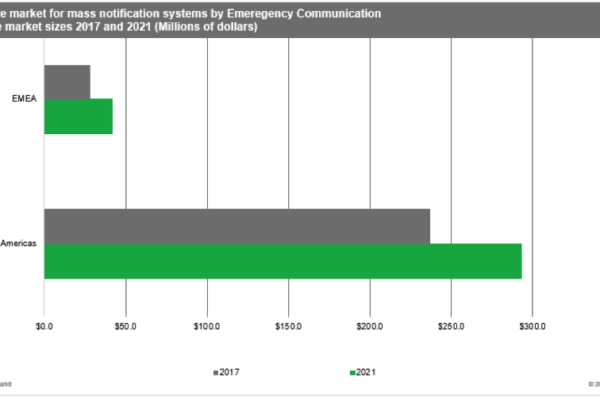
I n the Americas, hurricanes, tornadoes and earthquakes are occurring more frequently, so unimpeded mass communication during these events is critical. MNS software is often employed so companies can communicate with their employees, federal agencies, university students and the general public. More channels of communication available in these types of events, means more people can reach safety faster and more lives can be saved. In Western Europe, the second-largest market for MNS software, weather-related incidents occur less often, How Catastrophic Events are Changing Mass-Notification System Market By Robert Brooks – Analyst, Security and Building Technologies, IHS Markit cooperation with the INTERPOL National Central Bureau in Vienna and private sector partners NEC Corporation and Cyber Defense Institute. “NEC has contributed as a strategic partner to INTERPOL’s commitment to improve the cybersecurity skills of investigators throughout the world. For the third year, NEC is honored to have helped develop the Digital Security Challenge by providing our expertise at this cutting-edge event,” said Kozo Matsuo, Vice President of NEC Corporation’s Cyber Security Strategy Division. Training sessions to develop participants’ practical knowledge on IoT device analysis and the latest trends in malware-related crime were delivered by specialists from NEC Corporation, InfoSec, Meiya Pico, SECOM, Kaspersky Lab and Trendso the need for MNS software is lower than in the Americas. While individual countries might deal with specific weather threats – like blizzards and freezes in Sweden and flooding in the UK – in 2017 the United States alone experienced four major hurricanes. Mass-notification system (MNS) software used in emergency communication, the primary segment used during a catastrophic event, is expected to grow in the Americas at a compound annual growth rate (CAGR) of 6.8 percent from 2017 to 2021, reaching $293.1 million in 2021. Due to heightened terrorist activity in Europe, and with US-based multinational companies moving to Western Europe, the MNS software emergency communication market in EMEA is expected to grow at a CAGR of 11.4 percent from 2017 to 2021, reaching $41.6 million in 2021. Our Analysis FedRAMP opens the door for cloud-based solutions Federal Risk and Authorization Management Program (FedRAMP) is a US government program providing a new standardized approach to security assessment, authorization and continuous monitoring for cloud products and services. While this certification is not mandated by law, it will certainly affect how software-as-a-service (SaaS) and cloud vendors perform business with federal government agencies – increasing MNS software sales by the federal government, because nearly all vendors in this industry will switch to cloud-based solutions. Once a company is certified by FedRAMP, additional measures to buy or maintain vendors’ solutions is required. This cost savings will appeal to many government agencies as they look at the total cost to own a system. Western European governments will continue to use on-premises or hybrid solutions, because they are constrained by local laws and regulations surrounding the use of personal information and privacy. A majority of cloud-based MNS software market leaders are located in the US, which creates additional lag time for cloud systems to be purchased in European countries. New MNS platforms can reduce human error There is an obvious and growing need for more user-friendly system interfaces. For example, during a regulated standard test of Hawaii’s emergency missile warning system in January 2018, an employee selected the option to send out a full missiledefense alert, instead of choosing the test-cycle option. While this is a dramatic example of human error, there is a continuing need to improve the user interfaces of these systems to avoid unnecessary public panic in the future. Privacy laws and regulations slow cloud-based MNS software adoption across Europe I ncreasing acts of terrorism across Western Europe and North Africa over the past two years have forced central governments to investigate new and innovative ways to keep the general public safe. While most investment goes toward security cameras, access control, security doors and tough perimeter security, some governments will also choose to buy MNS software to facilitate communication between first responders and security teams. Privacy issues need to be addressed on a country-by-country basis, including the location of servers hosting cloud-based platforms. In Germany for example, MNS software providers must comply with the ‘German work first’ rule. This rule was implemented by the German government, because it did not want any German citizen’s information to be contained outside the country. Each country in the European market has different rules about hosted systems, which adds another layer of complexity to selling cloud-based systems in Europe. Security Technology I HS Markit provides extensive coverage of security technology markets, encompassing access control and fire, cybersecurity, digital ID, critical communications and video surveillance.  

Read More
Bosch and Genetec. End-to-end security, day after day_1

BOSCH and Genetec End-to-End Security, Day After Day

Cybercrime – one of the world’s biggest crimes goes nearly unnoticed. The Internet of Things makes mobility, businesses and industries more connected, but it also leaves them more vulnerable to cybercrime. Online hacking has become so widespread that, by 2021, it is estimated that the cost of cybercrime damages will be $6 trillion annually.* All it takes for a hacker is finding a single weak link, from the outside or more commonly inside, in a surveillance network to gain access to, and jeopardize an entire data system. To cancel out this risk, employ a data security system that’s been configured by experts with vast cybersecurity knowledge to make it completely effective from end-to-end. Partners in crime prevention The reputation of Genetec and Bosch in the field of mission-critical video security projects is constantly growing. Having access to the video management system (VMS) expertise of Genetec and Bosch’s innovative surveillance cameras gives customers the upper hand over the hackers, because Bosch cameras are fully integrated with Genetec systems, resulting in an endto-end data security solution incorporating all Bosch network video surveillance cameras, plus Genetec Archiver and Security Center. All network-wide communications between Bosch cameras and Genetec Archiver and Security Center are assigned an authentication key. This electronic signature enables the system to verify the legitimacy of network components like cameras or storage units, and viewing clients, ensuring that an infrastructure of trust is built before network-wide communications start. The best form of protection is encryption Cybercrime is one of the greatest threat to every company in the world,* so an effective and reliable method of safeguarding the video security infrastructure is needed. This is why encryption of data streams and stored data is vital. All Bosch IP-cameras have a built-in Trusted Platform Module (TPM) to safely store cryptographic keys used for authentication ensuring trustworthy communications between all network components and encryption of all video data. All cryptographic operations, for authentication and encryption, are only executed inside the unique built-in Trusted Platform Module (TPM). Encrypted video data is then sent from the camera to the Genetec Archiver using SRTP (Secure Real-Time Transport Protocol). Additional security is established via a ‘permissioning’ scheme based on privileges accumulated by specific users. Synchronized – Centralized – Better protected Because Genetec Security Center integrates with Active Directory, feature 82 SecurityLink India ■ March 2018 user management can be monitored and centralized at Windows level. As well as individual users, user groups from Active Directory can be synchronized with Security Center, whilst new users will automatically inherit existing Security Center privileges defined for that group. Securing cameras, management software, and clients Passwords are still an essential layer of security, but the Genetec Archiver also uses a client certificate (which can be signed by a trusted third party and is factory-installed) to authenticate themselves to the Bosch IP camera. In addition, only Bosch-approved firmware updates will be accepted, and any cryptographic operations are only executed inside the unique built-in Trusted Platform Module (TPM). Certificates are less at risk from hacking, which is why Genetec uses certificate authentication for its Security Center management software and clients. The video management systems interact directly with the Bosch cameras using certificates for authentication, and because stored data stays encrypted and data is transmitted via SRTP (Secure Real-time Transport Protocol) confidentiality and data protection are guaranteed. Using SRTP throughout the whole video security infrastructure enables customers to set up a secured multi-cast network, and get security and good network scalability at the same time. Together, Bosch and Genetec provide one of the world’s best data security solutions.  

Read More
Smart IoT Industrial Park

Smart IoT Industrial Park Brings Productivity & Quality to a New Level

To grasp the current manufacturing trends and seize the Zeitgeist of Industry 4.0, Dahua Technology has put to use a new smart IoT industrial park in Hangzhou. Dahua Smart (IoT) Industrial Park occupies in total 512 acres in Fuyang district of Hangzhou, about 20 minutes’ drive from Dahua headquarters, designed to host 6000 staff (by 2017, 4500 people have been working/ living in the 262 acres of phase one area). With topnotch technologies, personnel, materials and other benefits, Dahua’s smart industrial park will bring productivity and quality to a brand new level. Faster production & adaption The automatic production solution based on integrated information system not only grants a higher productivity that significantly shortens the delivery cycle time for Dahua customers, but also a greater flexibility to specialized requests and ever-changing reality. The employment of software such as ERP, PLM, PDM, MES, APS and WMS helps achieve information integration, which, combined with industrial cameras, RFID sensory technologies and automation technologies, can integrate personnel, logistics, works, engineering projects and finance from respective sections of production (preparation, assembly, testing, packaging, inspection, shipment), rendering the whole process visible, traceable and digital. The mounter serves as a good synecdoche to illustrate the incredible efficiency of the whole production system. The concerning highend devices (including mounter, printer, automated optical inspection equipment, Ersa reflow soldering tools etc.) provided by ASM (originally Siemens) achieve a speed among the fastest in the world. According to IPC standard, X4iS, the latest high-speed mounter can process 125,000 components per hour, or 35 per second. X35 multifunctional mounter can do 54000 components per hour, or 15 per second. A production line in X series can enhance the productivity by 2.7 times while reducing the consumption of energy by 52%, comparing to the original production line in D series under the same conditions. The faster speed also applies to the development of new molding, since Dahua smart industrial park provides the great benefit of internal synergy, allowing the end-to-end vertical supply chain with marketing, R&D and manufacturing efficiently integrated. The advanced organizing system is supported by topnotch equipment such as MAKINO highspeed graphite processing machine, GF CNC, GF WEDM-LS machine, Hexagon 3D Nikon projectors and electronic displays. With a processing accuracy of +/-0.002 to +/-0.005mm, while also supporting CAD/ CAM/ CAE collaborative development and simultaneous manufacturing, these machines enable Dahua to develop new mechanical molding in as short as 7 days. By far, this developing system has already produced high precision molding for Lechange Robots, monitoring cameras in TP1-TC6 series, G20 intelligent head-gears, smoke alarm for fire detectors etc., all of which are proving the effectiveness of the system in shortening the development cycle and keeping the competitive edge with new products in the business. Higher quality Higher quality saves lots of time and economic costs for clients. Even more importantly, higher quality results in less likelihood for products to malfunction especially when they are used in critical, notallowed-to-go-wrong situations. Dahua’s products are guaranteed with a higher quality for two reasons – first, Dahua has set a high standard of accuracy in production; second, with a reliability lab at the production end, it has put together an effectively closed loop for quality control in the manufacturing process. Accuracy enhanced Accuracy has always been one vital index defining the manufacturing ability because it directly sets the limit to quality and range of products to be produced. Again, take the mounter mentioned above for example – it can process components, in metric size, as small as 03015 (0.3×0.15mm), with a +-0.025mm SMD precision (within the 3-stigma range), boasting world leading performance and capable of covering basically all types of components used in the industry. Dahua industrial camera plays an important role in IoT, providing a closed loop for quality control in the manufacturing process, in which all materials, personnel and devices are connected and products are traceable to the specific production line and precise time it got made. Boasting a variety of functions, Dahua industrial cameras are used in different sections of production, enabling automatic assembly, high-precision graphic inspection and product flaw inspection. Through high definition machine vision, Dahua industrial cameras automatically and precisely locate the components, limiting the assembly error to micron level. Equipped with enhanced vision and intelligent analytics algorithm, the industrial camera can spontaneously detect and recognize flaws in the performance and outlook of products, thus promising not only the volume of cameras production but also the steady quality of each and every one of them. Reliability reinforced Reliability must be put to test, in R&D as well as in manufacturing process. The reliability lab at the production end serves to assure quality by randomly taking products from production lines and put them into reliability tests simulating falling, high/ low temperature, worn-out conditions, which are conducted by industry leading testing equipment in the lab. Thus what’s conceived in R&D is confirmed from the production line, the synergy of both ends promising better products (for common use or specialized needs). This lab is also responsible for testing all the raw materials. Thanks to the aforementioned information integration, all tests are automatically conducted, recorded and traceable. In conclusion, Dahua Smart (IoT) Industrial Park is endowed with the latest and world leading manufacturing equipment/ system boasting high level automation and intelligence, which is essential to satisfy the ever higher demands from clients in terms of delivery time, specialized use and quality. There is still great potential to this new smart industrial park. It is literally only in its phase one, and in the future phase, it is expected to be more intelligent, to realize clientcentered flexible production and to enable a safer society and smarter living. By – Balasubramanian Jayam Head of Marketing (India & SAARC), Dahua Technology Co., Ltd.  

Read More

HID Predictions in Id Technology

HID Global has identified the top trends in the identity technology industry for 2018. The company points towards increased cloud and mobile access adoption, more focus on securing the Internet of Things (IoT), and data analytics as some of the top trends that will take center stage in developing more intelligent, connected experiences this year. “Trusted identities will emerge this year as the fundamental building blocks for organizations to create environments that connect people, places and things,” said Samuel Asarnoj, Senior Vice President, Corporate Strategy & Business Development with HID Global, “The user experience will be redefined by mobile, IoT and cloud technologies, and deliver new capabilities for the future.” HID Global sees five significant trends in 2018 that will influence how organizations leverage the power of trusted identities. Organizations embracing the benefits of the cloud I ncreased awareness of the cloud’s ease of deployment, flexibility, connectivity options and productivity benefits will escalate adoption. Access control cloud platforms with APIs and SDKs will fuel new software solutions that expand choices for organizations to get the most out of their investments. Cloud-based card issuance will drive adoption due to its simplicity, security and cost structure, while governments increasingly investigate how printed IDs can be complemented by cloud-issued mobile citizen IDs. Cloud authentication and credential management will further integrate mobile devices, tokens, cards and machineto-machine endpoints. And digital certifi cates in the IoT will draw upon the trusted cloud services to deliver and manage certificates across thousands of devices. More connected devices and environments drive focus on securing the IoT Digital certificates will become a core component for adding trust in the IoT by issuing unique digital IDs to printers and encoders, mobile phones, tablets, video cameras and building automation systems, plus a broader range of things like connected cars and medical devices. Apple iOS 11 ‘read’ support of NFC will fuel adoption of IoT-based applications such as brand protection, customer loyalty programs and other use cases that will further drive the need to enhance security in the IoT. Mobile access reaches tipping point for mass market adoption 2017 was the year when mobile access went mainstream and adoption will accelerate even further in 2018. Maturity in mobile solutions and integration into other systems, coupled with mobile’s ability to enhance user convenience, improve operational efficiency and provide higher security will drive accelerated growth for mobile access and mainstream adoption. Card emulation, the NFC mode most coveted for mobile access control, remains reserved exclusive to Apple Pay; this leaves Blue tooth as the communication standard for cross-platform mobile access support. Still, organizations will invest in readers and other infrastructure that supports NFC and BLE to prepare for future possibilities. Convergence of physical and digital security The concept of physical identity & access management (PIAM) will drive convergence of physical and digital security to a single credential, putting identity at the center of all use cases. Government, finance, energy and other regulated markets will emerge as the forerunners using these solutions for secure access to buildings, email, websites and VPN. The new converged identity models that use cloud authentication and mobile devices are also emerging such as the ability to verify a person’s presence at a location, mobile IDs that validate physical citizen IDs, and smart cards that authenticate users to enterprise resources. Data analytics will drive risk-based intelligence for predictive models and new capabilities Devices, access control systems, IoT applications and other solutions connected to the cloud will provide robust data for advanced analytics. Insights from these analytics can be used to optimize workflow solutions and provide more seamless access for end users. Predictive analytics and biometrics will play a crucial role in people-centric security and address employee demands for workplaces to deliver premium, more individualized services. Analytics will also help reduce downtime in the enterprise, spur factory automation and improve compliance via condition monitoring that is based on real-time location and sensing solutions.

Read More
School Security Systems Industry US Market

School Security Systems Industry US Market Overview

With the growing number of schools in the United States with video surveillance, electronic access control and other traditional security systems, the number of potential “greenfield” projects for suppliers falls. Declining numbers of new security system installations will lead to slowing market growth over the next five years. Even so, security manufacturers are looking to implement the following new security technologies to improve school safety, which would also help reignite market growth: 1.     Facial recognition technology Many of the video surveillance systems currently used in schools are not actively monitored and also rarely lack any form of effective automated response. Adoption of facial recognition technology would allow the surveillance system to proactively search for potential threats, and alert school administrators and security staff about unrecognized individuals in the building. Unfortunately, affordable facial recognition technologies are often unable to adequately recognize the number of faces in a typical school; plus, these systems can place a large strain on a school’s information technology network. 2.     Logical and physical security identity management integration I ntegrating the school’s access control database with a higher authority logical database – for example, a student directory – would allow the access rights of former staff, and students who have been expelled or already graduated, to be removed automatically. However, access control providers may find it difficult to get permission to access student records and other sensitive data. Education administrators may also be uncomfortable with possibly creating a potential avenue of cyberattack. 3.     High-security classroom doors with multipoint looking systems Higher-grade doors would create a far more effective barrier between students and potential attackers, creating numerous safe spaces throughout the building in emergencies. It’s also true, though, that purchasing thousands of doors would be expensive. Fire regulations often dictate that key entrances and exits remain fail-safe during emergencies. Locking and unlocking doors multiple times would also disrupt teaching. 4.     Weapons checks using metal detectors or x-ray machines at school entrances Using metal detectors or x-ray machines at entrances along the school perimeter makes bringing weapons into the school much more difficult. However, schools often have multiple entrances, which means each school would require multiple detectors or x-ray machines – both of which are expensive. The school would also need to hire additional security staff to operate each machine. Securing entrances in this manner would also mean long queues would form after breaks and lunchtime, reducing the free time of students and staff. Access control intelligence service Entering its fourth full year, the IHS Markit Access Control Intelligence Service provides primary analysis of the equipment market, plus thorough investigation of key technology trends affecting the industry. Current topics of focus include mobile access, logical and physical identity management integration, adoption of biometric technology and security system convergence.

Read More

Verint®Systems New Line of Solutions for SMB Market

Verint®Systems Inc., the customer engagement company™, has announced its contact center workforce engagement offerings specifically designed for today’s small and medium-sized businesses (SMBs). Verint’s purpose-built SMB solutions provide a simple, modern approach to customer engagement, and rapid time to value. Because they are easy to implement, easy to use and easy to maintain, companies can cost-effectively heighten contact center workforce engagement, enhance service quality, optimize performance and meet compliance requirements. The new Verint SMB offerings are available in the cloud and on-premises, and include: Compliance recording: Captures, archives and retrieves interactions across channels – such as voice, including mobile, and instant message communications – and helps reduce risk to confidently meet strict compliance demands. In addition to traditional voice calls, the solution records customer interactions across unified communications platforms such as Microsoft Skype for Business and Cisco Jabber. Recording and quality management: Captures, replays and evaluates customer interactions across communications channels. Leveraging the technology, organizations can bring a focused approach to employee coaching and training. Workforce management: Simplifies forecasting and scheduling, while helping manage and reduce costs, advance workforce efficiencies and drive operational excellence. As employees expect the work environment to adapt to their personal lives, Verint solutions are helping businesses evolve with mobile apps and built-in support for flex scheduling and adherence. Workforce optimization: Combines recording, quality management and workforce management, bringing a holistic approach to ensuring the right employees with the right skills are available at the right time, supporting quality and compliance requirements, and sharing intelligence to improve workforce engagement and customer service operations. “Verint SMB offerings are changing how small and medium-sized businesses approach customer and workforce engagement,” says John Goodson, Senior Vice President and General Manager of products at Verint, “Our partners can easily integrate these offerings with other contact center solutions, providing customers maximum flexibility with low total cost of ownership.”

Read More

Oncam Unique Evolution 180 Range

Oncam has added the Evolution 180 product range to its portfolio, building upon the experience and heritage of the company’s 360-degree technology. The addition of the panoramic 180-degree camera range meets the needs of customers in a variety of markets that require a purpose-built wallmounted camera with Panoramic+ views from a single sensor. Environments that benefit from this unique view include education, hospitality, casinos, banking, retail and transportation, which demand monitoring large walkways, open spaces and corridors without blind spots. “Customer demand for a dedicated high-quality 180-degree technology was the driving force in the development of our latest product. They wanted a camera that was tailor-made for true panoramic views. Currently, 180-degree views in the market are created with a single sensor 360-degree camera in panorama mode, which isn’t an ideal approach as it doesn’t allow the use of the full width of the sensor,” said Jon Marsh, Vice President of Product, Oncam, “This is why we’ve created the Panoramic+ view, which dictated the design of the product putting more pixels on target than any other panoramic camera. This innovation further boosts the capabilities of our product portfolio and builds on the proven track record of top quality imagery from a single sensor for which Oncam is known. Furthermore, the Evolution 180 enables us to reach a greater segment of the marketplace that requires and demands full coverage from their surveillance solutions.” The Evolution 180 camera range is introduced with the Indoor model, available immediately in black or white, and a robust and attractive outdoor model, which will be available in April. The Evolution 180 range offers a 12MP sensor and a 6MP dewarped panoramic image with Oncam’s angle compensation technology which provides adaptive dewarping. It is a true day/ night camera which doesn’t require SDK dewarping as the Panoramic+ view is created natively in the camera. The solution is ONVIF Profile S compliant for added integration flexibility with the leading video management systems on the market today.

Read More

FICO Fintech 4finance Deploys AML and KYC Solution

4finance Group, Europe’s leading online and mobile consumer lender, has deployed FICO® TONBELLER® Siron® solutions for anti-money laundering (AML) and know your customer (KYC) compliance across 10 countries and 20 back-office systems in just nine months. The cloud-based FICO solutions are delivering audit-verified compliance with global and regional regulations while maintaining 4finance’s promise to issue customers a loan in 15 minutes. For these achievements, 4finance Group has won a 2017 FICO Decisions Award for Regulatory Compliance. “Working with FICO, we created an AML/ KYC framework that bolstered our compliance without compromising on speed and our promise to customers,” said Andis Grandāns, AML Officer at 4finance Group, “In fact, fewer than 0.5 percent of customers applying for their first loan feel any impact on the speed of their loan being disbursed. As proof of our success, we have already undergone a regulatory audit on our AML/ KYC processes and received a clean bill of health.” Speed to market 4finance Group is a global digital finance business that combines the discipline of a rigorous, highly regulated consumer lender with the capabilities and drive of a fast-paced, data-driven, borrower-focused fintech. It took on this project to ensure compliance with new requirements of the 4th European Union AML Directive in online consumer lending. “Our challenge was to find an AML compliance solution that was flexible in the way it could be integrated, but absolutely robust when it came to compliance capabilities,” said Grandāns, “Our speed to market and our ability to deliver funds to our customers quickly are fundamental to our business. We needed to ensure compliance in a way that did not compromise our brand promise of delivering fast funds to creditworthy people. We chose FICO TONBELLER because it offered us the fastest deployment, cloud for expansion to new markets, and the most powerful capabilities for detecting criminal activity.”

Read More

NIST Blockchain Technology Aims to Go Beyond the Hype

Beguiling, baffling or both – that’s blockchain. Aiming to clarify the subject for the benefit of companies and other organizations, the National Institute of Standards and Technology (NIST) has released a straightforward introduction to blockchain, which underpins Bitcoin and other digital currencies. Virtual barrels of digital ink are flowing in the media nowadays about these cryptocurrencies and the underlying blockchain technology that enables them. Much of the attention stems either from the giddy heights of value attained lately by the most well-known of these currencies, Bitcoin, or from the novelty of blockchain itself, which has been described (link is external) as the most disruptive technology since the internet. Blockchain’s proponents believe it lets individuals perform transactions safely without the costs or security risks that accompany the intermediaries that are required in conventional transactions. The NIST report’s authors hope it will be useful to businesses that want to make clear-eyed decisions about whether blockchain would be an asset to their products. “We want to help people understand how blockchains work so that they can appropriately and usefully apply them to technology problems,” said Dylan Yaga, a NIST Computer Scientist who is one of the report’s authors, “It’s an introduction to the things you should understand and think about if you want to use blockchain.” A blockchain is essentially a decentralized ledger that maintains transaction records on many computers simultaneously. Once a group, or block, of records is entered into the ledger, the block’s information is connected mathematically to other blocks, forming a chain of records. Because of this mathematical relationship, the information in a particular block cannot be altered without changing all subsequent blocks in the chain and creating a discrepancy that other record-keepers in the network would immediately notice. In this way, blockchain technology produces a dependable ledger without requiring record-keepers to know or trust one another, which eliminates the dangers that come with data being kept in a central location by a single owner. The blockchain idea has attracted enough supporters that there are now several hundred digital currencies on the market, and the companies that are investigating ways to employ blockchain number many more. Because the market is growing so rapidly, several stakeholders, customers and agencies asked NIST to create a straightforward description of blockchain so that newcomers to the marketplace could enter with the same knowledge about the technology. “Blockchain is a powerful new paradigm for business,” Yaga said, “People should use it, if it’s appropriate.” The question is when it is appropriate. As with any new tool, there can be a temptation to employ it purely for its novelty value. The report outlines some possible use cases, including banking, supply chain management and keeping track of insurance transactions. The report, Yaga said, was created partly to help IT managers make informed decisions about whether blockchain is the right tool for a given task. “In the corporate world, there’s always a push to adopt new technologies,” Yaga said, “Blockchain is today’s shiny new toy, and there’s a big push to adopt it because of that.” “We want to help people to see past the hype,” he said, “as lofty a goal as that is.” NIST has been tasked before with writing definitions of emerging concepts in information technology such as the definition of cloud computing it released in 2011. While Yaga describes the blockchain description as approachable – it’s “as high-level as I can write it,” he said – the document is longer than some other NIST definitions because the technology combines so many complex ideas. Among them are digital signatures, peer-to-peer networking and hash chains, all of which are tools common in cryptography and with which NIST has had extensive involvement. “We don’t have any axe to grind or product to sell, though,” Yaga said, “A lot of articles you’ll read online feature a disclaimer indicating that the author owns a certain amount of cryptocurrency or stock in a company. I have no vested interest in the monetary value of these networks. But we don’t pass judgment on the technology; we just want to get past the rumors.” To that end, Yaga said, the document began as a sort of FAQ addressing falsehoods the authors had come across such as the idea that there was no need for trust in the system. (“You do need trust,” he said, “just not a trusted third party, like a bank.”) It expanded to discuss the technical tools common to most blockchain-based systems and also explored related issues such as the high demands blockchain systems place on network resources. The roughly 60-page report might enlighten anyone who wants a picture of blockchain that is not skewed to any players’ interests, but Yaga said he and his co-authors hope it will give perspective to technical decision makers in particular. “A company’s IT managers need to be able to say, we understand this, and then be able to argue whether or not the company needs to use it based on that clear understanding,” he said, “Some people are saying you should use it everywhere for everything. We wrote with the perspective that you shouldn’t use it if it’s not necessary.”

Read More