securitylinkindia

Smiths Detection IONSCAN 600

First approved Explosives Trace Detector on new TSA air cargo screening list Smiths Detection’s IONSCAN 600 is the first explosives trace detection system to be ‘approved’ on the TSA Air Cargo Screening Technology List (ACSTL) under the latest program requirements to ensure security of cargo aboard airplanes. These latest requirements, which came into effect in 2016, require a significantly higher level of explosives detection capability and software functionality. The IONSCAN 600 is a portable desktop trace detection system that detects minute quantities of explosives, as well as narcotics such as fentanyl, within seconds. It is designed to be extremely flexible for use in dynamic screening environments and is fully operational on hot-swappable batteries to ensure continuous use. It was submitted for ACSTL TSA testing in April 2017 and will also be submitted for evaluation to be used for trace detection at US airport checkpoints in the near future. IONSCAN 600 is similar in operation to previous generation systems, thereby minimizing the training needs as cargo companies bring the new product into operation. Additionally, the IONSCAN 600 is much easier to maintain which will help operations save time and money over its lifecycle. “IONSCAN 600 is becoming the first explosive trace detection system to make the ‘approved’ list for TSA’s ACSTL reflects Smiths Detection’s continued global leadership in aviation security technology,” said Stephen Esposito, Vice President, Business Development and Sales of Smiths Detection, “We are working with the TSA to complete testing to move IONSCAN 600 to the ‘qualified’ air cargo list and look forward to completing that process within the next year.”

Read More

Elbit Showcased Situational Awareness & Intelligence at Milipol 2017

At recently held Milipol 2017, Elbit Systems showcased an array of innovative and operationally proven technologies that are specifically designed to enable enhanced Situational Awareness (SA) and improved Intelligence during large scale emergencies, thereby substantially improving the effectiveness of HLS operations. WAPS solutions SkEye WAPS™ is an airborne WAPS system developed specifically to address requirements raised by forces and agencies responding to terrorism, HLS threats and natural disaster events. Covering up to 80 square kilometers, SkEye simultaneously analyzes up to 10 Regions of Interest (ROI) and offers system’s users the ability to select real-time or ‘back in time’ video footage within the covered area without being limited to a single segment. Grouneye™ is a line of ground surveillance systems designed for wide-area persistent intelligence gathering. It enables a large number of users to receive real-time, high-resolution imagery and even go ‘back-in-time’ for forensic debriefing. GroundEye can be installed on masts, carried by dismounted forces or vehicle mounted. SupervisIR™ is a ground-based 24/7 infrared WAPS system that offers greater search-area coverage, an easy user interface and pixel perfect visualization of multiple regions of interest. The system is highly effective at detecting, tracking, and displaying visual motion imagery of moving air, ground and sea targets, making it ideally suited for border patrol, perimeter security, surveillance and counter-surveillance operations. The system provides infrared surveillance capability that is equivalent to approximately 150 thermal imagers placed side by side. SA, communication and unmanned systems SmarTrack is an SA technology for dismounted forces. It enables first responders, dismounted and special-forces to immediately locate, reliably track and monitor up to 100 members of a network. Using patented Radio Frequency (RF) ranging technology, SmartTrack provides force commanders operating in urban areas, inside buildings, or when GPS signal is jammed, with three-dimensional location of force members and a data link to transmit C2 data between users, thereby enabling continued operational level command & control and effective SA. PNR 1000 is a lightweight personal network radio with automatic voice and data relay. Part of Elbit Systems’ Software Defined Radio (SDR) E-LynX™ family, the PNR 1000 radio supports up to 64 member ad-hoc networking including full-duplex reliable voice conferencing, data and video. DOMINATOR™ is well tested and extensively operational suite for the dismounted force member. DOMINATOR comprises integrated hardware components, C4I applications and an advanced in-house developed load carriage system, interconnecting dismounted forces ensuring superior SA and high level of command and control. Widebridge™ is a cloud based broadband service for first responders allowing for real-time secure streaming of voice, video and data across all echelons and all channels of communication, thus ensuring seamless inter-forces collaboration that is often impeded due to communication gaps that are inevitable when various first responding forces use different communication systems and equipment. THOR is avertical take-off and landing (VTOL) Mini-UAS. It is a low-altitude multi-rotor platform designed for surveillance and reconnaissance missions over land and at sea. Electrically propelled, THOR has a low acoustic signature enabling covert operation in day and night. It flies to a ceiling of up to 2,000 ft. above ground at a range of 10 kilometers carrying payloads up to 3 kg for 75 minutes.

Read More

Mobile Technology Asperis X7 Powered by Suprema BM-Slim2 Fingerprint Module

Mobile-Technologies, a leading global provider of biometric solutions has recently introduced the Asperis X7. A FAP 20 fingerprint authentication scanner module, powered by Suprema’s latest BM-Slim2, Asperis X7 is a robust biometric device specifically designed for Telcos, banking and law enforcement agencies, enabling users to perform real-time operations in the field. Equipped with an IP grade casing, powerful processing capabilities, best-in-class readers and integrated with Mobile-Technologies’ innovative software solution, it is a reliable and ergonomic device, which along with all the standard technologies, provides the ultimate solution for smart card and biometric requirements. On the biometric side, Suprema’s BM-Slim2 offers an unrivalled level of security with the industry’s most advanced live fingerprint detection (LFD) technology. With the emergence of mobile authentication in the global Telco industry, LFD becomes a critical feature, that improves the reliability and integrity of fingerprint databases, enabling operators to better fulfill regulatory requests. The BM-slim2 is an optical sensor with very low consumption, allowing enhanced mobile autonomy for Asperis X7, with the FAP 20 certification providing large sensor scanning area for higher quality fingerprint images. “Suprema continues to provide leading biometric developers with greater level of security and flexibility in designing their equipment. The latest advances of Suprema’s BM-Slim2 range fingerprint module adds further performance and connectivity options when developing today’s mobile authentication applications,” said Bogun Park, CEO at Suprema ID, “Mobile-Technologies is our strategic partner, and at Suprema, we are proud of providing BM-Slim2 fingerprint module to this new Asperis X7. At Suprema, we are always collaborating with trusted technology and hardware partners to advance quality and reliability of our biometric solutions.” “At Mobile-Technologies we pride ourselves on the unparalleled integrity and security of identification and registration products. Our strategic partnership with Suprema ensures we continue to set new standards with the launch of the Asperis X7,” said Eli Hem Jensen, CEO at Mobile-Technologies.

Read More

Protection Against Privileged Account Exploitation Simplified

CyberArk PASS Version 10 delivers 10x improvement in time spent on operational tasks CyberArk has recently unveiled major advancements to accelerate adoption of the most comprehensive privileged account security solution on the market. With new capabilities encompassing simplicity, automation and risk reduction, the CyberArk Privileged Account Security Solution is the industry’s only solution that can easily scale to protect against privileged account exploitation anywhere – on-premises, in hybrid cloud environments and across DevOps workflows. Simplifying privileged account security at scale The CyberArk Privileged Account Security Solution v10 dramatically speeds deployments and simplifies privileged account security processes to: Streamline the user experience: CyberArk delivers 10x improvement in time spent on privileged account-related tasks and reduces the time spent by IT auditors reviewing session recordings by 5x. The new user interface makes it easier to navigate workflows, visualize risk, monitor privileged activities, and comply with audit and policy requirements. Enable customer-driven API strategies: An expanded API strategy enables customers to accelerate integration of the CyberArk Privileged Account Security Solution with existing security, operations and DevOps tools. New REST APIs empower IT operations to reduce the time it takes to onboard accounts by up to 90 percent, a critical capability for organizations that need to onboard thousands of accounts at a time. Protecting privileged credentials everywhere Unprotected privileged credentials represent an attractive target for external attackers and malicious insiders. These risks are amplified in enterprises that are prioritizing cloud-first strategies and accelerating DevOps adoption. For organizations of all sizes, CyberArk has introduced new capabilities to: Accelerate security in the cloud: CyberArk extends its support for Amazon Web Services (AWS), automating the onboarding of credentials through integrations with CloudWatch and Auto Scaling. This enhancement significantly reduces the risk of unmanaged credentials in elastic compute environments, and enables security teams to save time and focus on mitigating potential threats. CyberArk offers cloud platform support across AWS, Microsoft Azure and, now, Google Cloud Platform (GCP), and has validated the ability to stand up a privileged account security solution in AWS in 15 minutes or less. Prevent privilege attacks at the endpoint: CyberArk Endpoint Privilege Manager stops and contains damaging attacks by protecting against advanced endpoint threats that exploit privileged credentials. The new CyberArk Application Risk Analysis Service extends Endpoint Privilege Manager capabilities through machine learning and cloud-based analytics to help stop attackers from gaining a foothold on endpoints by detecting potentially malicious applications, which enables timely, well-informed privilege and application control policy decisions. “Deploying privileged account security is a top priority for minimizing our risk profile, but onboarding user accounts can be a drag on productivity,” said Joel Pace, Senior Security Analyst at First Tennessee Bank, “The new CyberArk Privileged Account Security Solution release introduces greater automation for manual tasks, and its enhanced user-friendly interface can help visualize risk to enable more rapid response. CyberArk is simplifying privileged account security processes and making it easier to protect assets and meet policy and compliance requirements.” “As the number one market share leader, CyberArk invests the most R&D resources to reduce privileged account risk. These advancements to the CyberArk Privileged Account Security Solution are the result of ongoing usability testing with dozens of customer design partners to deliver an easier to use and deploy solution that improves the customer experience and the security of their most valuable assets,” said Roy Adar, Senior Vice President of Product Management, CyberArk, “We are committed to keeping our customers ahead of evolving threats that exploit privileged accounts. From ransomware on endpoints to sophisticated attacks that seek and target the weak links in the cloud and DevOps pipeline, CyberArk dramatically limits the window of opportunity for an attacker.”

Read More

OnSSI Ocularis VMS 5.5 – More Powerful & Efficient than Ever

Integrations and automation features elevate VMS technology to the next level OnSSI introduces new Ocularis 5.5, the latest version to the company’s industry leading video management software (VMS) solution. Built on the open platform and advanced management and recorder capabilities of Ocularis, the updated version features new integrations and automation functions that increase overall performance and cost-efficiency. “This newest release of Ocularis is more powerful and comprehensive than ever. It further expands our ability to provide end users and integrators with an easy-to-use VMS platform that delivers unprecedented performance and cost-efficiency,” said Ken LaMarca, VP of Sales & Marketing, OnSSI, “Regardless of the system size, Ocularis can scale to meet users’ specific needs on the level of customized software solutions.” OnSSI continues to evolve Ocularis since replacing the VMS solution’s innovative recorder in 2015. Key enhancements include new smart camera drivers for Dahua and Panasonic cameras for immediate support without the need to wait for individual camera drivers or driver packs; dewarping support for Panasonic cameras; and H.265 support for Axis cameras with the Ocularis Smart Camera Driver. A new system status overview in Ocularis Administrator simplifies device verification and report generation. Additional system efficiency is achieved with the playback of alarm recordings only, reducing bandwidth and increasing event notifications and video call-up times. OnSSI has also implemented new integrations with Agent Vi analytics and Open Options access control and event monitoring. “Users and integrators alike will find Ocularis to be even easier to install, implement and use than ever before, with powerful new capabilities that improve overall security,” said Mr. LaMarca.

Read More

VICON’s New H.265 Cameras

New models offer the simplest way to reduce VMS bandwidth utilization and storage requirements Vicon Industries, Inc., designer and manufacturer of video surveillance and access control software, hardware and components, introduced several new models of H.265 megapixel IP cameras. With superior compression that allows the cameras to transmit high resolution video at 50% lower bitrate than H.264, these models provide the simplest way to reduce demand for bandwidth and storage when used as part of a VMS solution. This is accomplished without any degradation to video quality, and the end result lowers overall cost of video management system operation. Vicon’s new line of H.265 cameras includes a selection of form factors, with resolutions ranging from 2 to 5 megapixels, and a choice of fixed or varifocal lenses. V800 series: Available as mini-bullets (V810B) and indoor domes (V800D), these cameras combine excellent quality video with cost-effective and easy-to-install housings. All offerPoE, WDR (Wide Dynamic Range), multi-streaming, and a range of other features that vary by specific model. V930/ V9500 series: These turret cameras combine the durability of a bullet camera with the ease of positioning offered by a dome. They are designed for demanding indoor or outdoor use and feature a fixed (V930D) or motorized varifocal autoiris (V9500D) lens and IR illuminators. The V930EZ includes integrated pan/ tilt motors that enable remote adjustment of the field of view. The V930D/ V9500D can be positioned manually. All offer PoE, WDR and triple streaming. The V930EZ model includes an SD slot for local storage. V940 series: These bullet (V940B) and dome (V940D) cameras are designed for use in the most demanding environments, featuring rugged construction and impact resistant housing. They can perform in even the lowest lighting conditions and offer an array of advanced features, including on-board video content analysis (VCA) and smart IR LED technology.

Read More

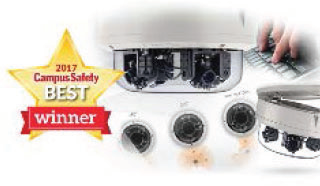
Arecont Vision SurroundVideo® Omni G3 Named 2017 Campus Safety BEST Winner

Arecont Vision®SurroundVideo® Omni G3 surveillance camera has won a 2017 Campus Safety BEST Award. This is the latest award for the omnidirectional multi-megapixel Omni G3, first unveiled in 2016. Campus Safety Magazine, honoring superior products and services for hospital, school, and university protection professionals, has announced the winners of the 2017 Campus Safety BEST Awards, including SurroundVideo Omni G3. Winning entries recognizing superlative security, law enforcement, emergency management, and safety solutions for K-12 institutions, universities, and healthcare organizations were awarded. SurroundVideo Omni G3 is the surveillance industry’s first multi-sensor, adjustable view camera with no-touch, remote setup. This capability ensures easy and rapid installation. The multi-sensor surveillance camera market was created by Arecont Vision in 2006 with the introduction of the first SurroundVideo 180° and 360° panoramic models, followed in 2014 by Omni G1. The SurroundVideo Omni G2 with remote focus was added in 2015. Both the Omni G1 and G2 are industry award winners in their own right, and continue to be offered alongside the new Omni G3. The three cameras are able to address any market requirement with a range of features and competitive price points. A single high-definition SurroundVideo camera replaces multiple pan-tilt-zoom or fixed-view single-sensor cameras for a wide range of campus safety requirements, while providing non-stop entire-scene coverage and video streaming. SurroundVideo delivers enhanced high-definition video and improved situational awareness indoors and out. Omni G3 brings remote setup to simplify and speed the installation process while enabling customers to easily change their area of coverage. For example, a stadium may wish for a different view for a sports events versus a concert, and Omni G3 can be remotely adjusted, including use of several pre-set and customer-set coverage options.

Read More

DIY Security Systems & the Future of the Professional Installer

By Anna Sliwon – Research Analyst, Building And Security Technology, IHS Markit In 2016, the global market for DIY security equipment reached $60 million, with the great majority of gear – 85 percent – sold in the Americas. The American market for DIY intruder alarms is forecast to grow at a CAGR of more than 20 percent over the next five years. In recent years, the residential security market has seen an influx of DIY intruder alarm system providers from internet service providers such as Deutsche Telekom and consumer electronics companies including Ring and Nest – the latest such providers to offer DIY security systems. DIY on the upswing The popularity of DIY systems is on the rise for several reasons. Self-install systems have no installation costs and can be set up fairly quickly. Equipment usually comes pre-configured, and often only requires a basic understanding of wireless technology. And end users are becoming more tech savvy thanks to the increasing availability of how-to video tutorials on intruder alarm system installation. Alarms can be monitored through a dedicated smartphone application, bringing the costs down to zero while also freeing users from lengthy monitoring contracts. Professional monitoring contract options for DIY systems often come at a lower price than contracts for professionally installed systems. Also, with the growing availability of pay-as-you-go monitoring, users can opt to have the alarm monitored only a few months a year, further reducing the overall annual cost of monitoring. In some cases, the cameras used in DIY systems are more affordable when compared to those offered as part of a professional package. In certain DIY systems, cameras can also be offered at a discounted rate if the user opts out of alarm monitoring services for the camera. DIY end users also have more options available to them, as they can choose from a wide range of consumer devices. With professionally installed systems, usually only one type of pre-selected camera is offered. This limits the end user’s choice to accepting the supplier’s camera or not having a camera in the system. Very often, equipment is interoperable with a wide range of commercially available video cameras, voice speakers or video doorbells, and allows for virtually unlimited expansion and customization. Professional security systems also allow for expansion, but the services of a professional installer may be required to integrate some of the devices, and advanced features are often turned off when a service contract ends. This means that a customer may still be able to arm and disarm the security sensors for a local alarm, but any advanced automation features will not be available to non-active subscriber accounts. Professional solution providers are under pressure New players have entered the security marketplace from other industries, resulting in increased competition and pricing pressures. The flexibility of DIY systems has allowed non-traditional security equipment providers to increase the overall penetration rate of homes with alarm systems – something professional equipment providers have long struggled to achieve. DIY systems are most likely to be chosen by young apartment renters, where there is no previous history of security equipment and the likelihood of annual moves is common. In regions with high population densities, this will lead to the replacement of the professional install option, leaving DIY as a first choice for newcomers to alarm systems. For new homeowners who are also young families concerned with monthly fees, DIY systems may provide a viable option for securing property without long-term contracts. The rise of the DIY market poses the biggest challenge to suppliers of professional security equipment. A blessing in disguise New players from other industries bring into play additional marketing resources to help educate consumers and drive increased awareness of the benefits of security systems. DIY systems have helped lower the barriers to acquiring security systems. As the needs of DIY consumers evolve over time (for instance, they become property owners), they are more likely to switch to professionally installed systems, thereby increasing opportunities for the professional market via system upgrades. DIY systems rely on open protocols and Wi-Fi connectivity that can sometimes be unreliable, creating connection issues. Some of the sensors can become unrecognizable to the system, requiring intervention from the user. In contrast, professional wireless systems rely on UL- or EN-certified equipment and operate on the basis of proprietary frequency, enabling them to work with the control panel much more seamlessly. Not going away anytime soon The need for professional installers will not disappear completely anytime soon. Professionally installed systems provide added peace of mind. When equipment malfunctions, issues can be addressed immediately by a qualified engineer. And what’s more, the quality of the equipment is usually higher in professionally installed systems, and professional configuration and setup greatly reduces the potential for connection instability and false alarms. Although DIY security equipment is in principle very easy to install, it is still relatively new technology. Therefore, software and connection issues are likely to surface in the process of operating the equipment, which may undermine the performance of the system. Dealing with technical support that’s available only online or over the phone could be a daunting process and may not appeal to every consumer. Professional installers are usually located across numerous local offices, making an in-person interaction much more accessible and simple. The proportion of elderly people in economically developed countries is increasing. Many senior citizens are not tech savvy enough to install a DIY system by themselves, so they tend to rely on professionally installed systems that are usually maintained by a family member. Moreover, in many cases these systems include individual monitors like personal emergency response systems (PERS) that can alert if a vulnerable person is in distress inside as well as outside the home. In addition to PERS, many service providers have been trialing programs that analyze the routines and behaviors of the elderly. This means that instead of an elderly patient needing to wear a pendant, his or her behavior is monitored passively by analytics software that alerts caregivers and…

Read More

Indian PSI Prepares for the Next Leap

(FICCI & PWC) The security industry is a large and expanding area of the economy with an estimated global market worth of USD 173 billion. The private security industry in India, valued at INR 570 billion is also promising. The Indian industry is still nascent and is likely to see exponential growth both in terms of manpower employed, and market share due to rapid infrastructural and economic development, leading to an increased need for prevention, detection and protection of assets and citizens against criminal acts such as fraud, terrorism, theft, drug-related offences and violent crimes. Yet another factor adding to the demand is the increase in individuals joining the billionaire league and seeking private protection at all times. The private security industry is one of the largest employers in India and is continuously growing. It is employing almost 8.5 million people and has the potential to employ 3 million more people by 2020. Manned guarding continues to be the service line with maximum employment and is also the highest revenue generator for the private security industry, contributing to 80 per cent of the revenue, followed by cash services. Government policies like making guards and installing CCTV cameras in schools, ATMs, and various other locations mandatory have also accelerated the demand of the industry in the country. With a high level of advancements in technology, services like electronic security services, integrated facility management, and security architecture and engineering will see greater prominence in the time to come. This not only has the potential to improve the quality of services offered by security companies but may also prove to be a boon for the large workforce who will have the opportunity to up-skill themselves and progress to engaging employment conditions. With the passage of time, security companies have evolved from servicing only homes and businesses to servicing the government. The rapid growth of the private security industry is both a refl ection of the inability of government security agencies to provide adequate security to private property and of the growing sophistication of the requirements of the private sector. In the context of current policy and regulatory developments in the country, the private security industry will continue to play an important role. More investments coming into manufacturing and other related industries will not only trigger the demand for private security personnel but also compel the industry to adopt processes and practices in sync with international standards. The contribution of this sector to employment generation in India is unique. Private security industry provides employment to a large number of rural youth, which otherwise would have remained outside the fold of formal employment. – Dr. Sanjaya Baru Secretary General, FICCI However, as per the industry sources, 60 per cent of the security service providers still operate as unorganised, thereby keeping the sector price oriented, and amenable to unfriendly employment practices that make it difficult to monitor quality and compliance. The sector continues to be perceived by the work force as non-aspirational as people are unaware of career prospects and the benefits that can be achieved. Technology integration is yet another challenge as it is widening the gap between the well-established players and smaller players in the industry. Most clients are now looking for technology-enabled security solutions which some of the bigger players in the industry already have; however, because of high capital and highly skilled manpower requirements, it is getting harder for smaller companies to keep up with the pace. Lack of quality manpower, high attrition rates and compliance requirements also continue to pose major challenges to the growth of the manned guarding security services market. Government policies are changing the game quickly with important decisions being taken to overcome challenges such as revision in foreign direct investment (FDI) rates, re-categorization of security workers and modification in the minimum wages. However, the industry stakeholders are still of the view that more changes at the policy level and improved enforcement could help private security grow further and make the sector more viable for investments. Some key suggestions are creating a grading framework for private security players in the market and having a single window licence process. Industry overview Considering the growing demand for security services, security firms in India are seeking capital to expand their business. Some international players are also foraying into India to tap the potential of the industry. Demographic characteristics India’s competitive advantage has been its competitive wage structure and availability of manpower. A large number of youth within the age group of 15–19 fall below the poverty line as they drop out of formal education and have limited avenues for employment – majorly in regions including Bihar, Uttar Pradesh, Jharkhand, Madhya Pradesh, Rajasthan and Assam. They come to cities in search of better employment opportunities. The youth from cities, though, associate with the security industry with low aspirational value owing to lack of social security schemes, long working hours and poor working conditions. Nevertheless, the private security industry continues to be one of the largest employers in India. Over 90 per cent of this workforce consists of security guards who are at the base of the pyramid, with little to no relevant experience or expertise. They resort to working as security guards as the last option. Recent policy initiatives FDI rates: FDI in private security agencies (PSAs) has been revised through the automatic route to 49 per cent and through the Government approval route to 74 per cent. Re-categorisation: In January 2017, vide a Gazette Notification, workers in private security have been re-categorized under the Minimum Wages Act, along with a modification in the minimum rate of daily pay. Security guards without arms have been recategorized as ‘skilled,’ and security guards with arms and security supervisors have been categorised as ‘highly skilled.’ Wage rate revision: The Central Government has also revised the minimum wage payable to employees of the ‘watch and ward’ sector to INR 637 per day effective April 2017. Stakeholders are of the opinion that more changes need to…

Read More

Motorola Solutions Technology for Safer Cities & Secure Businesses

Company’s newest smart public safety technology including apps, devices, infrastructure and future concepts will be showcased at the first Mission Critical Africa event in Cape Town Motorola Solutions introduces advanced solutions and futuristic technologies for safer cities and secure businesses across Africa. Danani Longwe, Motorola Solutions General Manager for South Africa said, “There’s a growing need among public safety agencies for critical actionable data. Emergency services, along with the rest of the public sector are eager to gain advantages of technology to increase safety and efficiency. There is increasing demand for broadband technologies, mobile apps, next generation command and control and advanced security solutions,” Said Longwe, “The majority of our customers in the region already understand that access to real-time intelligence is critical for their work.” “At Mission Critical Africa we will demonstrate a powerful set of software tools that help make cities safer by increasing public safety agencies’ situational awareness and capabilities. Other featured Motorola Solutions devices and apps, enable organizations to work more safely and collaboratively, thus helping their business thrive.” Tunde Williams, Head of Field and Solutions Marketing EMEA for Motorola Solutions, said the company’s vision for smarter public safety includes use of Big Data and Artificial intelligence for greater efficiency, “The abundance of data along with advanced AI technologies such as deep learning and computer vision, will play a growing role for public safety agencies. With the help of technology we are moving to an era where we will be able to predict and prevent crime before it happens.” “Public safety organizations need not only the technology and tools to meet their evolving needs, but also a partner with specialized knowledge and experience to understand their challenges, find solutions and imagine new ways to get the job done,” said Williams. Motorola Solutions’ global leadership in delivering secure and reliable critical communications is demonstrated through recent major milestones. These include: A contract to deliver mobile apps, software and services for the FirstNet network as part of its role on the AT&T team selected by the U.S. Government to deliver America’s first nationwide wireless broadband public safety network. A contract to deliver system integration and next-generation, mission-critical voice and data services for the emergency services network in the UK. Implementation of the three largest public safety broadband networks in the world – in Los Angeles County, California in the U.S. and in two Middle Eastern countries. Delivery of leading public safety broadband trials with multiple international police and military forces throughout the world.

Read More