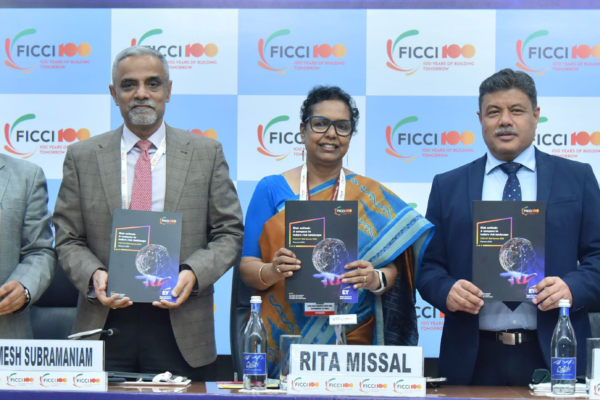
Business environments worldwide are becoming more complex and interconnected, with uncertainty shaping strategic, operational and investment decisions. Risks now emerge simultaneously from multiple risk vectors and often interact to influence stability, growth and governance. In this setting, organizations need a structured and coherent view of risk to support sound judgement and timely action. Within this broader landscape, India is navigating an economic transition shaped by global developments and domestic pressures. Geopolitical tensions, evolving trade patterns, regulatory changes, technology dependence, climate considerations and workforce dynamics are influencing how enterprises plan and operate, affecting supply chains, market access, compliance and cost structures. The FICCI-EY Risk Survey 2026: Risk outlook – A compass to India’s risk landscape for Indian businesses, offers a comprehensive view of these challenges. Drawing on insights from business leaders across sectors, the report examines risk perception, prioritization and management juxtaposed with global trends, India-specific risks and sector-level perspectives to support informed decision-making. Key findings at a glance Geopolitical pressures and rapid shifts in the operating environment are increasingly influencing organizational priorities, affecting stability, leadership focus and business confidence. Survey insights reflect growing pressure across technology, governance and workforce dimensions, with respondents highlighting several areas of heightened exposure. Concerns around digital risk remain prominent Workforce challenges persist Governance-related pressures are also increasing Together, these findings indicate that risks across technology, governance and talent are becoming more interconnected rather than operating in isolation. As these pressures converge, organizations have to take a more integrated approach to risk management, strengthening oversight, capability planning and decision-making to support stability and sustained performance in an evolving operating environment. Major risks shaping business outcomes A close look at the changing global conditions influencing investment and sourcing decisions Geopolitical developments, shaped by evolving trade policies and shifting global priorities, continue to influence the global operating environment. As major economies adjust their policy direction, uncertainty is expected to persist into 2026, affecting trade, investment and supply networks. These shifts are contributing to a gradual realignment of global trade flows. Many economies are placing greater emphasis on domestic capacity building and supply resilience, particularly across sectors such as semiconductors, clean energy and advanced manufacturing. Changes in trade measures are influencing the availability and pricing of critical inputs used across electronics, electric mobility and renewable energy value chains. Together, these trends reinforce the importance of preparedness. Ongoing geopolitical shifts continue to influence energy markets, supply chains and regulatory environments, with implications across operational, financial and reputational areas. In such an environment, scenario planning and geopolitical awareness are becoming important tools to support informed decision-making and strengthen organizational resilience. Resilience and adaptability are no longer optional. Building flexibility and staying attuned to geopolitical shifts can influence how organizations sustain performance in this evolving environment. The FICCI-EY risk survey data indicates that economic slowdown, market disruptions and sustained inflation remain key areas of attention for Indian businesses, with 68% of respondents reflecting a shared view on their relevance. Economic volatility continues to feature prominently, with 67% of respondents agreeing or strongly agreeing on its impact on business planning and operations. Geopolitical factors also remain relevant, with 64% of respondents acknowledging that geopolitical tensions are having a noticeable impact on their organizations, contributing to uncertainty in decision-making and long-term outlook. These findings reinforce the need for boards to embed geopolitical foresight, prioritize resilience over efficiency and align capital allocation with a fragmented, unpredictable global landscape. The message for business leaders is clear: Sectoral impacts are real and immediate. Technology, automotive, defense, energy and manufacturing firms should build resilience into their supply chains, diversify sourcing and stay agile in pricing and regional strategy. In this new era, monitoring geopolitical flashpoints is not just prudent but essential for survival and growth. Cyber risks Elevating the conversation from IT threat to boardroom priority Cyber risk is emerging as a defining challenge for operational stability and infrastructure resilience in today’s digital-first business landscape. No longer isolated, these risks now shape the very foundation of enterprise continuity and competitive advantage. Ransomware and Distributed Denial-of-Service (DDoS) attacks disrupt production, logistics and essential services, resulting in downtime and financial loss. Data breaches expose sensitive customer and business information, leading to lasting reputational damage. As system defenses improve, human error is exploited through phishing and social engineering. In parallel, dependence on third-party vendors expands exposure, where a single security failure can cascade into regulatory, legal and operational consequences across the organization. Globally, the average cost of a data breach stands at US$4.4 million, while ransomware incidents now cost approximately US$5 million, up nearly 17% year-on- year, reflecting a shift toward data theft and system disruption. Attacks on critical infrastructure are also rising, with manufacturing, healthcare, energy and finance being among the most affected. Ransomware incidents have increased 50% in 2025, largely via phishing and remote access. India faces a sharp rise in cyber intrusions due to AI- based social engineering, cloud gaps (misconfigured or weak cloud security settings that expose systems and data), and vulnerability chaining (attackers linking multiple small security flaws to gain deeper access into networks). Bot activity has increased, with multi-vector campaigns becoming more common. Deepfake voice scams affect the banking sector, leading to losses from fraud and higher complaint volumes on the National Cyber-Crime Reporting Portal (NCRP). The survey indicates that technology and cybersecurity risks are a growing concern, with 61% of respondents agreeing or strongly agreeing that digital disruption affects competitiveness and cyber attacks pose major threats. Additionally, 57% highlight the impact of data theft and insider fraud, while 47% acknowledge challenges in managing sophisticated cyber threats. Cyber-attacks and data breaches pose major financial and reputational risks, while rising threat sophistication, insider fraud and business espionage demand stronger internal controls and vigilance. These findings reinforce that the real challenge is not just to defend but to anticipate and adapt. For organizations, the implication is increasingly evident: Cyber risk poses a direct threat to operations, revenue and trust and cyber readiness is central to business continuity and confidence. Artificial intelligence (AI) risks Evolving from technical…