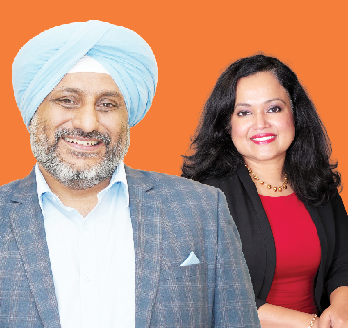
Garry Singh and Sagarika Chakraborty
on Building Organisations That See What Others Miss
In an era where businesses are overwhelmed with information yet increasingly exposed to disruption, the challenge is no longer collecting data – it is understanding what matters and acting before opportunities disappear or risks materialise. From geopolitical tensions and cyber threats to artificial intelligence and rapidly shifting market dynamics, organisations today operate in an environment where speed of insight is becoming as important as speed of execution.
Against this backdrop, intelligence is emerging as a defining leadership capability rather than merely a support function. Gurupawan ‘Garry’ Singh, President of IIRIS, and Sagarika Chakraborty, Co-Founder and CEO for India and the Gulf, have been at the forefront of advocating this transformation. Through their work across intelligence, strategic risk, investigations, and organisational design, they have advanced a powerful idea – intelligence should not function as an isolated department but as the central nervous system of an organisation.
Together, Garry Singh and Sagarika Chakraborty have developed frameworks such as the Intelligence Pyramid, highlighting how organisations can convert data into insight, insight into decisions, and decisions into meaningful outcomes. Their work reflects a broader shift in thinking – from reactive management toward intelligence-led leadership and resilience.
In this exclusive cover story conversation, Garry Singh and Sagarika Chakraborty share their perspectives on the future of intelligence-driven enterprises, the convergence of security and business strategy, the opportunities and challenges posed by AI, and how organisations can build the capability not only to respond to change, but to anticipate it before others do.
This conversation draws on the authors’ June 2026 research paper, ‘Business Intelligence Is the Single Most Critical Factor for Success in New Age Business,’ which introduces the Intelligence Pyramid framework.
You have spent decades working at the intersection of security, intelligence, risk management, and business leadership. Could you briefly share your professional journey and what inspired the establishment of IIRIS?
Garry Singh: My career has been built across disciplines that most organisations treat as separate: security, intelligence, investigations, and enterprise risk. The thread running through all of them is a single question, what do we know, how reliably do we know it, and what should we do about it before events overtake us. From protecting people in volatile environments to investigating complex frauds and advising boards, I saw the same pattern repeatedly: the organisations that suffered most were rarely short of information. They were short of judgement applied in time.
IIRIS was founded to close that gap. We built it as a forensic intelligence and strategic risk advisory firm because intelligence, the tradecraft of turning fragments into foresight, belongs not only to governments and armed forces but in the boardroom. The inspiration was a settled conviction, that disciplined intelligence, practised with integrity, is one of the few durable advantages still available to an enterprise.
Sagarika Chakraborty: My route was different and complementary. I trained as a corporate lawyer at NLU Jodhpur and took an MBA in strategy at ISB, then moved into investigations and forensic intelligence. What drew me was the same gap Garry describes, but seen from the evidence side: companies held facts that were never converted into findings they could defend or act upon. I wanted to bring legal rigour and commercial discipline to a field that, in this region, was often informal.
Co-founding IIRIS let us build a firm where intelligence is gathered to an evidentiary standard, graded honestly, and delivered in a form a board can actually use. Doing that across India and the Gulf, in markets maturing very quickly, was both the challenge and the opportunity.
How has the role of intelligence evolved over the past decade, particularly in today’s environment marked by geopolitical instability, cyber threats, AI disruption, and economic uncertainty?
Garry Singh: A decade ago, corporate intelligence was a quiet, specialised function, often confined to physical security. Three shifts have moved it to the centre. Threats have converged, so a single hostile act is now cyber, physical, financial, and reputational at once. The decision clock has compressed, from quarterly review cycles to hours. And geopolitics has returned to the boardroom through sanctions, supply chain fragmentation, and great-power competition. Over all of this sits AI, both a powerful tool and a weapon in an adversary’s hands. Intelligence has become a core leadership competence rather than a support activity.
Sagarika Chakraborty: From the engagement side I see the same evolution in the questions clients now ask. A due diligence that once meant a registry search and a reference call now has to account for sanctions exposure, beneficial ownership across jurisdictions, digital footprint, and reputational risk that moves in real time. Fraud has gone digital and cross-border. Regulators increasingly expect organisations to have anticipated risk, not merely responded to it. The investigator’s remit has widened, from establishing what happened to advising what is likely to happen next.
In your recent concept, you indicate that ‘Intelligence is not a department; it is the organisation.’ What exactly does this mean in practical terms for modern enterprises?
Garry Singh: It means intelligence is not a box on an organisation chart. In our recent paper I described it as the central nervous system of the enterprise, and the phrase is exact. Intelligence is the way an organisation senses its environment, makes sense of what it sees, and acts ahead of events. When it is confined to a department, the rest of the business stops feeling responsible for noticing, the signals never reach the centre, and the specialists, however skilled, are blind to most of what the enterprise already knows.
Sagarika Chakraborty: In practice this is very real. In almost every serious investigation we run, the decisive fragment comes from outside the security team, from a finance clerk who noticed an odd reconciliation, a salesperson uneasy about a counterparty, a vendor manager who saw a pattern. The capability that matters is whether the organisation can surface those fragments, route them to someone who can interpret them, and act. That is a question of channels, culture, and trust, not of a single department.
Why do many organisations continue to struggle despite having unprecedented access to data and technology?
Garry Singh: Because data abundance and intelligence are not the same thing. Most organisations have industrialised collection and neglected the discipline of converting it into decisions. I point to Kodak: it did not lack intelligence about digital photography, it invented the technology, but a business model wedded to film created an inertia that proved fatal. The failure was not in gathering intelligence but in applying it. That is the modern pathology in a phrase, organisations that are data rich but intelligence poor.
Sagarika Chakraborty: What I see in client environments is fragmentation. Legal holds one piece, compliance another, security a third, finance a fourth, and no one owns the question of what it all means. Everyone has dashboards; no one is accountable for the judgement. The data exists, but the architecture to assemble it into a single decision-ready picture does not. Until someone is explicitly responsible for turning information into intelligence, more technology simply produces more detailed records of opportunities that were missed.
What is the fundamental difference between data, information, and intelligence, and why is this distinction so often misunderstood in corporate environments?
Garry Singh: Data is raw observation. Information is data placed in context. Intelligence is information rigorously analysed and linked to a specific decision within a defined window of time. In our paper we set four tests that separate genuine intelligence from noise: it must be timely, accurate, relevant, and actionable. Strip away any one and you are left with information, however well presented. Data tells you what happened, information what is happening, and intelligence what it means and what to do about it.
Sagarika Chakraborty: As a lawyer I would add a fifth quality that matters enormously in practice: it must be defensible. Real intelligence is sourced, corroborated, and graded for confidence, so it can withstand scrutiny in a boardroom, a regulatory inquiry, or a court. The distinction is misunderstood because the market sells data and analytics as intelligence, and because rumour dressed up with conviction can look like a finding. The discipline of grading and sourcing is what separates an assessment you can rely on from one you cannot.
In your opinion, what are the most common intelligence failures occurring in businesses today?
Garry Singh: The clearest way to diagnose an intelligence failure is to map it against the intelligence cycle, because each phase has its own point of breakdown. It rarely begins at collection; in a data-rich environment the signals are present. Upstream sits a failure of direction, where leadership never sets clear requirements, so collection runs on habit. The most frequent breakdown is analytical, through confirmation bias, mirror-imaging, and the analytical line of least resistance, where the inconvenient hypothesis is discarded because a senior voice has already settled the question.
The next is in dissemination, the last mile, where a sound assessment arrives too late or in a form no one reads, rather than bottom line up front with its confidence stated plainly. The final and most expensive is in consumption, the decision-maker’s failure to act, Kodak again. Underlying all of it is one error, treating intelligence as reporting rather than as decision support.
Sagarika Chakraborty: In our casework the recurring failures are concrete. Over-collection without prioritisation, where teams drown in material and miss the signal. A drift toward the comfortable conclusion, which is confirmation bias by another name. And findings that are accurate but reach the board too late or in an unusable form. To those I would add a governance failure I see often, acting on unverified intelligence, where someone moves on a rumour without corroboration and creates legal and reputational exposure. Rigour at the front end prevents costly errors at the back.
Could you explain the three layers of the Intelligence Pyramid, Strategic, Tactical, and Operational, and how they complement one another? How can leadership teams ensure a seamless flow of intelligence between these three layers?
Garry Singh: The Intelligence Pyramid, which we set out in the paper, has three integrated layers. At the apex is the strategic layer, on a three to five year horizon, owned by the board and C-suite, mapping the future trajectory of the market through macro, competitive, technology, regulatory, and insider-threat intelligence. In the middle is the tactical layer, one to three years, owned by business unit and regional heads, translating strategy into campaigns and resource allocation. At the base is the operational layer, real time, owned by frontline managers, and it is the enterprise’s most sensitive early warning system.
They complement one another only when intelligence flows in both directions. A grievance captured operationally can signal a strategic shift; a strategic threat must cascade down to tactical allocation. The principle I return to is that intelligence must flow as freely as capital, because it is the lifeblood of agility. Where that flow keeps breaking, we install cross-functional fusion nodes that synthesise signals across silos.
Sagarika Chakraborty: Ensuring that seamless flow is a leadership task, and the tactical layer is usually where it fractures. Four things hold it together. A shared taxonomy, so all three layers describe risk in the same language. A disciplined requirements process, so collection serves decisions rather than habit. Feedback loops running up and down, so the board hears ground truth and the front line understands strategic intent. And incentives that reward sharing rather than hoarding. Leadership has to pull intelligence actively, asking for it before decisions, and protect the people who carry uncomfortable signals upward.
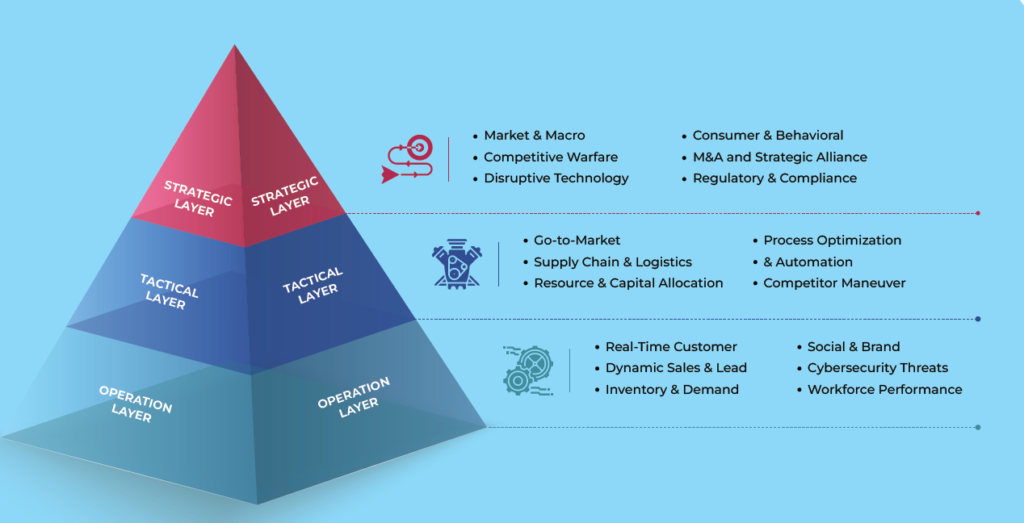
| Tier | Objective | Best Handled By |
| Strategic | Long term value creation and competitive positioning | C Suite, Board of Directors |
| Tactical | Effective execution and market share growth | Business Unit Heads, Regional Managers |
| Operational | Daily performance optimisation and real time response | Frontline Managers, Operations Staff |
The Intelligence Pyramid: three integrated horizons of intelligence, with insight flowing in both directions.
Traditionally, intelligence has been associated with military and government agencies. How can corporate security leaders leverage intelligence methodologies to create business value?
Garry Singh: The methodologies transfer remarkably well, because the discipline is universal. The intelligence cycle, setting direction, collecting, processing, analysing, and disseminating, is simply a structured way of converting uncertainty into informed decisions, which is exactly what leaders need. The reframing that matters is moving security from a cost centre that prevents loss to a capability that improves decisions.
Sagarika Chakraborty: The value becomes concrete in the work itself. Integrity due diligence on a counterparty before an acquisition can prevent a costly misjudgement. Fraud and asset-tracing work recovers value and deters repetition. Supply chain and country-risk intelligence protects a market entry. In each engagement the security leader is not guarding a perimeter, they are informing the decisions that determine whether value is created or destroyed. That is how a security function earns commercial credibility.
What role should security leaders play in strategic decision-making rather than remaining confined to operational security functions?
Garry Singh: They should be in the room before decisions are made, not summoned after incidents occur. That single change of timing transforms the value of the function. It requires two shifts: elevating from incident response to enterprise risk, and learning to speak the language of strategy, growth, and shareholder value rather than threats and controls.
Sagarika Chakraborty: In our markets the role is still maturing, and the seat has to be earned. The security or intelligence leader who can sit at a deal table and give a clear, confidence-graded read of the risk, and a route through it, becomes indispensable. The ones who stay in operational language stay in the operational room. My advice to clients is to bring the function into strategy, M&A, and market-entry conversations early, and to judge it on the quality of decisions it improves, not the incidents it closes.
How do you see security intelligence converging with business intelligence, cyber intelligence, and enterprise risk management?
Garry Singh: Convergence is already underway, because modern threats refuse to respect functional boundaries. A single adversary act can begin as a cyber intrusion, become a physical risk, surface as fraud, and end as reputational damage. If each discipline sees only its fragment, the organisation never perceives the whole. The destination is all-source fusion, a single common picture of the threat and opportunity landscape.
Sagarika Chakraborty: Clients increasingly ask for exactly this. A single matter we handle will touch legal, cyber, financial, and reputational dimensions, and the client no longer wants four separate reports that they have to reconcile themselves. They want one integrated risk picture with a clear recommendation. Enterprise risk management, business intelligence, cyber, and security intelligence are converging because the decisions they inform are the same decisions. Our job, increasingly, is to fuse them.
What are the emerging threats that security professionals should be preparing for over the next five years?
Garry Singh: Several threats are converging, and the combination is more dangerous than any one alone. AI-enabled deception, deepfakes, synthetic identities, and automated social engineering at a scale that defeats traditional verification. The weaponisation of supply chains and third parties, where the adversary strikes the weaker connected partner. Geopolitical fragmentation through sanctions and export controls. The insider threat amplified by hybrid work. And information operations that target a brand directly. Beneath them sits the steady convergence of cyber and physical systems.
Sagarika Chakraborty: From the casework I would sharpen a few of these. Synthetic identity and deepfake-enabled fraud are no longer theoretical; we are seeing them in live matters. Third-party and vendor risk is now the most common point of entry. And for Indian and Gulf firms expanding internationally, sanctions and counterparty exposure has become a serious and underappreciated risk, where a single ill-vetted partner can create regulatory consequences across several jurisdictions. Preparation means building the screening and early-warning capability before the deal, not after.
Artificial Intelligence is transforming the way organisations collect and analyse information. How do you see AI reshaping intelligence operations?
Garry Singh: AI is transforming the lower half of the cycle, collection and processing, far more than the upper half, analysis and judgement. At the operational layer it processes high-frequency data and flags anomalies; at the tactical layer it drives predictive modelling; at the strategic layer it scans vast unstructured material for the weak signals that precede major shifts. But it needs a unified data fabric beneath it, because an advanced algorithm built on flawed data simply accelerates flawed insight. As the cycle speeds up, the value of human judgement rises, not falls.
Sagarika Chakraborty: In investigations AI has been genuinely transformative. Open-source research, document review across languages, and pattern detection that once took weeks now take hours, which lets our analysts spend their time on judgement. But it cuts both ways. The same tools let adversaries manufacture convincing false material, so the burden of verification and provenance has gone up sharply. A finding generated quickly still has to be corroborated and graded. Speed without verification is not intelligence, it is exposure.
What opportunities and risks do you foresee as organisations increasingly rely on AI-driven intelligence platforms?
Garry Singh: The opportunities are scale, speed, and reach across languages and datasets that were previously impossible. The risks deserve equal weight: confident fabrication, automation bias, the opacity of systems whose reasoning cannot be inspected, model poisoning, and over-reliance. The governing rule is simple, keep a human in the loop on every consequential decision. The more important the decision, the more firmly that holds.
Sagarika Chakraborty: My concern is governance and defensibility. If a platform produces a finding you cannot explain, audit, or trace to a source, you cannot rely on it in a board paper, a regulatory response, or a legal proceeding. There are also data-protection obligations, the DPDP Act here, GDPR in Europe, that constrain what these platforms may lawfully ingest and retain. The opportunity is real, but it has to be governed, with auditability and lawful basis built in from the start, not bolted on after an incident.
How should enterprises balance technological innovation with ethical considerations and privacy concerns?
Garry Singh: By treating legitimacy as a strategic asset, not a constraint to manage around. Just because something can be collected does not mean it should be. Every activity should pass the tests of necessity and proportionality. Trust is an organisation’s licence to operate, and it is far more easily lost than rebuilt. The future-ready enterprise innovates boldly and governs rigorously, and understands that these are partners, not opposites.
Sagarika Chakraborty: On the legal side this is concrete. A lawful basis, data minimisation, defined retention, and transparency are not obstacles, they are the conditions under which an intelligence capability is sustainable and its products usable. An investigation that breaches privacy or oversteps ethical lines may deliver a short-term gain and a long-term liability, in law, in reputation, and in the trust of employees and partners. Ethics is not a brake on intelligence. It is the boundary that keeps intelligence admissible and the organisation protected.
How can companies move from reactive crisis management to proactive risk anticipation?
Garry Singh: The discipline comes from military strategy, the observe, orient, decide, act loop. The organisation that cycles through it fastest dictates the terms of engagement for the industry. We call that speed cognitive velocity, and it is now the most formidable barrier to entry, more durable than capital or brand. Anticipation begins with a baseline, so anomalies stand out, and an indicators-and-warnings approach that defines the early signals in advance. The shift is from reactive crisis management to proactive resilience engineering.
Sagarika Chakraborty: Practically, this means embedding foresight into governance rather than leaving it to instinct. Horizon scanning, structured scenario planning, red-teaming, and pre-mortems, run regularly and reported into the risk committee, are what turn anticipation from an aspiration into a habit. The organisations that do this well are not predicting the future, they are rehearsing for plausible versions of it, so that when one arrives they recognise it early and respond from a prepared position rather than a standing start.
What role does intelligence play in supply chain resilience, geopolitical risk monitoring, and business continuity planning?
Garry Singh: Intelligence is the foundation of all three, because each depends on seeing risk before it crystallises. In a connected economy risks are rarely isolated: a localised supply disruption can cascade into a revenue shortfall, a credit downgrade, and a higher cost of capital, each stage amplifying the last. Frameworks that treat risks in isolation cannot see these chains forming. Intelligence provides the holistic visibility to identify and arrest them early.
Sagarika Chakraborty: In supply chains the central challenge is visibility beyond the first tier, where concentration and fragility usually hide. Our work maps that extended network, screens suppliers for sanctions and integrity risk, and provides early warning of distress in a vendor a client may not even know it depends on. For geopolitical risk, the discipline is converting an abstract environment into the specific exposure that affects this organisation. And continuity planning only works when it is built around the scenarios a particular enterprise is genuinely exposed to, tested against real indicators, with the cross-border lens that India and Gulf operations now demand.
You emphasize that intelligence is as much an organisational design challenge as a technology challenge. Could you elaborate?
Garry Singh: As we say in the paper, restoring the flow of intelligence is fundamentally a challenge of organisational design, not technological implementation. Technology enables the flow; design determines whether it actually happens. The most sophisticated platform will produce expensive, unread reports if the structure silos information, the incentives reward activity over insight, and there is no requirements process or feedback loop. I put it simply, the box matters far less than the wiring.
Sagarika Chakraborty: The wiring is a human system, and that is where most of our advisory work on capability-building actually sits. Who owns intelligence. How a signal routes to the person who can decide. What incentives reward surfacing a problem rather than concealing it. We frequently find clients have bought excellent tools and left the processes and accountabilities undefined, so the intelligence has nowhere to go. Redesigning those flows, the requirements, the routing, the ownership, delivers more than any platform purchase.
How can leaders create a culture where intelligence is actively shared and acted upon across departments?
Garry Singh: Culture is the decisive variable, and it is shaped by what leaders do, not what they say. The first condition is psychological safety: where the messenger is punished, signals are suppressed long before they reach a decision-maker, so a strong culture treats bad news as an opportunity to recalibrate. The second is radical transparency, where failing to share critical intelligence is itself seen as a failure. The third is incentives, augmenting functional targets with cross-functional measures that reward the intelligence a team contributes upward.
Sagarika Chakraborty: The hardest instinct to break is that information is power. In many organisations functional leaders hoard data because it confers leverage, and no policy overcomes that until the incentives change and leadership visibly models the opposite. What works in practice is cross-functional forums where signals are shared as routine, recognition for the person who raised the uncomfortable truth that proved right, and senior leaders who are seen to ask for intelligence before they decide and to act on it when they receive it. Culture, far more than technology, decides whether a finding is acted upon.
How is IIRIS helping organisations build intelligence capabilities and decision-making frameworks globally?
Garry Singh: We work in three complementary ways. We answer specific, high-stakes questions through bespoke investigations and intelligence. We help organisations build their own capability, designing the frameworks, the Intelligence Pyramid among them, and the requirements and feedback processes that make them work. And we embed decision-support into how leadership operates. We do this across ten countries, from India and the Gulf to the United Kingdom, Europe, and Africa.
Sagarika Chakraborty: From the India and Gulf practice, that means a spectrum of work: integrity due diligence, forensic audit and fraud investigation, geopolitical and country-risk advisory, and the design of intelligence functions for clients who want a permanent capability rather than a one-off report. Increasingly we also train client teams, because the goal is to leave an organisation able to do this for itself. The constant thread is that we are not producing reports for their own sake; we are improving the quality of decisions.
What are some of the key initiatives, research projects, or consulting engagements currently being undertaken by IIRIS?
Garry Singh: On the research side, Sagarika and I have just published a paper, ‘Business Intelligence Is the Single Most Critical Factor for Success in New Age Business’, which introduces the Intelligence Pyramid as a practical blueprint for embedding intelligence into the operating DNA of an organisation. It anchors much of our advisory work, and we continue to publish on the convergence of security, cyber, and enterprise risk.
Sagarika Chakraborty: Much of our client work is confidential, so I will speak to the public-facing initiatives. We are active in women’s safety technology, developing intelligence-led, AI-supported detection and rapid-response concepts designed to cut urban response times, where intelligence has a direct human benefit. We also build women’s leadership and entrepreneurship platforms across India and the Gulf, and invest in developing the next generation of professionals through training. Alongside that runs the core practice of investigation, due diligence, and forensic work that is the firm’s foundation.
How do you see IIRIS contributing to the future of security, intelligence, and risk management in India and internationally?
Garry Singh: Our ambition is to raise the standard of the discipline itself, from a base rooted in India but operating to the highest international tradecraft. We want to professionalise the field, show that corporate intelligence can be rigorous and ethical rather than opaque, and contribute to international engagements from expertise built in this region.
Sagarika Chakraborty: India has extraordinary talent and a rapidly maturing corporate sector, but ethical, decision-focused intelligence is still developing here. I want IIRIS to build local capability that meets global standards, so organisations do not have to choose between proximity and quality, and to model intelligence that is defensible and ethically grounded. I also care about who enters the field. Building pathways for women into security and intelligence, where they remain underrepresented, is part of how we strengthen the profession for the long term.
How do you see the relationship between intelligence, security, and business competitiveness evolving over the next decade?
Garry Singh: The three will become inseparable. The old barriers to entry, capital, distribution, brand, are eroding, and the most formidable barrier now is cognitive velocity, the speed at which an organisation can perceive change, orient, decide, and act. Firms that consistently outpace competitors in that loop force the rest into a permanently reactive posture, and the advantage compounds. I expect intelligence to become a board-level competence alongside finance and strategy.
Sagarika Chakraborty: For our clients this is already visible. Security is being reframed from insurance to advantage: the firms that anticipate win deals and avoid losses their competitors walk into. As Indian and Gulf companies compete globally, the ones that build genuine intelligence capability will navigate the sanctions, counterparty, and geopolitical complexity that sinks the unprepared. Over the decade, competitiveness will increasingly be a function of how well an organisation sees and decides, not only how much it spends.
Looking back on your career, what has been the most important lesson intelligence work has taught you about leadership?
Garry Singh: The most important lesson is humility about what you actually know, paired with the courage to act despite uncertainty. Intelligence work teaches you, sometimes painfully, the difference between what you know, what you believe, and what you assume, and disciplines you to attach honest confidence to your judgements. Yet the decision rarely waits for certainty, so you must act on incomplete information while remaining ready to be wrong. And above all, protect the dissenting voice, the analyst who tells you what you do not want to hear is often the most valuable person in the room.
Sagarika Chakraborty: For me the lesson is that integrity is non-negotiable and, in the long run, practical. In this work the temptation is always the comfortable answer, the one the client hopes for or the one that confirms a prior view, and yielding to it is how serious mistakes are made. The discipline of insisting on what the evidence actually supports, and saying so even when it is unwelcome, is what earns lasting trust. Leadership in this field is rigour and empathy together, the rigour to be honest, and the empathy to deliver hard findings in a way people can act on.
What advice would you offer to young professionals aspiring to build careers in intelligence, security, and risk management?
Garry Singh: Four things. Master the tradecraft and the ethics together, never one without the other; your integrity is the one asset you cannot rebuild once lost. Develop genuine business fluency, because the future belongs to those who can connect intelligence to decisions. Cultivate judgement above technique, since tools will keep changing but the ability to reason under uncertainty only grows in value. And stay relentlessly curious; never let expertise harden into the false confidence that you already know.
Sagarika Chakraborty: Build a strong foundation, in law, finance, or a language, because depth in an adjacent discipline makes you a better analyst. Treat integrity as your currency from the first day; reputations in this field are built slowly and lost instantly. And to young women in particular: this profession needs you, and you should claim your seat in it without waiting to be invited. The field is wider and more open than it looks from the outside, and the people who endure are the ones who keep learning.
If there is one message you would like CEOs, board members, security leaders, and policymakers to take away from your article and your work at IIRIS, what would it be?
Garry Singh: If there is one message, it is that intelligence is not an overhead to be minimised. It is your organisation’s capacity to see, decide, and act ahead of events, and it is the central nervous system of the enterprise, not a department in a corner. I will end where our paper ends. The era of knowing without doing has ended; the era of structural agility has begun. Every organisation will face its moment of discontinuity, and those that navigate it will be the ones whose intelligence architecture let them see it early enough to act.
Sagarika Chakraborty: And build it deliberately. Wire intelligence into how decisions are actually made, govern it ethically and lawfully, and lead it from the top. Done with integrity, intelligence is not only a shield against loss but a genuine source of advantage, and it is available to any organisation willing to invest in it seriously. The others, as Garry says, will look back at the data they already had and ask why no one connected the dots.
Conclusion
As businesses navigate an increasingly uncertain and interconnected world, the question is no longer whether organisations possess enough information; it is whether they can transform that information into meaningful action. The traditional boundaries separating intelligence, security, risk, and strategy are rapidly disappearing, creating a new reality where the ability to anticipate change and act with speed has become a defining competitive advantage.
At the heart of Garry Singh and Sagarika Chakraborty’s thinking is the concept of the Intelligence Pyramid – a framework that integrates Strategic, Tactical, and Operational intelligence into a single, interconnected architecture. Rather than treating these as isolated functions, the model emphasises the continuous flow of intelligence across all organisational levels. Strategic intelligence helps leadership anticipate future shifts and emerging opportunities; tactical intelligence translates vision into executable plans; and operational intelligence acts as a real-time early warning system that captures signals from the front lines. The true value lies not in the individual layers but in their ability to work together as a unified system.
Their message throughout this conversation remains consistent and compelling: organisations do not fail because they lack data; they fail because they struggle to convert signals into understanding and understanding into timely decisions. Technology can strengthen this process, but it cannot replace organisational design, culture, and leadership intent.
In an age where disruption is becoming a constant rather than an exception, intelligence is no longer a support function operating on the margins of business. It is increasingly becoming the central nervous system of the enterprise itself. The organisations that will define the future are likely to be those that build intelligence into their DNA, connect the dots before others can, and transform foresight into action. The rest may eventually discover that the answers they were searching for had always been present – the architecture to understand them simply did not exist.